
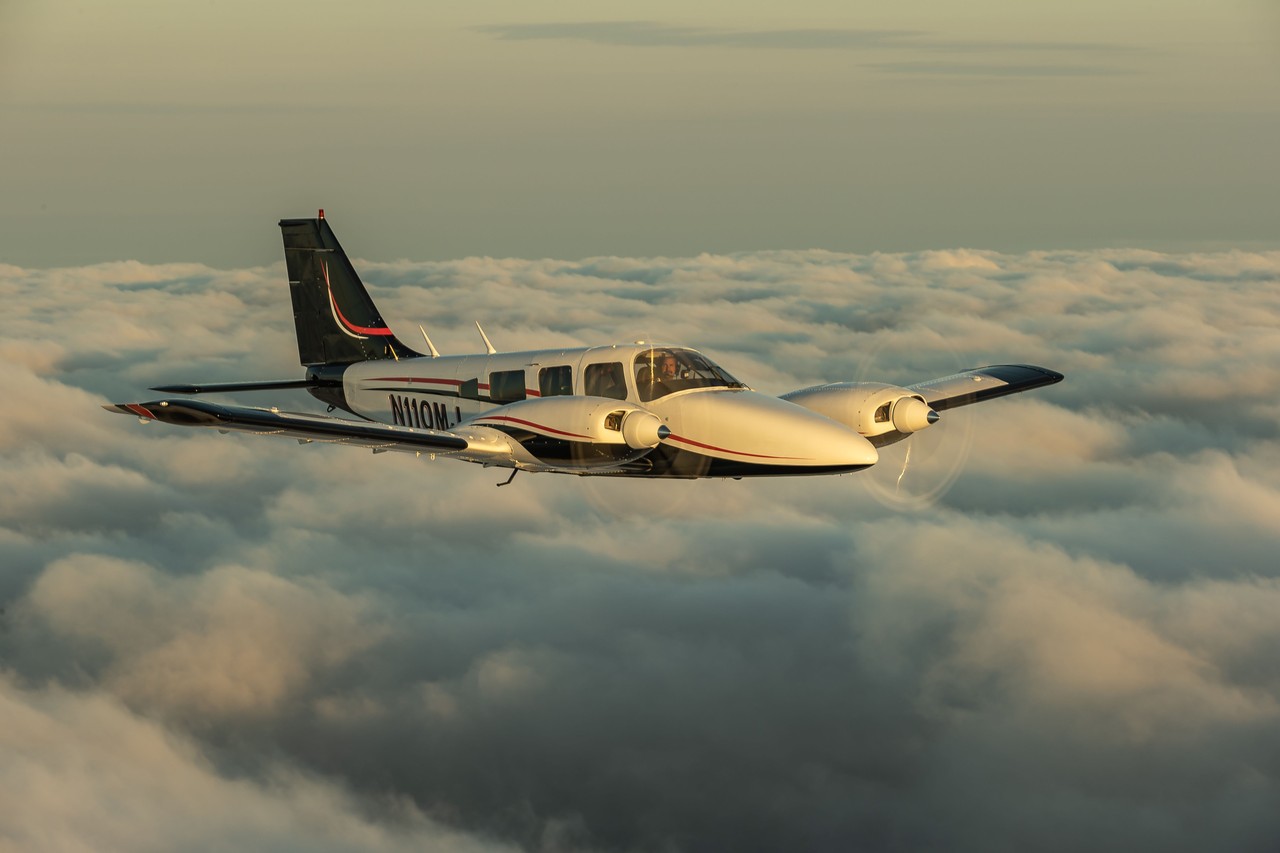
Development and Early Years
Piper Aircraft launched the PA-34 development program in the mid-1960s to create a twin-engine variant of their popular Cherokee Six. The first prototype, registered N3401K and initially designated PA-34-180 Twin Six, took to the skies on April 25, 1967, powered by two 180-horsepower Lycoming O-360 engines. This initial aircraft retained the fixed landing gear configuration, but subsequent prototypes introduced retractable gear and increased power.
The second prototype flew on August 30, 1968, incorporating retractable landing gear and a taller vertical stabilizer. By October 20, 1969, the third prototype had flown with 200-horsepower Lycoming IO-360-A1A engines, bringing the design closer to production standards. The Federal Aviation Administration granted type certification in 1971, and production commenced at Piper's Vero Beach, Florida facility.
Production Success and Market Dominance
The Seneca achieved immediate commercial success, with Piper manufacturing 360 units in 1972 alone—more than doubling the combined three-year production run of competing aircraft like the PA-39 Twin Comanche. During the same period, Cessna's Skymaster, the only comparable twin-engine aircraft in the market, managed merely 63 deliveries. The first three years of Seneca production yielded 933 aircraft, establishing the type as a dominant force in the light twin market.
The original Seneca I, designated PA-34-180, accumulated 934 total units including the prototype before giving way to the improved Seneca II in 1975. This second generation, certified on July 18, 1974, addressed early handling complaints through redesigned flight controls including enlarged and balanced ailerons, rudder anti-servo tabs, and stabilator bobweights.
Engine Evolution and Performance Improvements
The Seneca II marked a significant technological advancement with the introduction of Continental TSIO-360E and TSIO-360EB turbocharged engines, each producing 200 horsepower. These powerplants dramatically improved high-altitude performance, boosting the single-engine rate of climb to 235 feet per minute and tripling the single-engine service ceiling to 13,400 feet. The Continental engines initially carried a 1,400-hour time between overhaul rating, later extended to 1,800 hours in 1977.
Subsequent variants continued the progression toward greater power and capability. The Seneca III, introduced in 1981, featured Continental TSIO-360-KB engines rated at 220 horsepower for five minutes, then 200 horsepower for continuous operation. These engines drove three-blade propellers and powered the aircraft through 930 production examples before Piper's 1991 bankruptcy temporarily halted manufacturing.
Corporate Challenges and Recovery
Piper Aircraft's Chapter 11 bankruptcy filing in 1991 interrupted Seneca production after more than two decades of success. The company had delivered 2,588 Seneca II aircraft and 930 Seneca III models before financial difficulties forced the halt. However, the reorganized "New" Piper Aircraft achieved certification for the Seneca IV on November 17, 1993, resuming production in 1994.
The Seneca IV represented a limited production run of just 71 aircraft before the introduction of the current Seneca V in 1997. These latest variants employ Continental TSIO-360RB and LTSIO-360RB engines, maintaining the 220-horsepower rating while incorporating modern avionics and interior appointments.
Design Innovation and Safety Features
A distinguishing characteristic of the Seneca design involves its counter-rotating propeller configuration, eliminating the critical engine phenomenon that complicates emergency procedures in conventional light twins. This engineering decision enhances safety by ensuring equal performance regardless of which engine fails, simplifying pilot training and emergency response procedures.
The aircraft maintains the structural foundation of Piper's Cherokee Six, including the distinctive constant-chord wing design often called the "Hershey bar" wing, stabilator empennage, and basic fuselage architecture. Maximum gross weight evolved from 4,000 pounds in early models to 4,200 pounds in later serial numbers, eventually reaching 4,750 pounds in current Seneca V aircraft.
International Production and Current Market
Beyond Piper's American manufacturing, the Seneca design achieved international recognition through licensed production agreements. Embraer manufactured the type in Brazil as the EMB-810, while Polish production proceeded under the designation M-20 Mewa, demonstrating the design's global appeal and adaptability.
Today's new Seneca V models command approximately $750,000 depending on options and equipment levels. The aircraft serves diverse roles including personal transportation, business aviation, and multi-engine flight training. With total production exceeding 5,000 aircraft across all variants, the Seneca represents one of general aviation's most successful twin-engine designs, surviving industry consolidation that eliminated most competing piston twins in favor of turbine-powered alternatives.