
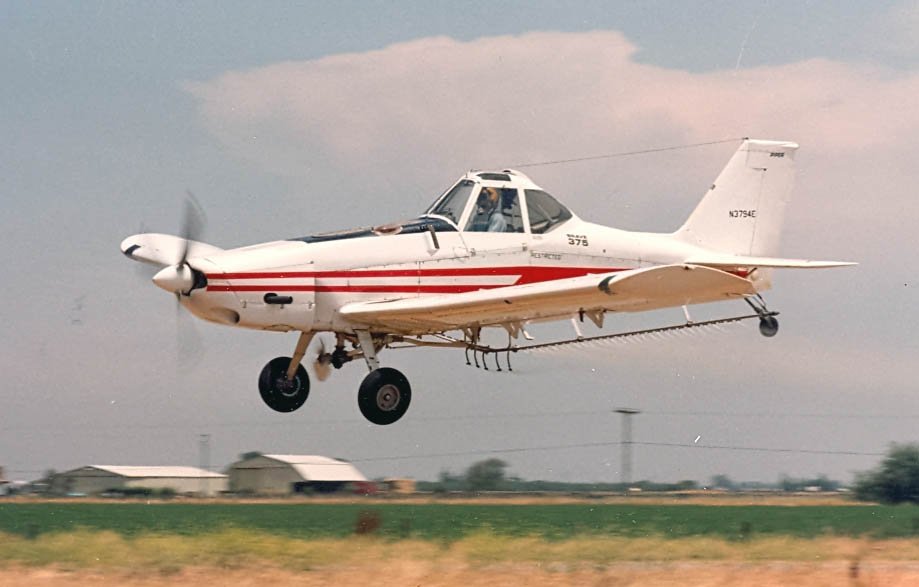
Development and Design Philosophy
Piper Aircraft's research and development team at Vero Beach, Florida, conceived the PA-36 Pawnee Brave through operational surveys of their earlier PA-25 Pawnee, identifying market demand for a larger agricultural aircraft. The design team, building upon Fred Weick's foundational work on the PA-25, aimed to compete directly with the Cessna 188 AGwagon by creating an aircraft with substantially greater payload capacity and improved operational efficiency.
The prototype, bearing serial number 36-EA and registration N36PA, completed its maiden flight on November 17, 1969. Following extensive testing and certification processes, the Federal Aviation Administration issued type certificate A9SO on May 31, 1972. Piper publicly unveiled the aircraft on October 9, 1972, with commercial deliveries beginning in 1973.
Engineering Innovations
The PA-36 incorporated several significant design improvements over its predecessor. Engineers developed a new wing structure featuring removable leading edges for enhanced maintenance accessibility. The aircraft's environmental systems received substantial upgrades, including improved ventilation and heating systems for pilot comfort during extended agricultural operations.
Piper introduced "Safoam" anti-sloshing fuel tanks to prevent fuel movement during aggressive maneuvering typical of agricultural work. The standard chemical hopper capacity increased to 30 cubic feet, with an optional 38 cubic feet configuration available, accommodating maximum loads of 1,900 pounds. Initially equipped with a stabilator design, Piper later modified the empennage to a conventional stabilizer and elevator configuration based on operational feedback.
Engine Development and Challenges
The early PA-36-285 models, produced from 1973 to 1977, featured the Continental Tiara 6-285 engine producing 285 horsepower. This flat-six piston engine employed a 2:1 gear reduction system driving a large-diameter, slow-turning Hartzell two-blade propeller designed to minimize noise pollution during agricultural operations. The PA-36 marked the first agricultural aircraft application of Tiara engines.
However, the Continental Tiara engines proved problematic, experiencing premature failures and crankshaft issues that compromised reliability. Responding to operator concerns and warranty claims, Piper transitioned to Lycoming powerplants in 1977. The PA-36 Brave 300 utilized the proven Lycoming IO-540-K1G5 engine generating 300 horsepower, with optional three-blade propeller configurations available.
In 1978, Piper introduced the PA-36 Brave 375, powered by the substantially larger Lycoming IO-720-D1CD flat-eight engine producing 375 horsepower. This installation required extensive modifications, including an extended engine cowling and reinforced engine mount to accommodate the additional power and weight.
Manufacturing and Production
Piper Aircraft manufactured PA-36 Pawnee Braves primarily at their Vero Beach, Florida facility, with some production occurring at Lock Haven, Pennsylvania. Between 1973 and 1981, Piper completed 938 aircraft before discontinuing production due to market conditions and competitive pressures.
Production rights subsequently transferred to WTA Incorporated, later reorganized as West Texas Aircraft, which continued manufacturing from 1982. These post-Piper variants, designated New Brave 375 and New Brave 400, incorporated the 400-horsepower Lycoming IO-720 variant. WTA produced approximately 150 additional aircraft through 1987, bringing total PA-36 production to over 1,000 units.
Operational Service
The PA-36 Pawnee Brave served exclusively in civilian roles, primarily conducting agricultural operations including crop dusting, pesticide application, and fertilizer distribution. Small to medium-sized agricultural aviation operators comprised the primary customer base, valuing the aircraft's increased payload capacity over the PA-25 Pawnee.
Secondary roles included banner towing and glider towing operations, where the aircraft's substantial power-to-weight ratio proved advantageous. The single-seat configuration eliminated passenger-carrying capability, focusing entirely on utility operations requiring maximum payload efficiency.
Company Legacy and Current Status
Piper Aircraft, founded in 1927 by William T. Piper and George H. Larner, established itself manufacturing affordable general aviation aircraft including the legendary J-3 Cub. The company entered agricultural aviation in 1959 with the PA-25 Pawnee, leading to the PA-36's development as an enlarged successor.
Financial difficulties plagued Piper during the 1990s, culminating in bankruptcy proceedings. New Piper Aircraft Inc. acquired the company in 1995, later reorganizing as The New Piper Aircraft, Inc. In October 1997, the restructured company obtained rights to the PA-36 design. Today, Piper Aircraft, Inc. continues operations from Vero Beach, Florida, though PA-36 production remains discontinued.
Technical Legacy
The combined PA-25 and PA-36 Pawnee family exceeded 6,000 total aircraft produced, representing one of general aviation's most successful agricultural aircraft lineages. While exact numbers of airworthy PA-36 aircraft remain undocumented, many continue serving in agricultural roles worldwide, testament to the design's fundamental soundness despite early engine difficulties.
The PA-36 Pawnee Brave represented Piper's most advanced agricultural aircraft design of the 1970s, successfully addressing payload limitations that restricted the PA-25's operational efficiency. Although production ceased in the 1980s due to market consolidation and competition, the aircraft's engineering solutions influenced subsequent agricultural aircraft development and sustained Piper's reputation in specialized aviation markets.