
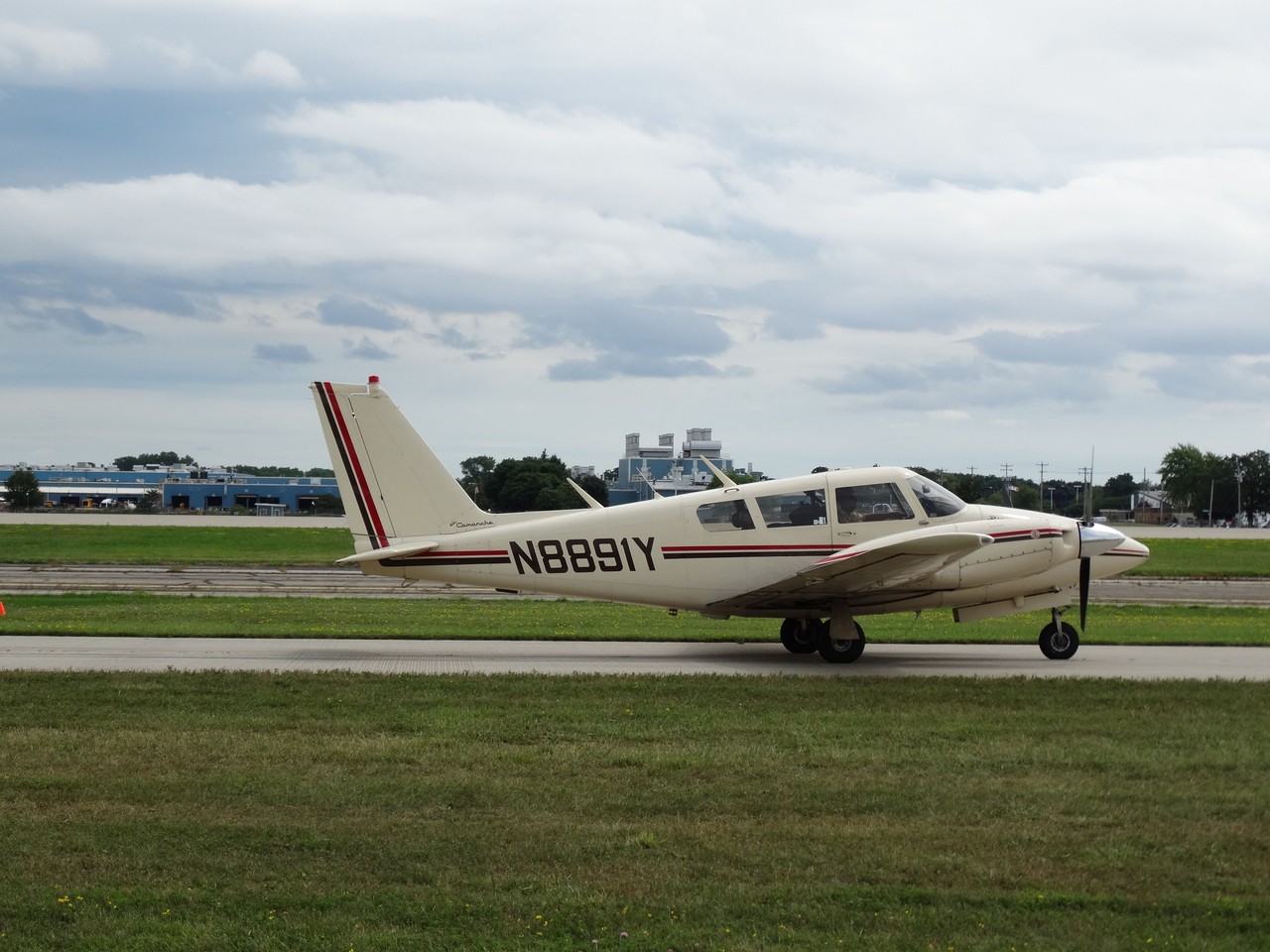
Design Innovation and Safety Revolution
The PA-39 Twin Comanche C/R emerged from a critical safety crisis that had plagued twin-engine general aviation aircraft throughout the 1960s. The original PA-30 Twin Comanche, despite its performance capabilities, suffered from a dangerous "critical engine" problem that resulted in a series of fatal crashes during single-engine flight operations. When one engine failed, the aircraft became difficult to control due to asymmetric thrust, leading to loss-of-control accidents that killed experienced pilots during training exercises.
Piper's engineering solution was elegantly simple yet revolutionary: counter-rotating propellers. The starboard engine became a mirror image of the port engine, with propellers rotating in opposite directions. This configuration eliminated the critical engine problem entirely, as either engine failure would produce identical handling characteristics. The innovation proved remarkably effective—comparative studies indicated that crash rates for the PA-39 were only one-third those of the conventional PA-30.
Development and First Flight
The PA-39's development traced back to modifications pioneered by Ed Swearingen, who operated an aircraft modification facility and first converted a single-engine Comanche into a twin-engine configuration. His prototype flew on April 12, 1961, in San Antonio, Texas. Piper refined this concept, with the official PA-30 prototype first flying from Lock Haven on November 7, 1962.
The counter-rotating variant took nearly seven more years to develop. The Twin Comanche D with counter-rotating engines completed its maiden flight on September 23, 1969, receiving FAA Type Approval on November 28, 1969. The first production PA-39 rolled off the assembly line on December 23, 1969, marking the beginning of a brief but significant production run.
Manufacturing and Production
Piper Aircraft Corporation manufactured all 155 PA-39s at its Lock Haven, Pennsylvania facility between 1970 and 1972. The company had been producing Comanche variants since 1958, ultimately building approximately 4,834 single-engine Comanches and 2,155 Twin Comanches (combining both PA-30 and PA-39 models) before disaster struck.
The Hurricane Agnes flood of June 1972 devastated the Lock Haven factory, effectively ending PA-39 production and marking the conclusion of Piper's entire Comanche line. The company relocated operations to Vero Beach, Florida, but did not produce another light twin until introducing the PA-44 Seminole in 1979. The flood thus made the PA-39 one of aviation's shortest production runs, with only three years of manufacturing.
Engine and Technical Specifications
Two Lycoming IO/LIO-320-C1A engines powered the PA-39, each producing 160 horsepower with a 2,000-hour time between overhauls. These four-cylinder, fuel-injected engines provided reliable performance throughout the aircraft's operational envelope. The counter-rotating configuration required one engine to be manufactured as a mirror image of the other, increasing production complexity but delivering crucial safety benefits.
The aircraft inherited the proven Comanche fuselage design, accommodating four occupants in a comfortable cabin arrangement. Total fuel capacity reached 120 gallons with 114 gallons usable, weighing 506 pounds when full. At 75 percent power and 8,000 feet altitude, the PA-39 cruised at 168 knots while consuming 17.2 gallons per hour, delivering a range of 1,188 nautical miles under normal cruise conditions.
Operational Service and Notable Achievements
The PA-39 served primarily in general aviation roles, from personal transportation to flight training. Its enhanced safety characteristics made it particularly valuable for twin-engine instruction, where the elimination of critical engine scenarios reduced training risks significantly. The FAA simultaneously revised its training requirements for twin-engine aircraft, contributing to the improved safety record.
One of the most remarkable PA-39 achievements occurred in the 1994 Round the World Air Race, when Texas mother-daughter team Marion P. Jayne and Patricia Jayne Keefer claimed victory flying their modified Twin Comanche. Their aircraft was the only American entry and the sole twin-engine competitor in the race. To achieve the necessary range, they installed 11 fuel tanks holding 252 gallons compared to the standard four tanks with 90 gallons, demonstrating the aircraft's adaptability for long-range operations.
Legacy and Current Status
The PA-39's brief production run belied its significant impact on twin-engine aircraft safety. Piper applied the counter-rotating propeller concept to subsequent light twins, validating the design philosophy that safety improvements could be achieved through thoughtful engineering rather than complex systems. The aircraft proved that addressing fundamental aerodynamic challenges could deliver measurable safety improvements.
Today, the PA-39 remains a sought-after aircraft among vintage aviation enthusiasts, though exact numbers of airworthy examples are not definitively documented. Its rarity, combined with its historical significance as a safety innovation, has made surviving examples valuable both as flying aircraft and historical artifacts representing a crucial evolution in twin-engine aircraft design.