
Development Origins
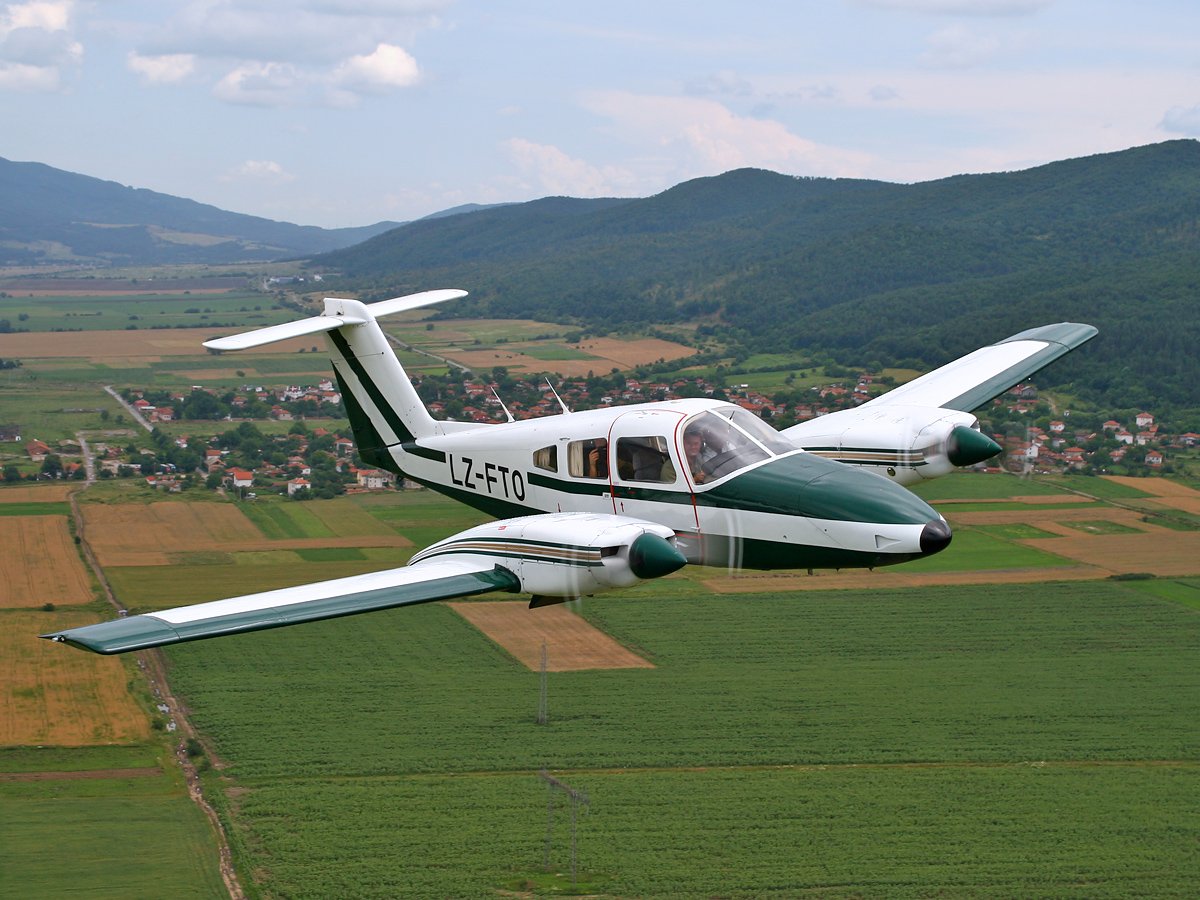
The Seminole emerged from Piper Aircraft's Project 10, initiated in 1974 under the direction of engineer Grahame Gates at the company's Lakeland, Florida facility. Piper sought to create an affordable replacement for their discontinued PA-39 Twin Comanche that would serve as an accessible entry point into twin-engine aviation. The original concept married an Arrow fuselage with a distinctive T-tail configuration, initially planned around 160-horsepower counter-rotating engines.
By 1975, the project had relocated to Vero Beach and received the designation "Light Twin." Engineering analysis revealed that 160 horsepower proved insufficient for acceptable climb performance, prompting the upgrade to 180-horsepower Lycoming engines. Further refinements in 1977 included re-engineering the rear fuselage with a smaller T-tail design, ultimately resulting in a longer rear fuselage and redesigned ailerons for the final configuration.
Production History
The first production Seminole took flight in May 1978, with customer deliveries commencing in July of that year. Piper marketed the aircraft as "the ideal aircraft for the single-engine pilot to step up to twin-engine flying," emphasizing its balance of purchase price, operating cost, and performance capabilities. The base price stood at $73,900 in 1978.
Production reached its zenith in 1979 with 329 aircraft manufactured, representing the peak year for Seminole output. However, market conditions forced a production halt in 1982, with manufacturing remaining dormant until 1989. A brief resumption occurred from 1989 to 1990 before Piper's financial difficulties again suspended production in 1990. New Piper Aircraft acquired the company in 1995 and resumed continuous Seminole production, which has continued uninterrupted to the present day.
Technical Innovation
The Seminole introduced several notable design features, most significantly its counter-rotating propeller configuration. This system eliminated the traditional "critical engine" concept inherent in conventional twin-engine aircraft, where one engine's failure creates more adverse handling characteristics than the other. With counter-rotating propellers, both engines produce equal and opposite torque effects, ensuring identical handling characteristics regardless of which engine fails.
Interestingly, Piper developed the T-tail configuration first on the Seminole before subsequently incorporating it into the Lance II. This distinctive empennage design positioned the horizontal stabilizer atop the vertical stabilizer, theoretically providing cleaner airflow over the control surfaces and improved performance characteristics.
Engine Evolution
The Seminole's powerplant history reflects ongoing improvements in reliability and performance. Initial production aircraft from 1979 to 1982 employed Lycoming O-360-E1A6D engines, which unfortunately experienced significant camshaft failures and tappet-spalling problems that plagued early operators. When production resumed in 1989, Piper adopted the improved Lycoming O-360-A1H6 variant, which resolved these mechanical issues and provided enhanced reliability.
Between 1980 and 1982, Piper also offered a Turbo Seminole variant powered by twin Lycoming TO-360 turbocharged engines producing over 200 horsepower each. This variant achieved 194 miles per hour at 65 percent power while consuming 19 gallons per hour, though production remained limited during this brief period.
Training Mission
The Seminole fulfilled its intended role as the premier multi-engine trainer in civilian aviation. Flight schools adopted the type extensively due to its forgiving handling characteristics, reasonable operating costs, and comprehensive systems that prepared pilots for larger twin-engine aircraft. The counter-rotating engines provided an ideal training platform, allowing instructors to simulate engine failures without the asymmetric handling complications found in conventional twins.
Beyond training applications, the Seminole attracted private owners seeking twin-engine safety for over-water operations, mountain flying, and personal transportation. The four-seat cabin configuration and 898-mile range with reserves made it suitable for both instruction and practical transportation missions.
Modern Developments
Contemporary Seminoles incorporate advanced avionics systems that have evolved significantly from the original steam gauge instrumentation. Current production aircraft feature Garmin G1000 NXi glass cockpit displays, while many existing aircraft have received retrofitted Garmin GNS 430 GPS/communication systems. These upgrades have maintained the Seminole's relevance in modern flight training environments.
The Federal Aviation Administration has established a structural life limit of 14,663 hours for Seminole wings and associated components, reflecting the aircraft's intensive training usage. Given the type's popularity in flight schools, numerous examples have accumulated over 10,000 flight hours, approaching this certificated limit.
Legacy and Continuing Production
With approximately 1,000 aircraft produced across nearly five decades, the Seminole represents one of general aviation's most enduring twin-engine designs. Its combination of benign handling characteristics, safety features, and affordable operating costs established it as the industry standard for multi-engine training. The aircraft remains in continuous production as of 2024, making it among the longest-produced twin-engine aircraft in general aviation history and the sole T-tail configuration in Piper's current lineup.