
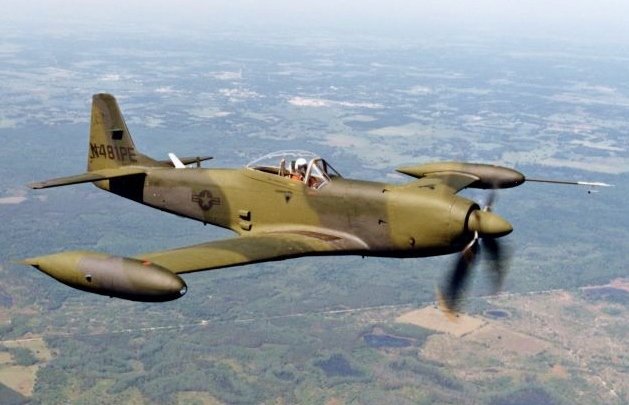
The Piper PA-48 Enforcer was a turboprop attack aircraft developed for close air support (CAS) and counter-insurgency (COIN) operations. The aircraft's lineage began in 1968 with David Lindsay and Cavalier Aircraft, who modified surplus P-51 Mustangs into turboprop-powered aircraft. Two early Cavalier prototypes, often identified as the PE-1 and PE-2, flew in the early 1970s, with one recording a first flight on April 29, 1971. In 1979, Cavalier sold the Enforcer design to Piper Aircraft.
While the PA-48 resembled the P-51 Mustang, Piper effectively redesigned the aircraft from the ground up. According to the Pima Air & Space Museum, the PA-48 shared less than 10% of its parts with the original Mustang, making it essentially a new airframe. In 1981, the United States Air Force (USAF) contracted Piper to build two new prototypes for evaluation. These aircraft were completed and first flown in 1983 at Piper's facility in Lakeland, Florida.
Technically, the PA-48 was powered by a single Avco-Lycoming YT55-L-9 or YT55-L-9A turboprop engine, a variant of the turboshaft used in CH-47 Chinooks, producing 2,445 shaft horsepower. This engine drove a four-bladed Aeroproducts propeller with a diameter of 11 feet 6 inches. The aircraft was designed for survivability and endurance, featuring ceramic armor plating, self-sealing fuel tanks, and wingtip fuel tanks to extend loiter time. It possessed 10 external hardpoints capable of carrying a total of 5,680 lb of ordnance, including bombs, rocket pods, and 30 mm gun pods.
Performance figures for the PA-48 included a cruise speed of 253 mph and a maximum speed of 345 mph at 15,000 feet, with some sources citing a never-exceed speed (Vne) of 402 mph. It had a service ceiling of 25,000 feet and a combat radius of 460 miles. Despite these capabilities, the USAF concluded its testing in 1984 and decided not to order the aircraft into series production. Consequently, the PA-48 never entered operational service and never received an official military designation. Today, one to two museum examples survive, including a prototype at the Pima Air & Space Museum with registration N481PE, though none remain airworthy.