
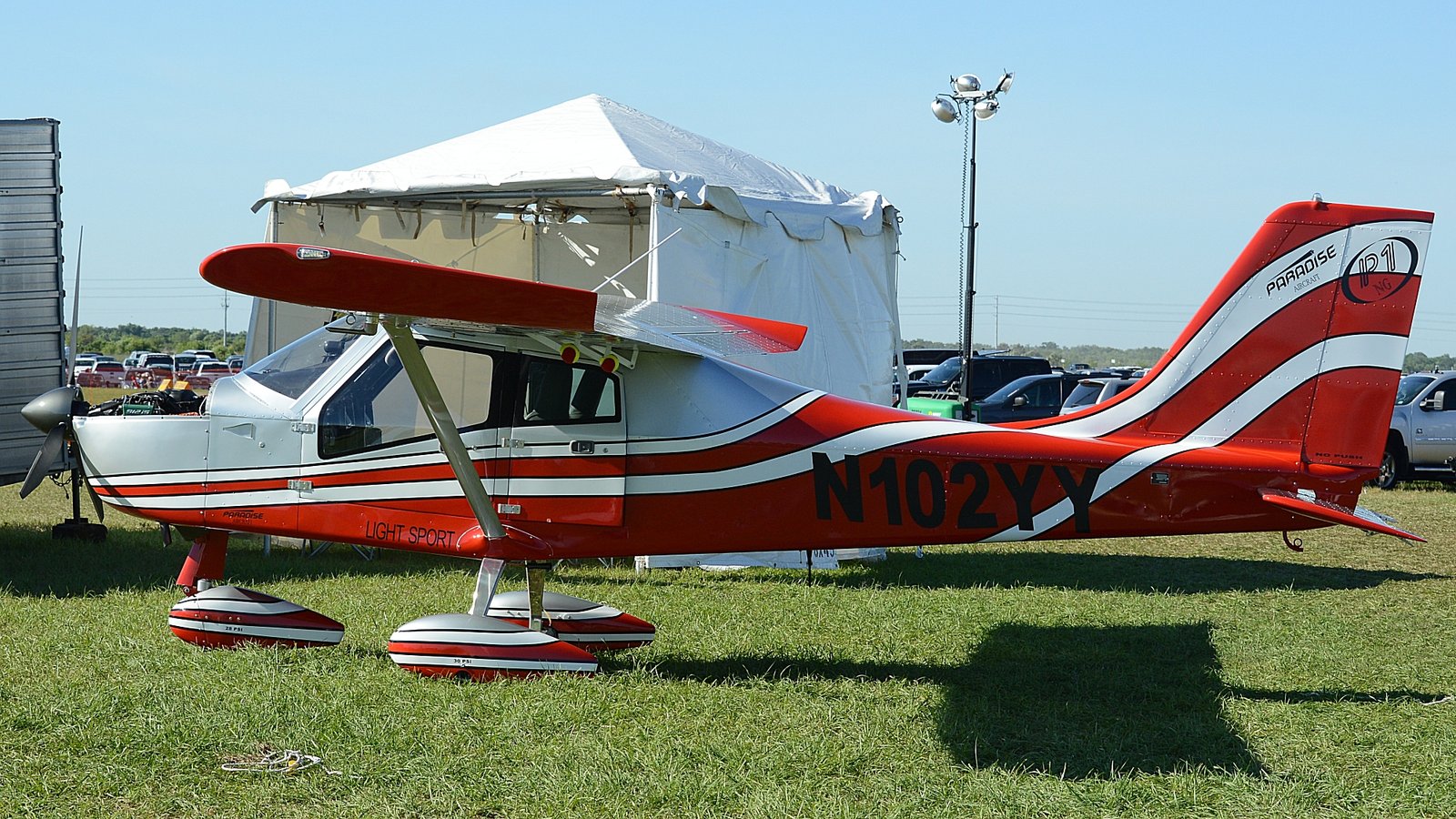
Design Origins and Development
The Paradise P-1 emerged from Brazil's unique aviation needs, originally conceived as an inexpensive utility aircraft for operations in the country's vast and challenging outback regions. The design preceded the formal establishment of its manufacturing company by two years, with the prototype taking its maiden flight in 1999, while Paradise Industria Aeronautica Ltda was not founded until 2001 in Feira de Santana, Bahia State.
The aircraft's development followed an unconventional path, transitioning from a purely Brazilian design to international certification. When the United States formalized light sport aircraft regulations, Paradise adapted the P-1 to meet these new standards, achieving Federal Aviation Administration acceptance as a factory-built special light sport aircraft in 2009.
The Manufacturer
Paradise Industria Aeronautica represents Brazil's growing presence in light aircraft manufacturing. Based in Feira de Santana, the company initially attempted to establish a dual-production strategy with a facility in Sebring, Florida, targeting the American market directly. However, this international expansion proved unsustainable, and the Florida operation was subsequently closed, consolidating all production in Brazil. By 2015, the company had no United States presence or representation, despite having achieved FAA certification for their aircraft.
The Brazilian factory operates with a nominal capacity of 120 aircraft annually, though actual production has been constrained by labor shortages. This limitation has affected the company's ability to meet demand, particularly given the aircraft's success in the Brazilian market where more than 130 examples were flying as of recent reports.
Technical Innovation and Configuration
The P-1 incorporates several design elements that distinguish it from typical light sport aircraft. According to Paradise, the wing design utilizes technology developed by NASA, contributing to the aircraft's exceptional stability characteristics. The construction methodology combines welded steel tube fuselage framing with aluminum sheet covering, providing durability while maintaining weight efficiency.
Powered by the proven Rotax 912 ULS engine producing 75 kilowatts, the P-1 can also accommodate alternative powerplants including the 80-horsepower Rotax 912 and the 115-horsepower Rotax 914. All variants utilize three-blade Warp Drive composite propellers, with Kevlar and glass Kiev propellers available as options. The aircraft's fuel flexibility extends to E10 automotive gasoline approval, reducing operating costs in remote areas.
Performance and Capabilities
The P-1's performance envelope reflects its utility mission origins. With a maximum speed of 220 kilometers per hour and cruise speed of 185 kilometers per hour, it balances efficiency with capability. The aircraft's low-speed characteristics prove particularly impressive, with stall speeds ranging from 58 to 88 kilometers per hour depending on flap configuration.
Operational versatility defines the P-1's appeal. Its 85-meter takeoff run enables operations from short, unpaved strips common in remote locations. The aircraft achieves a service ceiling sufficient for operations in varied terrain while maintaining a rate of climb of 244 meters per minute. With fuel capacity ranging from 100 to 142 liters, the P-1 provides a range of 1,380 kilometers at 65 percent power settings, translating to 7.8 hours of endurance without reserves.
Market Reception and Commercial Service
Despite its Brazilian origins, the P-1 found initial international success through Paradise USA's marketing efforts from Sebring, Florida. The aircraft entered the American market priced at $108,830 in 2009, positioning it competitively within the light sport aircraft segment. Standard equipment included comprehensive avionics with VFR radio, transponder, color GPS navigation, and a complete six-pack instrument panel.
By April 2016, twelve P-1 aircraft had achieved registration in the United States, while ten had been sold by January 2015. International expansion extended beyond North America, with the first Australian delivery occurring in early 2010. Several aircraft subsequently gained registration under Recreation Aviation Australia regulations, demonstrating the design's adaptability to different certification frameworks.
Production Legacy and Variants
The P-1's success spawned an entire family of Paradise aircraft designs. The company developed the P-1NG as an improved version of the original, while expanding into larger aircraft with the P-2 two-seat variant and P-4 four-seat high-wing aircraft. The Paradise Eagle represented a departure from the high-wing configuration, offering a two-seat low-wing alternative within the light sport aircraft category.
Production continues at the Feira de Santana facility, with Paradise maintaining its position as a specialized manufacturer of affordable light aircraft. The P-1's ongoing production reflects the sustained demand for simple, reliable aircraft capable of operations from minimal infrastructure, particularly in developing aviation markets where such capabilities remain essential for connectivity and utility services.