
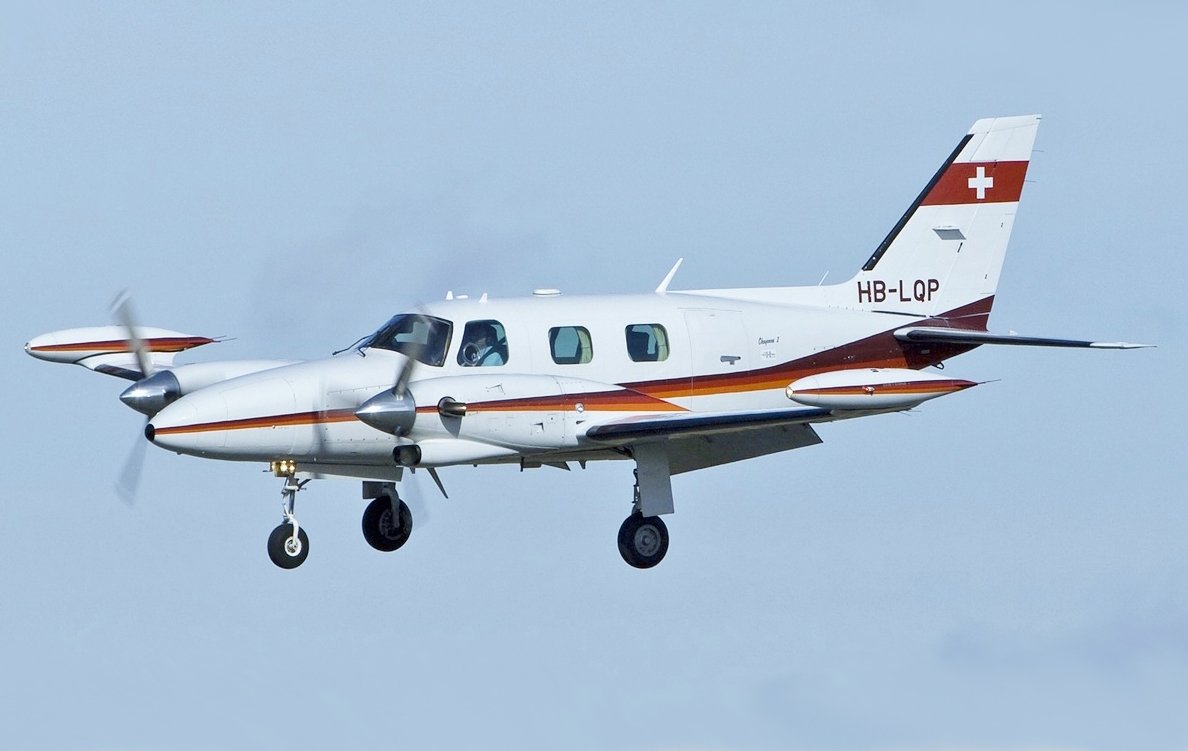
Market Impact
The Cheyenne I carved out a significant position in late 1970s business aviation by bridging the gap between high-performance piston twins and expensive turboprops. When Piper introduced the aircraft in 1978 at a base price of $500,000, it undercut competing turboprops by substantial margins, making turbine power accessible to operators previously limited to piston aircraft. This pricing strategy proved successful, with 189 aircraft finding buyers over the five-year production run ending in 1983.
Development Strategy
Piper's approach with the Cheyenne I involved strategic cost reduction rather than completely new design. The aircraft utilized the proven PA-31P Pressurized Navajo airframe, which had been in development since 1966 and production since the early 1970s. By adapting this existing pressurized platform and installing less powerful engines than the original Cheyenne, Piper created an economical entry point into turboprop ownership. Equipment that came standard on the higher-performance Cheyenne became optional on the Cheyenne I, further reducing base pricing.
Piper Aircraft Corporation
Piper Aircraft Corporation had established itself as a major force in general aviation by the 1970s, with manufacturing facilities in Lock Haven, Pennsylvania, and a specialized plant in Quehanna for producing PA-31 subassemblies. The company's experience with pressurized aircraft began in 1962, leading to the successful PA-31P Pressurized Navajo program. The entire PA-31 family ultimately encompassed nearly 3,400 twin-engine aircraft plus several hundred turbine variants, making it one of Piper's most significant product lines. This experience with pressurization technology later influenced Piper's development of single-engine pressurized aircraft like the Malibu and Mirage.
Engine and Performance
The heart of the Cheyenne I consisted of two Pratt & Whitney Canada PT6A-11 turboprop engines, each producing 500 shaft horsepower and driving constant-speed propellers at maximum speeds of 2,200 RPM. These engines, part of the highly successful PT6A series, offered 3,500-hour overhaul intervals, providing operators with predictable maintenance costs. The powerplants enabled the aircraft to achieve a maximum cruise speed of 236 knots indicated airspeed while burning 65.5 gallons per hour.
With a maximum gross weight of 8,700 pounds and empty weight of 4,907 pounds, the Cheyenne I could carry 1,593 pounds of payload. Standard fuel capacity reached 308 gallons, with long-range tanks extending this to 390 gallons for a maximum range of 883 nautical miles. The aircraft's service ceiling of 29,000 feet allowed operations above most weather, while its initial climb rate of 1,750 feet per minute provided respectable performance for a 500-horsepower-per-side aircraft.
Operational Characteristics
Pilots appreciated the Cheyenne I's combination of turboprop reliability with manageable operating costs. The aircraft's stall speed of 72 knots indicated airspeed made it accessible to pilots transitioning from high-performance piston twins, while the pressurized cabin provided passenger comfort at altitude. Wing loading of 38 pounds per square foot and power loading of 8.7 pounds per horsepower resulted in balanced handling characteristics suitable for business aviation missions.
The cockpit accommodated a single pilot for most operations, though many operators chose to fly with two crew members for enhanced safety margins. The passenger cabin seated up to six occupants, making it ideal for small corporate flight departments or charter operators serving regional routes.
Evolution and Variants
Piper's turboprop strategy evolved throughout the Cheyenne I's production period. The original Cheyenne, powered by more potent 620-horsepower PT6A-28 engines, was redesignated as the Cheyenne II after the Cheyenne I's introduction in 1978. In 1979, Piper stretched the Cheyenne II fuselage by 24 inches to create the PA-31T2 variant.
The Cheyenne I itself received updates in 1984 with the introduction of the Cheyenne IA. This variant featured redesigned engine nacelles, modified exhaust stacks, and increased interstage turbine temperature limits that improved both cruise speed and range. However, market conditions led to the Cheyenne IA's discontinuation after just one year, with only 17 examples completed in 1985.
Production Legacy
The Cheyenne I's production total of 189 aircraft represented solid market acceptance for a specialized turboprop design. While modest compared to piston-powered aircraft production numbers, this figure demonstrated substantial demand for affordable turbine power in business aviation. The aircraft's success encouraged Piper's continued development of turboprop designs, ultimately leading to the larger PA-42 Cheyenne III and IV models that expanded the company's presence in the turboprop market.
Today, many Cheyenne I aircraft remain in active service, testament to the durability of both the basic airframe design and the reliable PT6A powerplants. The type established Piper as a credible manufacturer of entry-level turboprops, helping democratize turbine-powered flight for smaller operators throughout the 1980s.