
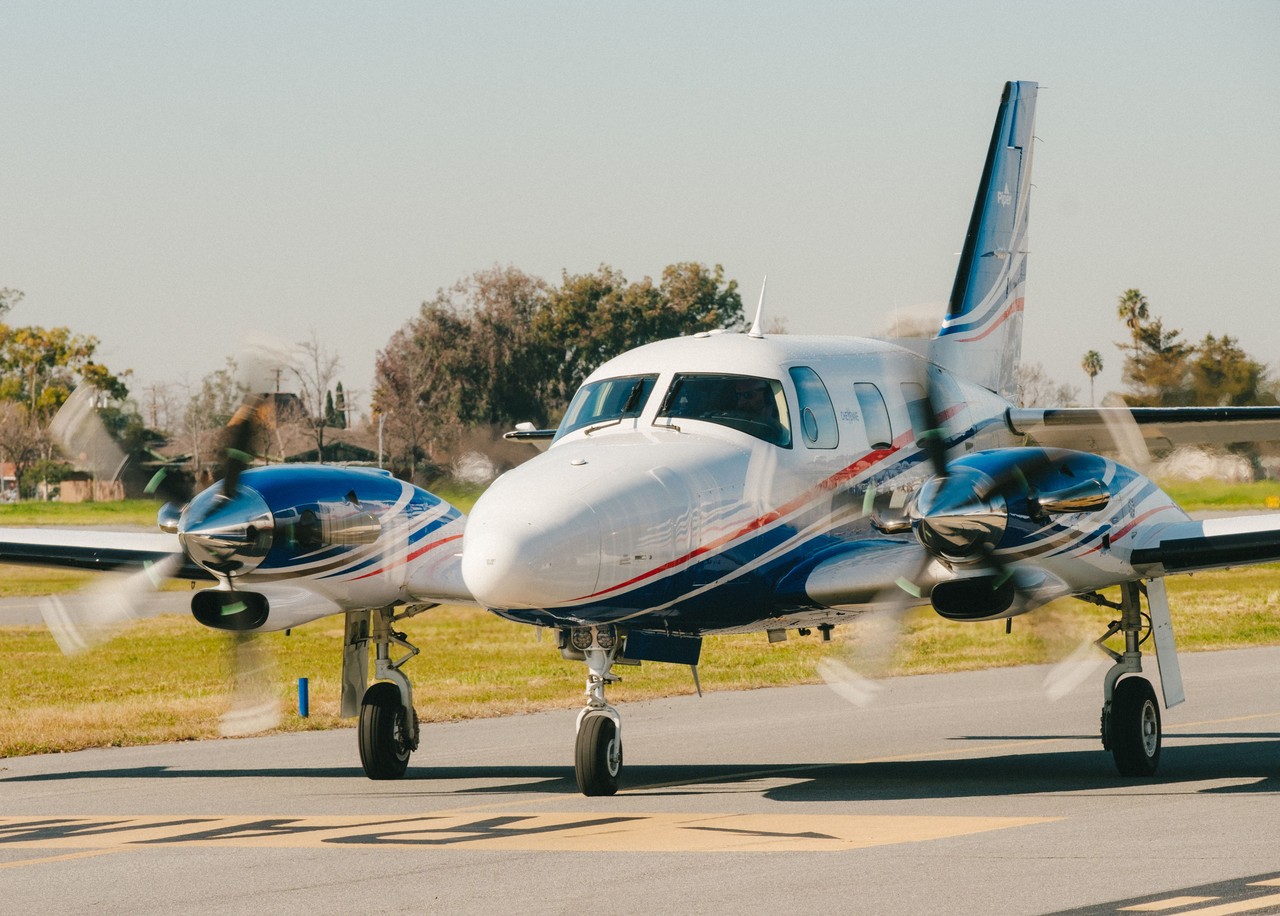
Corporate Aviation Pioneer
The Cheyenne II emerged during the business aviation boom of the 1970s, capturing a significant share of the pressurized turboprop market. Its introduction allowed smaller corporations and charter operators to access airline-level performance and comfort previously reserved for larger aircraft. The type's popularity was evident when Piper's 100,000th aircraft milestone in 1976 was celebrated with a Cheyenne delivery, underlining the aircraft's importance to the company's success.
Development and Design Innovation
Piper engineers began developing the Cheyenne II in 1965, recognizing the need for a pressurized upgrade to compete in the expanding business turboprop market. The design team adapted the proven PA-31 Navajo airframe, incorporating pressurization systems and turboprop powerplants to create an entirely new category of aircraft for Piper. After the prototype's maiden flight on August 20, 1969, the first production aircraft took to the skies on October 22, 1973, following FAA certification in May 1972.
The Cheyenne II represented several technological firsts for Piper Aircraft Corporation. As the company's initial production turbine-engine business aircraft, it marked a dramatic departure from their traditional piston-powered designs. The engineers incorporated wingtip fuel tanks that extended range to 1,444 nautical miles, while the pressurized cabin allowed operations at altitudes up to 29,000 feet, well above most weather and air traffic congestion.
Powerplant Excellence
Two Pratt & Whitney Canada PT6A-28 turboprop engines provided the Cheyenne II's impressive performance capabilities. Each engine delivered 620 shaft horsepower through a free-turbine design that had revolutionized turboprop aviation since the PT6A family's introduction in 1963. The PT6A-28 variant, entering production in the early 1970s, featured flat-rating for consistent high-altitude performance and pioneered efficient reverse-thrust propellers in the business turboprop category.
These engines proved remarkably reliable, with hot-section overhauls scheduled at 3,600-hour intervals. The PT6A's reputation for dependability contributed significantly to the Cheyenne II's commercial success, as operators could count on consistent dispatch reliability for critical business missions.
Performance and Pilot Appeal
Pilots appreciated the Cheyenne II's balanced performance envelope, with a best cruise speed of 269 knots indicated airspeed and an impressive initial climb rate of 2,710 feet per minute. Even with one engine inoperative, the aircraft maintained the same climb rate, providing crucial safety margins during critical phases of flight. The stall speed range of 75-86 knots indicated airspeed allowed for reasonable approach speeds at shorter business airports.
The cockpit accommodated one or two pilots, though most commercial operations utilized two-pilot crews for enhanced safety and workload management. With fuel capacity ranging from 382 to 390 gallons, depending on configuration, the aircraft offered excellent range flexibility for varying mission requirements.
Manufacturing Legacy
Piper Aircraft Corporation, founded in 1927 by William T. Piper and George H. Larmon, had established itself as a premier general aviation manufacturer through aircraft like the legendary J-3 Cub. The Cheyenne II represented the company's ambitious expansion into sophisticated business aviation markets during the 1970s prosperity.
Production continued from 1974 through 1983, with the initial PA-31T-620 model manufactured until 1977 before evolving into additional variants. The company faced financial difficulties in 1991, leading to bankruptcy, but emerged as New Piper Aircraft Inc. in 1995. Today, operating as Piper Aircraft and headquartered in Vero Beach, Florida, the company continues manufacturing modern aircraft including the M600 turboprop.
International Reach
The Cheyenne II's success extended beyond American borders through licensed production agreements. CHINCUL in Argentina and AICSA in Colombia manufactured variants for their respective regional markets, demonstrating the design's international appeal and adaptability to diverse operating environments.
Continuing Service
Decades after production ended, numerous Cheyenne II aircraft remain active in charter, corporate, and private roles worldwide. Examples like VH-TNZ (construction number 31T-7920064) at Essendon Airport represent preserved aircraft maintaining the type's heritage. Active sales listings indicate ongoing demand for these proven aircraft among operators seeking reliable, economical turboprop performance.
The Cheyenne II's legacy extends beyond its production numbers, having established Piper as a credible turbine aircraft manufacturer and paving the way for successors including the PA-42 Cheyenne III and IV. Its impact on 1970s business aviation helped democratize corporate air travel, bringing turbine reliability and pressurized comfort to mid-level operators previously limited to piston-powered aircraft.