
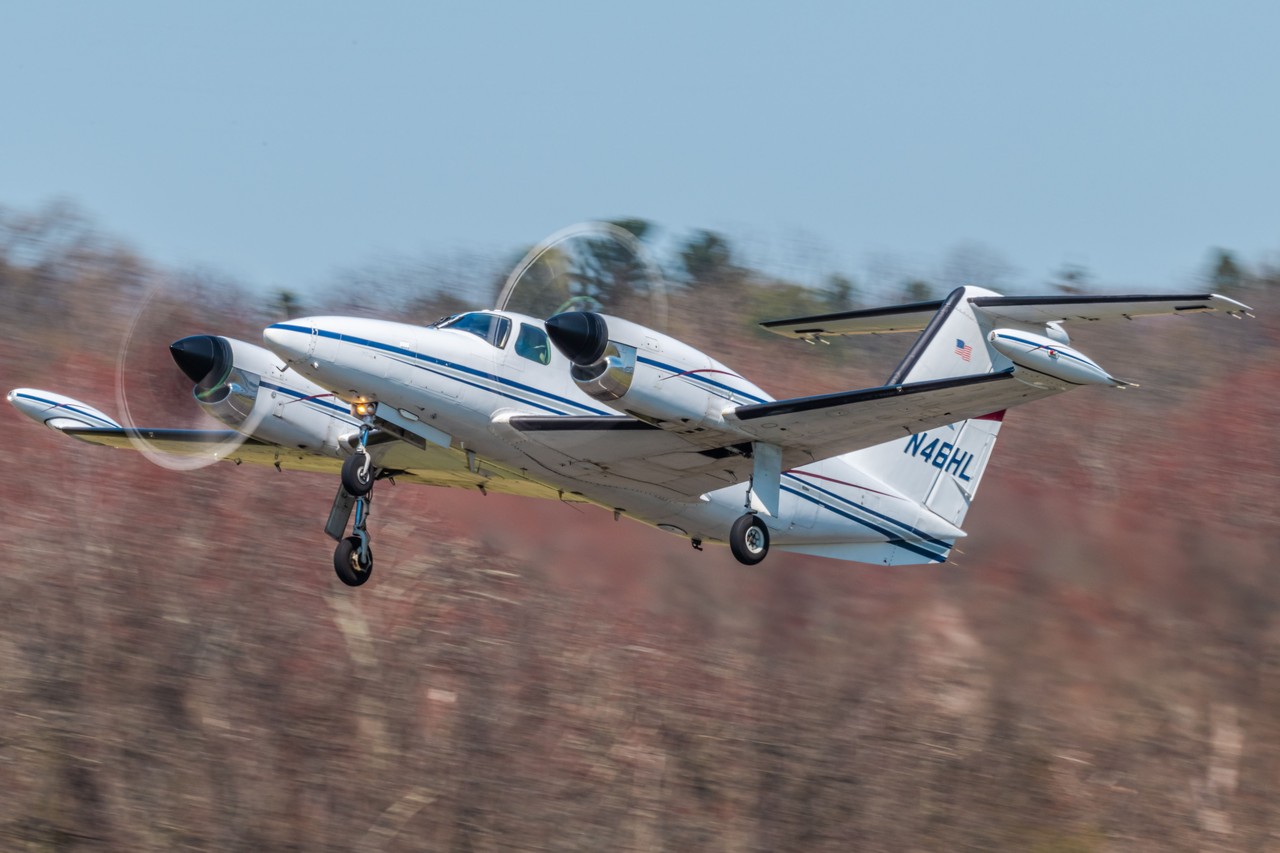
The Ultimate Cheyenne
The Cheyenne 400LS emerged from Piper's determination to push turboprop performance into jet territory without abandoning the fuel efficiency and operational economics that made turboprops attractive to business operators. Rather than developing an entirely new aircraft, Piper's engineering team evolved their successful Cheyenne III design, stretching the fuselage by approximately three feet and installing substantially more powerful engines to create what would become their fastest turboprop.
Development and Certification
Piper began serious development of the Cheyenne 400LS in the early 1980s as a direct response to the Cessna Citation I's success in the light business jet market. The prototype took to the skies in 1983, demonstrating performance figures that exceeded many contemporary jets. FAA certification followed in 1984, with the first deliveries beginning immediately thereafter.
The "LS" designation reflected the aircraft's production during Piper's ownership by Lear Siegler, a period marked by ambitious engineering projects despite the company's financial struggles. The entire production run of 44 aircraft carried serial numbers from 5135 to 5194, manufactured exclusively at Piper's Florida facility after Hurricane Agnes had devastated their Pennsylvania operations in 1972.
Record-Breaking Performance
On April 16, 1985, the Cheyenne 400LS proved its exceptional capabilities by establishing four aviation records. The aircraft set two class C-1e Group 2 time-to-climb records for reaching 3,000 and 9,000 meters, while simultaneously claiming two records among all turboprop aircraft for climbs to 6,000 and 12,000 meters. These achievements demonstrated the aircraft's remarkable climb performance of 3,242 feet per minute at maximum weight.
The powerplant responsible for this performance consisted of twin Honeywell TPE331-14 turboprop engines, each flat-rated to produce 1,000 shaft horsepower up to ISA+10°C conditions. These water-cooled engines drove composite Dowty Rotol four-blade propellers with 106-inch diameters, enabling the aircraft to achieve maximum cruise speeds of 351 knots at 24,000 feet.
Advanced Systems and Design
The Cheyenne 400LS incorporated sophisticated avionics that rivaled those found in contemporary jets. The standard equipment included Collins Aerospace FCB 65 five-tube electronic flight information systems, integrated flight directors, and APS 65 autopilots. The pressurization system maintained a comfortable 7.6 psi differential, allowing the aircraft to operate at its maximum certified altitude of 41,000 feet while maintaining a cabin altitude equivalent to 8,000 feet.
With a maximum gross weight of 12,050 pounds and an empty weight of 7,856 pounds, the aircraft could carry substantial payloads over impressive distances. Standard fuel capacity of 570 gallons provided a maximum range of 1,879 nautical miles, enabling nonstop flights between city pairs like New York and Atlanta or transcontinental European routes such as London to Cannes.
Operational Service
Unlike many aircraft in its class, the Cheyenne 400LS found its niche primarily with private owners, charter operators, and specialized business aviation companies rather than scheduled airlines. The typical passenger configuration accommodated seven to eight passengers in club seating arrangements, though maximum occupancy could reach ten including the pilot.
Charter companies particularly valued the aircraft's ability to access shorter runways while maintaining jet-like performance. With takeoff distances of just 1,930 feet over a 50-foot obstacle and landing distances of 2,280 feet, the Cheyenne 400LS could serve airports inaccessible to comparable jets while offering superior speed and range compared to traditional turboprops like the King Air 200.
The Manufacturer's Legacy
Piper Aircraft's journey to creating the Cheyenne 400LS began in 1927 when the Taylor Brothers Aircraft Manufacturing Company was founded by Clarence and Gordon Taylor. After the company's bankruptcy, engineer William T. Piper acquired the assets and renamed it Piper Aircraft Corporation in 1937. The company experienced significant growth following World War II but faced numerous ownership changes and financial challenges throughout the following decades.
During the Cheyenne 400LS production period, Piper was struggling with the liability insurance crisis that plagued general aviation manufacturers in the 1980s. The company filed for bankruptcy in the mid-1980s, contributing to the limited production run of just 44 aircraft. Today, Piper Aircraft continues operations under Brunei government ownership, based at Vero Beach Regional Airport in Florida.
Legacy and Current Status
Production ceased in 1991 after political and economic pressures made continued manufacturing economically unfeasible. The limited production run has made surviving examples increasingly valuable, with 37 aircraft confirmed still in service as of 2018. Many continue operating in charter service, testament to the aircraft's enduring performance capabilities and structural integrity.
The Cheyenne 400LS stands as a remarkable example of evolutionary aircraft design, proving that substantial performance improvements could be achieved through systematic upgrades rather than clean-sheet development. Its ability to cruise faster than early jets while maintaining turboprop operating economics created a unique niche that remains largely unfilled in today's business aviation market.