
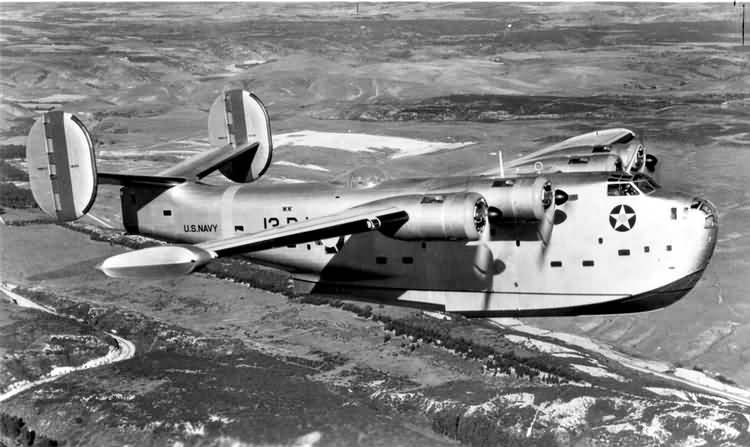
The Consolidated PB2Y Coronado was a large four-engine flying boat patrol bomber developed by Consolidated Aircraft to fulfill a U.S. Navy requirement for a long-range aircraft with superior payload and performance compared to the twin-engine PBY Catalina. Designed and built at Consolidated's facilities in San Diego, California, the prototype XPB2Y-1 first flew on December 17, 1937. The aircraft officially entered operational service in December 1940.
Technically, the Coronado was an evolution of the Catalina design, featuring a single-step hull and retractable wingtip floats. To increase capacity and power, it was equipped with four Pratt & Whitney R-1830-88 "Twin Wasp" air-cooled, 14-cylinder radial piston engines, each producing 1,200 horsepower. The PB2Y-3 variant, the primary production model, reached a maximum speed of 223 mph at 20,000 feet and had an approximate range of 1,800 miles. Its offensive capabilities included internal wing bomb bays capable of carrying eight 1,600 lb bombs or eight 650 lb depth charges, supplemented by external racks for additional ordnance or two Mk-13-3 torpedoes. For defense, the aircraft utilized up to eight 0.50 in M2 Browning machine guns mounted in nose, dorsal, and tail turrets, as well as waist positions.
During World War II, the PB2Y served with the U.S. Navy, U.S. Coast Guard, and the Royal Air Force (RAF). While designed for antisubmarine warfare and bombing—including four raids on Wake Island in early 1944—its high operating costs and shorter range compared to the PBY led many units to be diverted to transport and medical roles. It became a cornerstone of the Naval Air Transport Service (NATS) in the Pacific, serving as a hospital aircraft and VIP transport. Ten aircraft were provided to the RAF under Lend-Lease, where they operated as transports for No. 231 Squadron between North America, Bermuda, and West Africa. The U.S. Coast Guard also operated five PB2Y-5H aircraft for search-and-rescue and antisubmarine missions.
One of the most notable moments in the aircraft's history occurred in 1945, when a Coronado transported Admiral Chester W. Nimitz to Tokyo Bay for the signing of the Japanese surrender. Following the war, the PB2Y was quickly deemed obsolete and most were scrapped by 1946, though some limited civilian use occurred, including with Hughes Aviation. Of the 217 aircraft produced between the late 1930s and 1945, only one survivor remains today, preserved as a static display at the National Naval Aviation Museum in Pensacola, Florida.