
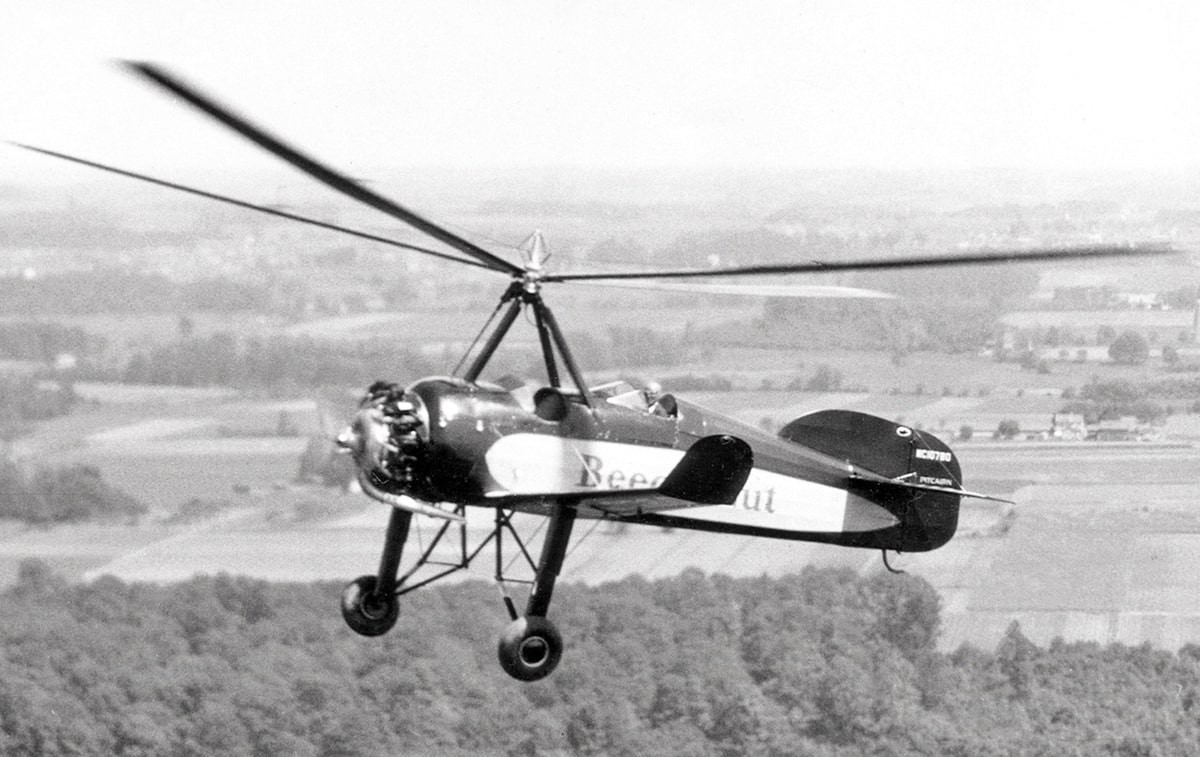
Revolutionary Design Achievement
The PCA-2 represented Harold F. Pitcairn's ambitious leap into rotary-wing aviation following his 1929 acquisition of Juan de la Cierva's autogiro patents. Pitcairn's engineering team significantly improved upon the imported Cierva C.8W testbed by incorporating steel spars instead of wooden construction and developing an innovative clutch system that enabled engine-driven rotor spin-up. This breakthrough allowed the PCA-2 to achieve true short takeoff and landing capabilities through improved rotor pre-rotation from propwash deflection.
The aircraft's certification by the Department of Commerce in 1931 marked a historic milestone as the world's first type-certified rotary-wing aircraft, legitimizing autogiros for commercial operation. Within months of certification, the PCA-2 demonstrated its capabilities with James Ray's dramatic landing on the White House South Lawn on April 22, 1931, capturing national attention and proving the autogiro's unique operational flexibility.
Record-Breaking Achievements
The PCA-2 quickly established itself as a record-setting aircraft through a series of remarkable flights. John M. Miller piloted his PCA-2 Missing Link on the first transcontinental rotorcraft flight, completing the journey on May 28, 1931. Aviation pioneer Amelia Earhart set an autogiro altitude record of 18,415 feet on April 8, 1931, though her subsequent attempt at a transcontinental flight ended in crashes that ultimately forced abandonment of the mission.
Lewis Yancey pushed the PCA-2's altitude capabilities even further, reaching 21,500 feet on September 25, 1932. The aircraft Miss Champion, registered as NC11609, achieved exceptional publicity during the 1931 Ford National Reliability Air Tour, covering over 6,500 miles across 21 states and 38 cities. Captain Yancey later flew this same aircraft on a 300-mile journey from Miami to Havana in January 1932, demonstrating the autogiro's long-distance capabilities.
Commercial Operations and Limited Military Service
Major corporations embraced the PCA-2 for promotional and utility purposes. Champion Spark Plug Company operated Miss Champion extensively for publicity flights, while Standard Oil Company of New York and Beech-Nut utilized PCA-2s for corporate transportation and promotional activities. The aircraft's ability to operate from confined spaces made it attractive for applications where conventional aircraft proved impractical.
The United States Navy acquired two PCA-2s designated as OP-1 variants in 1931 for reconnaissance evaluation. However, these trials yielded limited success, and the aircraft saw no combat service. The Navy's lukewarm reception foreshadowed the military's eventual preference for helicopters over autogiros during World War II.
Pitcairn Aircraft Company Legacy
Founded in 1926 by Harold F. Pitcairn, the Pitcairn Aircraft Company transformed from a conventional aircraft manufacturer into America's leading autogiro producer. The company's reorganization following the 1929 Cierva patent acquisition positioned it as the Pitcairn-Cierva Autogiro Company of America. Pitcairn's pioneering work earned him the prestigious Collier Trophy in 1930 for advancing rotary-wing development in the United States.
By 1941, Pitcairn had produced 83 autogiros total, including the PCA-2 as its primary production model. The company's final efforts included the PA-39 in 1941 and two PA-44 prototypes (designated YO-61) built for the Army Air Forces in 1942, though these were ultimately rejected. Post-World War II changes in the aviation industry led to the company's dissolution under its original name.
Technical Innovation and Performance
The PCA-2's Wright R-975 nine-cylinder radial engine provided reliable power for the demanding requirements of autorotation flight. The aircraft's four-bladed rotor system, constructed with steel spars and wire bracing, spanned 45 feet in diameter and provided 1,580 square feet of rotor disc area. With an empty weight of 2,233 pounds and gross weight of 3,000 pounds, the PCA-2 achieved a maximum speed of 120 mph and operational range of 290 miles.
The aircraft's service ceiling of 15,010 feet and maximum glide ratio of 4.8 demonstrated respectable performance for its era. The NACA M-3 modified airfoil section optimized the rotor blades for autorotation efficiency, while the 30-foot wingspan provided additional lift during forward flight.
Surviving Legacy
Of the fewer than 100 autogiros produced by Pitcairn across all variants, only two PCA-2s survive today. The famous Miss Champion underwent restoration to flying condition in 1982 under the direction of Steve Pitcairn, Harold's son. After flying to the Oshkosh air show in 1986, the aircraft was donated to the EAA AirVenture Museum in 2005, where it remains on display. Additional examples are preserved at The Henry Ford museum in Dearborn, Michigan, and the Canada Aviation and Space Museum in Ottawa.
The PCA-2's historical significance extends beyond its limited production numbers. As the bridge between Juan de la Cierva's 1923 C.4 autogiro and the practical helicopters that followed, the PCA-2 proved that rotary-wing aircraft could achieve type certification and commercial operation. Its pioneering flights and record-setting achievements helped establish public confidence in rotorcraft technology, paving the way for the helicopter revolution that would transform aviation in the following decades.