
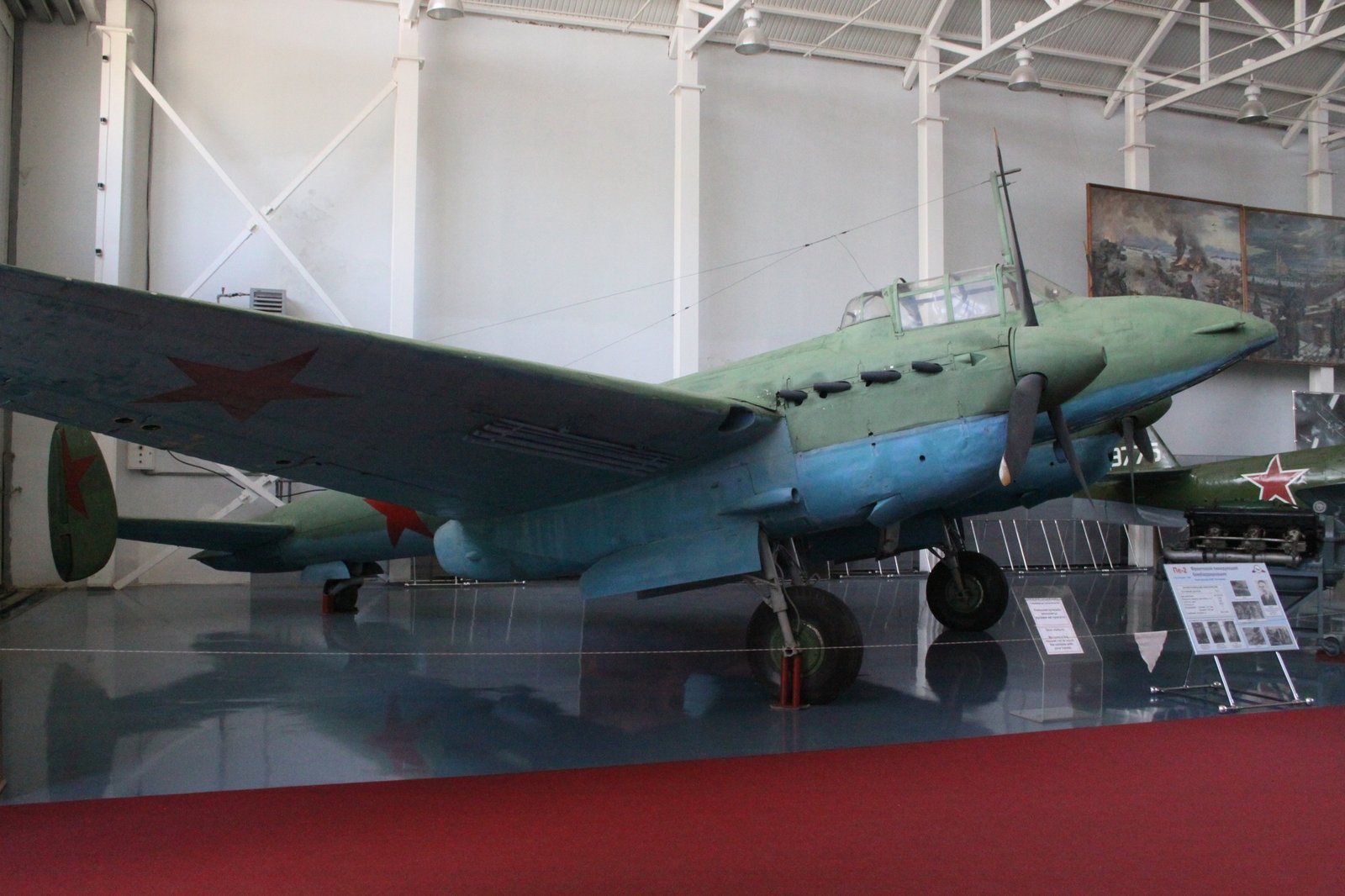
The Petlyakov Pe-2 was the primary twin-engine tactical bomber and dive bomber utilized by the Soviet Union during World War II. The aircraft's origins are rooted in the VI-100 high-altitude twin-engine fighter project, developed between 1939 and 1940 by a team led by Vladimir Mikhailovich Petlyakov. This development occurred under unusual circumstances, as Petlyakov had been arrested in 1937 and forced to work within a "sharashka," or special prison design bureau. The VI-100 prototype first flew in 1939, and a reworked bomber version was showcased during the May Day parade over Red Square on May 1, 1940. The first production-standard Pe-2 airframe flew on November 18, 1940, and the type was rushed into frontline service by March 1941.
Production of the Pe-2 was carried out by various Soviet state factories under the People’s Commissariat for the Aviation Industry (NKAP), with the Kazan Aircraft Production Association (Factory No. 22) serving as a primary manufacturing site. Total production figures vary slightly by source, with estimates ranging from 11,202 to 11,430 aircraft built between 1941 and 1945. The design was notable for its speed, reaching maximums of 540–580 km/h, and its specialized dive-bombing capabilities facilitated by structural reinforcement and dive brakes.
Technically, the Pe-2 was powered by two Klimov VK-105 series liquid-cooled V-12 piston engines, which provided between 1,050 and 1,210 hp each. The aircraft typically carried a crew of three: a pilot, a navigator/bombardier, and a radio-operator/gunner. Its payload included internal and external bomb racks capable of carrying 1,000–1,500 kg of ordnance, while defensive armament consisted of 7.62 mm ShKAS and 12.7 mm Berezin UBT machine guns.
During the Great Patriotic War, the Pe-2 operated across the Eastern Front from the start of Operation Barbarossa until the end of the conflict in 1945. It was employed by the Soviet Air Force (VVS RKKA) and Naval Aviation in roles ranging from tactical bombing and reconnaissance to night fighting (via the Pe-3 derivative). Notably, Pe-2s participated in raids against Romanian oil installations at Ploiești. While primarily a Soviet asset, Finland also operated captured Pe-2s. Today, the Petlyakov design bureau no longer exists as an independent entity, though the Kazan plant evolved into the Kazan Aviation Plant, currently a branch of Tupolev within the United Aircraft Corporation (UAC).