
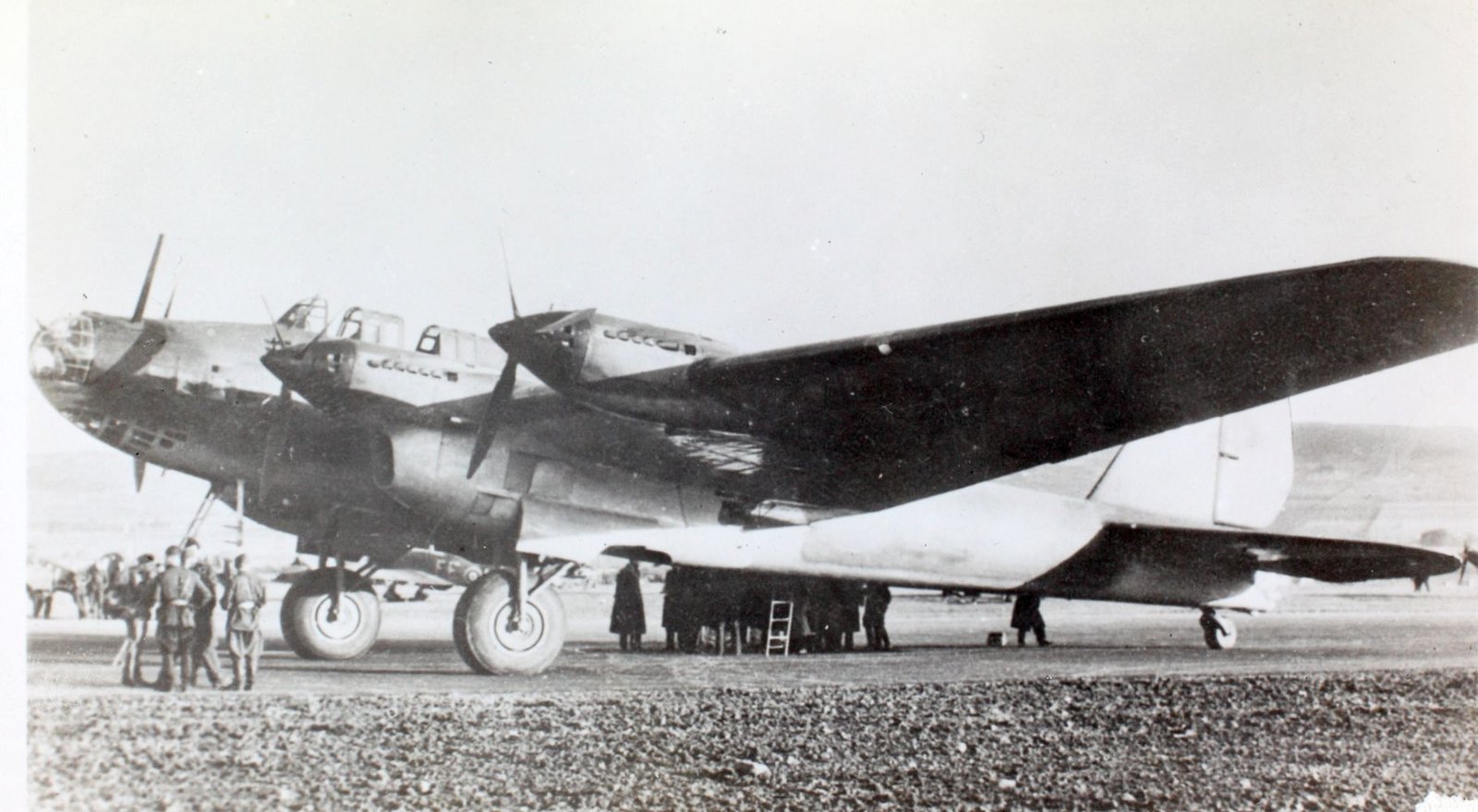
Design and Development
Designed by Vladimir Mikhailovich Petlyakov, the aircraft first took flight on December 27, 1936. Originally designated as the TB-7, the aircraft was later renamed the Pe-8 following Petlyakov's death in 1942. The design was a significant milestone for Soviet aviation, as it was the only four-engine bomber produced by the USSR during World War II. It was specifically engineered for long-range strategic operations and the ability to deliver massive bomb loads, including the 5,000 kg FAB-5000 bomb.
Production and Technical Specifications
Production took place at Aircraft Factory No. 124 in Kazan, a facility later known as the Kazan Aircraft Production Association (KAPO). Between 1936 and 1944, a total of 93 TB-7/Pe-8 aircraft were manufactured. While production began in the mid-1930s, the type is often cited as entering service in 1940 due to an extended period of prototyping and development.
Technically, the Pe-8 was powered by piston engines. Early production models utilized AM-35A engines, while later aircraft were fitted with M-82 engines after AM-35A production ceased. Performance figures vary by source and variant; one set of specifications lists a top speed of 275 mph, a service ceiling of 30,500 ft, and a range of 2,300 miles. Another source records a top speed of 440 km/h, a ceiling of 9,000 m, and a range of 3,600 km. The aircraft typically carried a crew of 11 and could transport up to 11,000 lb of conventional bombs.
Service History
Operating as a long-range heavy bomber for the Soviet Air Force, the Pe-8 targeted deep-strike objectives such as rail yards, airfields, and the city of Berlin. In July 1941, M. V. Vodopyanov formed the first combat unit of the type, which conducted a raid on Berlin in August 1941. Beyond combat, the aircraft was used for high-profile diplomatic missions, most notably a 1942 flight to the United States carrying V. M. Molotov, piloted by E. K. Pusep. Following their front-line service, some aircraft were repurposed as research and test platforms or converted into VIP transports.