
A Designer's Independent Vision
The F-20 Pegaso emerged from the entrepreneurial ambitions of Stelio Frati, one of Italy's most accomplished aircraft designers. After decades of creating successful designs for other manufacturers including Ambrosini, Aviamilano, Caproni, and SIAI Marchetti, Frati established Construzioni Aeronautiche General Avia in January 1970. Operating from a well-equipped facility in Milan's Bresso district with approximately two dozen employees, the company aimed to build prototypes of Frati's designs for licensing to larger manufacturers.
Development and Certification
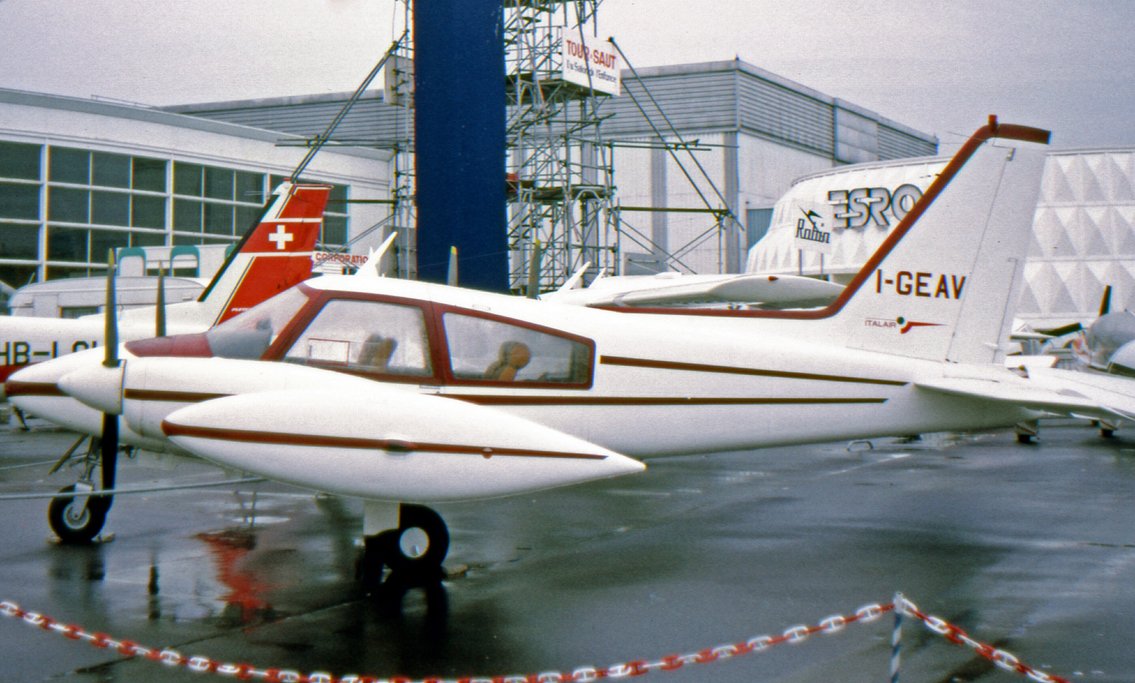
Work began on the first Pegaso prototype in September 1970, with the aircraft taking to the skies for its maiden flight on October 21, 1971, bearing the registration I-GEAV. The development program progressed with a second prototype, I-CBIE, which first flew on August 11, 1972. This second aircraft incorporated refinements and was slightly larger and heavier than its predecessor.
The certification process proved more complex than anticipated. Initially, Italair SpA of Bergamo—a company established by publisher Dr. Gianni Mazzocchi—was intended to handle series production and certification. However, financial constraints forced Italair to abandon the project, returning responsibility to General Avia. Despite these setbacks, the Pegaso achieved significant regulatory milestones, receiving RAI (Italian civil aviation authority) type approval on November 19, 1974, followed by FAA certification on May 14, 1975.
Technical Innovation
Frati designed the F-20 as an all-metal executive transport following his established philosophy of clean, efficient aerodynamics. The aircraft featured twin Continental IO-520-F or IO-520-K flat-six engines, each producing 300 horsepower. These horizontally opposed powerplants, manufactured by Continental Motors, were selected for their reliability and smooth operation characteristics essential for executive transport missions.
The post-certification aircraft incorporated several improvements over the prototypes, including enhanced cabin heating systems, improved soundproofing for passenger comfort, and three-blade Hartzell propellers that reduced noise and vibration. The first aircraft to benefit from these modifications completed its initial flight on December 17, 1979.
Limited Production Reality
Despite achieving dual certification and demonstrating at major aviation exhibitions—including the Turin show in 1972 and the Paris Air Show in 1973—the Pegaso never entered series production. Only three aircraft were ultimately completed: the two original prototypes and a third example, registered I-GEAA on July 8, 1981. This limited production reflected the challenging economics facing small aircraft manufacturers in the 1970s, particularly those attempting to compete in the crowded twin-engine executive transport market.
The prototypes saw operational service with Italian operators including Soc Italair, based between Bergamo and Genova-Sestri, and Soc General Avia, operating from Bresso and Bergamo. However, the aircraft's commercial impact remained minimal due to the absence of series production.
The Manufacturer's Trajectory
General Avia represented Frati's attempt to transition from freelance design work to comprehensive aircraft development and manufacturing. The company's business model focused on creating prototypes for licensing to established manufacturers with greater production capacity and market reach. Beyond the F-20 Pegaso, General Avia developed several other Frati designs, including the single SF.600 Canguro transport in 1978, the F.22 Pinguino in 1989, and notably, the turboprop-powered F.20TP Condor, which achieved its sole flight on May 7, 1983.
The company's specialized approach to prototype development reflected the realities of the Italian aviation industry, where design talent often exceeded manufacturing and marketing resources. General Avia eventually ceased aircraft manufacturing operations, though its work demonstrated the continued vitality of Italian aeronautical engineering during the 1970s and 1980s.
Turboprop Evolution
Recognizing market trends toward turbine power, Frati developed the F.20TP Condor variant, substituting Allison turboprop engines for the original Continental pistons. This derivative represented an attempt to modernize the basic design for contemporary executive transport requirements. However, like its piston-powered predecessor, the Condor remained a single prototype, highlighting the challenges facing independent aircraft developers in an increasingly consolidated industry.
Legacy and Historical Significance
The F-20 Pegaso occupies a unique position in aviation history as both a technical success and commercial disappointment. While achieving full certification in two major markets and demonstrating Frati's continued design excellence, it illustrated the difficulties facing small manufacturers attempting to establish new aircraft types during the 1970s economic climate.
The current status of the three Pegaso aircraft remains unclear, with no recent records confirming their continued airworthiness or museum preservation. Their story reflects the broader challenges of independent aircraft development, where technical achievement often proved insufficient to overcome market and financial realities. The Pegaso stands as a testament to the ambitions of one of Italy's most talented designers and the risks inherent in transforming innovative concepts into commercial success.