
Service History
The Penguin C achieved remarkable market penetration for a tactical unmanned aircraft, with sales reaching over 35 countries by 2018. Production totaled approximately 100 units, establishing the platform as a benchmark for extended-endurance surveillance missions. By 2018, the global Penguin C fleet had accumulated more than 4,000 flight hours, demonstrating exceptional reliability in professional operations ranging from military reconnaissance to law enforcement patrol duties.
The aircraft's non-ITAR classification proved crucial to its international success, allowing unrestricted global sales where competing American platforms faced export limitations. This regulatory advantage enabled UAV Factory to penetrate markets previously dominated by larger defense contractors.
Military Operations
The United States Army committed to the Penguin series in July 2022, marking a significant milestone for the Latvian-designed platform. Military operators primarily employ the Penguin C for intelligence, surveillance, and reconnaissance missions, taking advantage of its silent operation capability at altitudes up to 10,000 feet. The aircraft's low acoustic signature, achieved through its pusher propeller configuration and specialized muffler system, makes it particularly valuable for covert surveillance operations.
Unlike armed tactical drones, the Penguin C focuses exclusively on observation and intelligence gathering, carrying gyro-stabilized electro-optical and infrared sensors rather than weapons systems. This specialization has made it attractive to military units requiring persistent area surveillance without escalatory implications.
The Manufacturer
UAV Factory was established in 2009 in Latvia as a vertically integrated unmanned aircraft manufacturer, producing both airframes and specialized payloads including their Octopus ISR sensor systems. The company built its reputation on the earlier Penguin B platform, which achieved a world record 54.5-hour endurance flight in 2012, demonstrating the fundamental soundness of their design approach.
In early 2022, UAV Factory merged with Jennings Aeronautics and rebranded as Edge Autonomy, maintaining operations in both Latvia and the United States. This corporate evolution allowed the company to better serve American military customers while preserving its European manufacturing capabilities and engineering expertise.
Engine and Technical Innovation
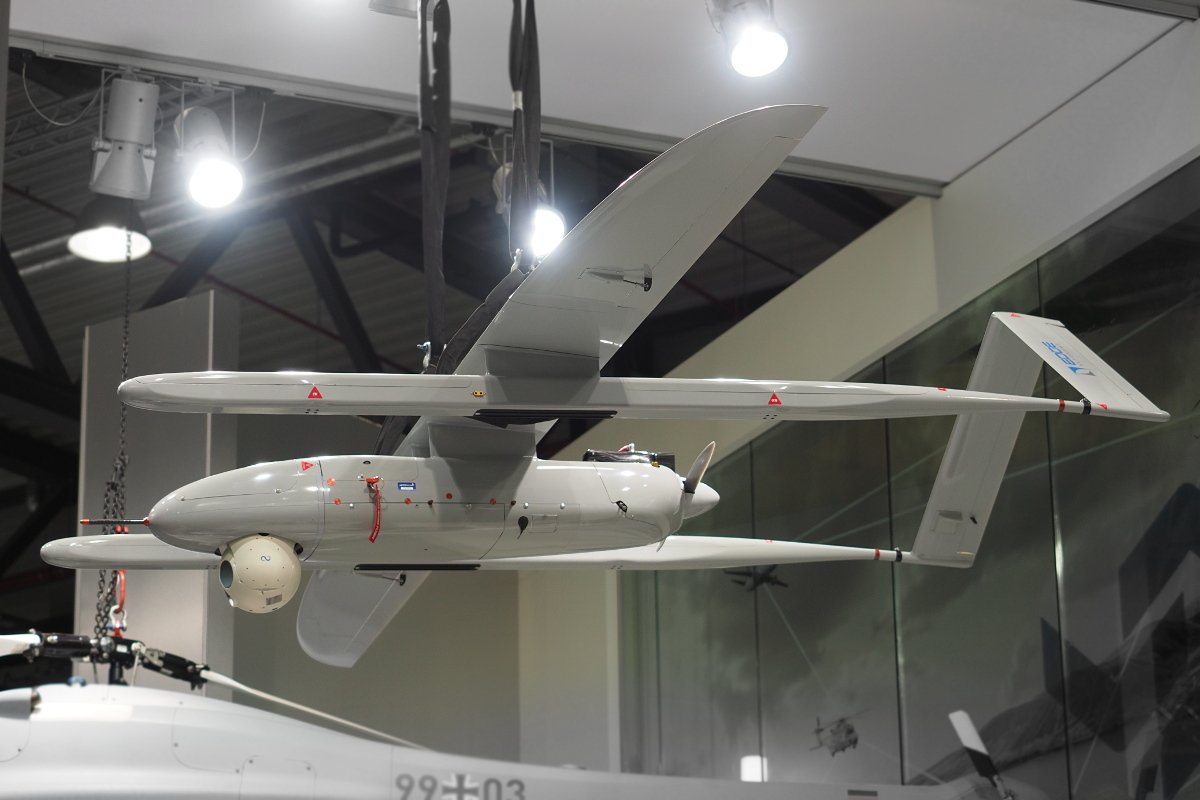
The Penguin C's propulsion system centers on a 28cc electronic fuel-injected two-stroke engine driving a two-bladed pusher propeller. This powerplant incorporates a 100-watt onboard generator to supply electrical power for avionics and payload systems during extended missions. The engine operates reliably in extreme temperatures from -40°C to +50°C, using standard 98-octane gasoline with integrated cooling systems.
The aircraft's twin-boom configuration features inward-canted vertical stabilizers that enhance aerodynamic efficiency during long-duration flights. This design choice, combined with the high-wing layout, provides inherent stability crucial for precision sensor operations. The entire propulsion module can be swapped in the field, reducing maintenance downtime.
Operational Characteristics
Pilots operate the Penguin C through a two-person ground control station, though the aircraft can execute fully autonomous missions once programmed. Launch requires less than one hour of setup time using a pneumatic catapult system designed for unimproved terrain operations. The aircraft tolerates winds up to 30 knots, making it suitable for challenging environmental conditions.
Recovery occurs via parachute deployment with pinpoint landing algorithms that minimize ground impact and aircraft damage. This system eliminates the need for prepared runways while ensuring consistent recovery performance across diverse terrain types.
Cruise performance ranges from 68 to 79 kilometers per hour, with a maximum speed of 50 miles per hour. The 20-plus hour endurance capability allows operators to maintain persistent surveillance over areas of interest with minimal logistics support. Operational range extends to 100 kilometers from the control station, providing substantial tactical flexibility.
Production Legacy
The Penguin C spawned the Penguin C Mk2 VTOL variant in August 2021, incorporating vertical takeoff and landing capabilities while maintaining 14-plus hour endurance. This evolution demonstrated the adaptability of the basic design to emerging operational requirements.
The platform's success influenced the broader tactical UAV market by proving that smaller manufacturers could compete effectively against established defense contractors through focused engineering and regulatory advantages. The Penguin C's combination of extended endurance, operational simplicity, and international availability created a new category of accessible long-duration surveillance platforms.
Today, the aircraft remains in active production under Edge Autonomy, with ongoing military and civilian operations worldwide. While exact numbers of currently flying aircraft remain undisclosed, the platform's continued production and recent U.S. Army adoption suggest sustained operational relevance in an increasingly crowded UAV marketplace.