
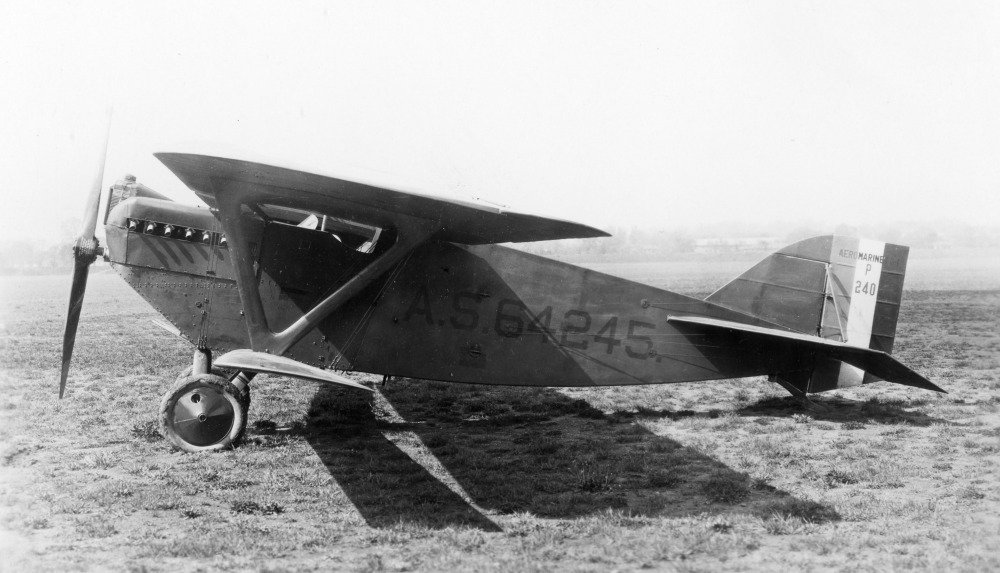
The Aeromarine PG-1 was a specialized, single-seat biplane developed for the United States Army shortly after World War I. Designed to fulfill a dual role as both a pursuit (fighter) and ground-attack aircraft, it was intended to perform aerial defense and ground strafing missions. The basic design originated with the U.S. Army Engineering Division at McCook Field, while the Aeromarine Plane and Motor Company of Keyport, New Jersey, served as the manufacturing contractor.
In May 1921, Aeromarine was selected to manufacture three PG-1 prototypes. The aircraft featured a distinctive and heavy armament suite for the early 1920s, consisting of a 37 mm Baldwin cannon that fired through the propeller hub and a single 0.5 inch (12.7 mm) machine gun. To protect the pilot during low-level attack missions, the cockpit was equipped with 1/4-inch armor. The prototype first took flight on August 22, 1922, powered by a 346 hp (258 kW) liquid-cooled Packard 1A-1116 piston engine.
Technically, the PG-1 was a large aircraft with a wingspan of 40 feet, a length of 24 feet 6 inches, and a wing area of 389 square feet. It had an empty weight of 3,030 lb and reached a maximum speed of 130 mph. Other performance metrics included a service ceiling of 19,000 feet, a range of 195 miles, and a rate of climb of 684 feet per minute. Despite these specifications, the aircraft performed poorly during testing and was described by historical accounts as an "aeronautical disaster."
Due to its poor flight characteristics, the U.S. Army abandoned the program between 1922 and 1923. The PG-1 never reached operational squadron service and remained a test-and-evaluation type. This failure marked the end of Aeromarine's military aircraft production for the U.S. armed forces. The company, which had previously found success with Model 39 and 40 naval trainers, eventually shifted toward commercial aviation with Aeromarine Airways. The firm was renamed the Aeromarine-Klemm Corporation in 1928 before closing permanently in 1930 during the Great Depression. No examples of the PG-1 are known to survive today.