
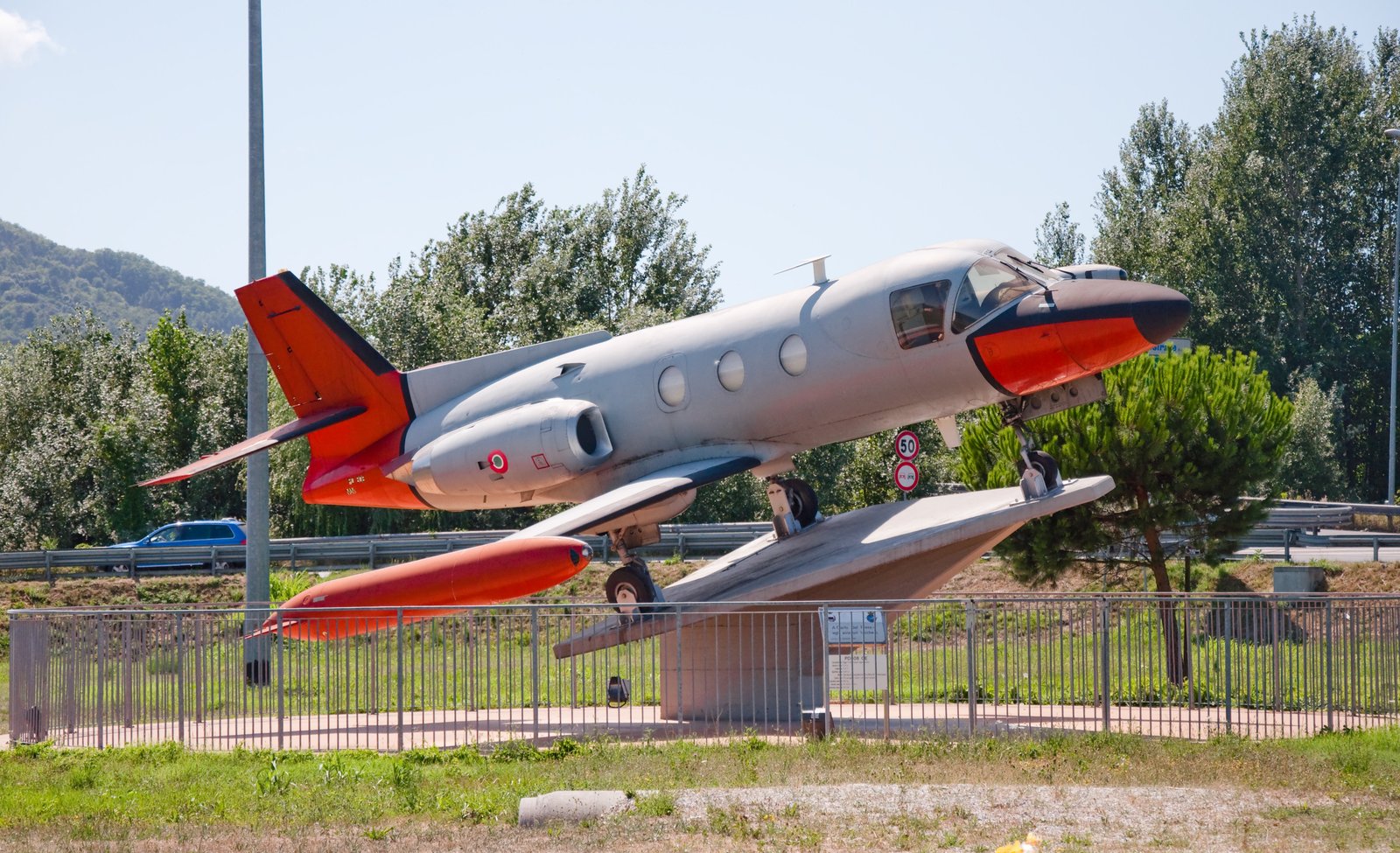
The Piaggio PD.808 was a twin-jet business and utility aircraft developed by the Italian manufacturer Rinaldo Piaggio S.p.A. in cooperation with the Douglas Aircraft Company. Conceived as a corporate aircraft capable of seating between six and ten passengers, the PD.808 represented a milestone in Italian aviation as the nation's first indigenous business jet. The aircraft's development was characterized by a unique partnership between Italian and American aerospace interests.
Production began in the mid-1960s, though sources vary regarding the exact date of the first flight, citing either August 29, 1964, or August 29, 1965. A total of 29 aircraft were manufactured, including prototypes. The aircraft was powered by two turbojet engines, with specifications listing either the Piaggio / Rolls-Royce Viper Mk 526, producing 14.7 kN (3,300 lbf) of thrust each, or the R-R (Bristol Siddeley) Viper 525, which provided 15.24 kN of thrust per engine.
While intended for the commercial market, civilian interest in the PD.808 remained weak. Only two seven-seat business jets were sold to commercial buyers. Despite attempts to attract more operators by proposing a variant equipped with General Electric CJ610 engines, the aircraft failed to gain significant traction in the civil sector. Consequently, the PD.808 found its primary utility in military service with the Italian Air Force (Aeronautica Militare), which operated 22 aircraft from 1970 until 2003. All but two of the series aircraft served with the Italian military.
The Italian Air Force utilized the PD.808 in various specialized roles. These included the PD-808TA for navigation training and the PD-808P for VIP transport. Specialized variants were developed for technical missions, such as the PD-808RM (radiomisure) for radio calibration—with production estimates for this variant conflicting between four and twelve units—and the PD-808GE (guerra elettronica) for electronic warfare. The PD-808GE1 entered service in 1972, followed by the PD-808GE2 in 1977.
Technically, the PD.808 was capable of reaching a maximum speed of 852 km/h (460 kt) and a cruise speed of 722 km/h. It featured a service ceiling of approximately 13,715 meters (45,000 ft) and a range between 2,100 km and 2,128 km. Its performance included a sea-level rate of climb of 27.5 m/s. The aircraft was operated by a crew of two and could accommodate up to nine passengers depending on the configuration.