
Production and Manufacturer History
The English Electric P.5 Kingston was manufactured by the English Electric Company Limited, a firm established on December 17, 1918, through the amalgamation of several engineering companies, including Dick, Kerr & Co. During the inter-war period, the company produced a small number of aircraft, such as the Wren and the Cork, before later becoming known for major designs like the Canberra jet bomber. The Kingston was produced in very small numbers, with a total of only six aircraft built. While specific production dates are not documented, the aircraft entered service in the mid-1920s. The original manufacturer eventually merged into the British Aircraft Corporation (BAC) in the early 1960s, which later became part of British Aerospace (BAe) and subsequently BAE Systems.
Design and Technical Specifications
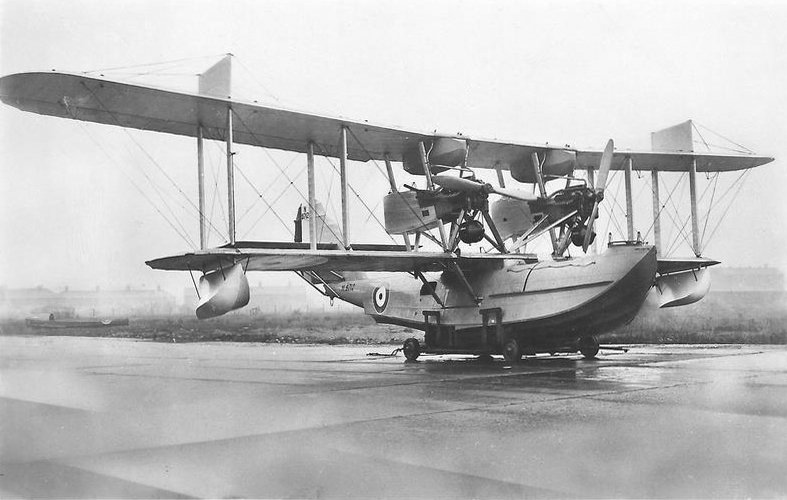
The Kingston was developed as a redesign of the English Electric Cork to satisfy Air Ministry Specification 23/23. The original design team for the Cork was led by W. O. Manning in 1922, and the Kingston evolved from this work as a production-standard version featuring a reworked hull and structure. The aircraft first flew on May 22, 1924. It was configured as a twin-engine biplane hull flying-boat with a wingspan of 85 ft 6 in and a length of 52 ft 9 in. The crew consisted of six members: a pilot, an observer, an engineer, and three gunners.
Powerplant and Performance
Power was provided by two D. Napier & Son Napier Lion IIIB 12-cylinder "broad-arrow" piston engines, each producing 450 hp (336 kW) for a total output of 900 hp. This configuration allowed the Kingston to reach a maximum speed of 104.8 mph (169 km/h) and achieve a service ceiling of 9,060 ft. Designed for long-endurance maritime operations, the aircraft possessed an endurance of 8 to 9 hours. Its maximum takeoff weight was 14,508 lb, with an empty weight of 9,130 lb.
Military Service and Legacy
Intended for the Royal Air Force, the Kingston's primary roles were coastal patrol and anti-submarine reconnaissance. To support these missions, it was armed with three 0.303 in (7.7 mm) Lewis machine guns and could carry a bomb load of up to 1,040 lb. Despite its specialized role, there are no records of the Kingston participating in major conflicts, as it operated during the inter-war period. Due to its limited production run and the passage of time, no surviving airframes are documented in museums or private collections. The P.5 Kingston remains a significant example of the transition from experimental WWI-era flying-boats to more mature maritime patrol aircraft.