
Service History
The PL-1's impact on aviation extended far beyond its homebuilt origins. Nearly 400 sets of plans were sold before production ceased, establishing Pazmany's reputation in the experimental aircraft community. The design's credibility reached new heights when Taiwan's Aerospace Industrial Development Corporation (AIDC) selected it for licensed military production, building 58 PL-1B variants starting with the first evaluation aircraft on October 26, 1968.
Military Operations
The Republic of China Air Force adopted the PL-1B Chieh Shou as a primary trainer, recognizing its exceptional aerobatic capabilities and reliability. One aircraft was personally presented to Generalissimo Chiang Kai-shek in 1968, highlighting the design's political and military significance. The success in Taiwan led other air forces to embrace Pazmany designs, with the Republic of Korea Air Force operating the Saemaeho variant and the Indonesian Air Force using the related LT-200.
The Royal Thai Air Force assembled two PL-2 variants in 1974 for evaluation, with one surviving example now displayed at the RTAF Museum. Sri Lanka Air Force operated modified PL-2 variants until the early 1980s, while South Vietnam's air force received one PL-2 named Tien Phong ("Pioneer") built under U.S. supervision, though plans for additional aircraft were cancelled in 1972.
The Manufacturer
Ladislao Pazmany founded Pazmany Aircraft Corporation in San Diego, California, in the early 1960s after working as an aeronautical engineer. The PL-1 originated from an EAA chapter group effort, representing Pazmany's first complete aircraft design. The company operated through the 1960s, shifting focus to the improved PL-2 after 1968, and continued developing aircraft including the PL-9 Stork starting in 1990.
Pazmany's contributions to homebuilt aviation earned him induction into the EAA Hall of Fame in 1997. His role in the EAA's first real-world evaluation of homebuilt aircraft at Oshkosh in 1970 helped establish credibility for amateur-built designs. The company is no longer in business, but Pazmany's designs continue influencing homebuilt aircraft development worldwide.
Engine & Technical Details
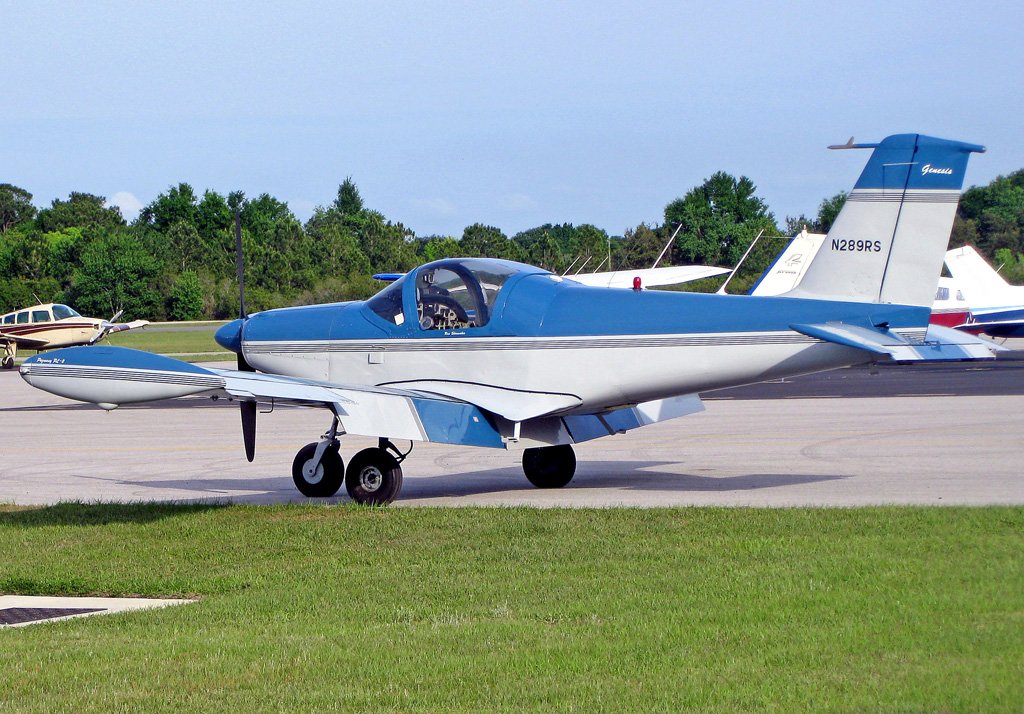
The original PL-1 prototype utilized a 95-horsepower Continental C-90 flat-four piston engine, providing adequate power for its 800-pound empty weight. The Taiwanese PL-1B variants featured the more powerful 150-horsepower Avco Lycoming O-320-E2A, improving performance for military training requirements.
Pazmany incorporated several innovative features, including laminar flow wings for enhanced efficiency and two 13-gallon fiberglass wingtip fuel tanks providing 600-mile range. The sliding canopy offered excellent visibility, while the metal and fiberglass construction simplified amateur building while maintaining structural integrity for aerobatic operations.
Pilot Perspective
Pilots praised the PL-1's sensitive controls and clean aerodynamics, making it an excellent trainer for both basic flight instruction and aerobatic training. With a maximum speed of 152 mph and cruise speed of 115 mph, the aircraft provided modern performance in a simple package. The 51-mph stall speed offered forgiving handling characteristics for student pilots.
Operational statistics demonstrate exceptional safety, with a near-perfect safety record over 50 years of service. The aircraft's 1,000-feet-per-minute climb rate and 18,000-foot service ceiling provided adequate performance for most training scenarios, while the short 550-foot takeoff and 175-foot landing distances enabled operations from small airfields.
Production & Legacy
While Pazmany never mass-produced the PL-1, the design's influence spread globally through plan sales and licensed production. The 58 aircraft built by AIDC in Taiwan represented the largest production run, proving that homebuilt designs could meet military manufacturing standards.
At least one example, New Zealand's ZK-PAZ (construction number AACA/175), was built by Bruce Fraser of Christchurch and registered on December 8, 1977, with a 115-horsepower O-235 engine. This aircraft remained active into the 1980s, representing the dedication of homebuilders worldwide who recognized the design's exceptional qualities.
The PL-1's legacy extends beyond individual aircraft to its role in legitimizing homebuilt aviation. Its adoption by multiple air forces demonstrated that amateur-built designs could achieve professional standards, paving the way for today's sophisticated homebuilt aircraft industry. Examples continue flying in various countries, testament to the design's enduring appeal and Pazmany's engineering excellence.