
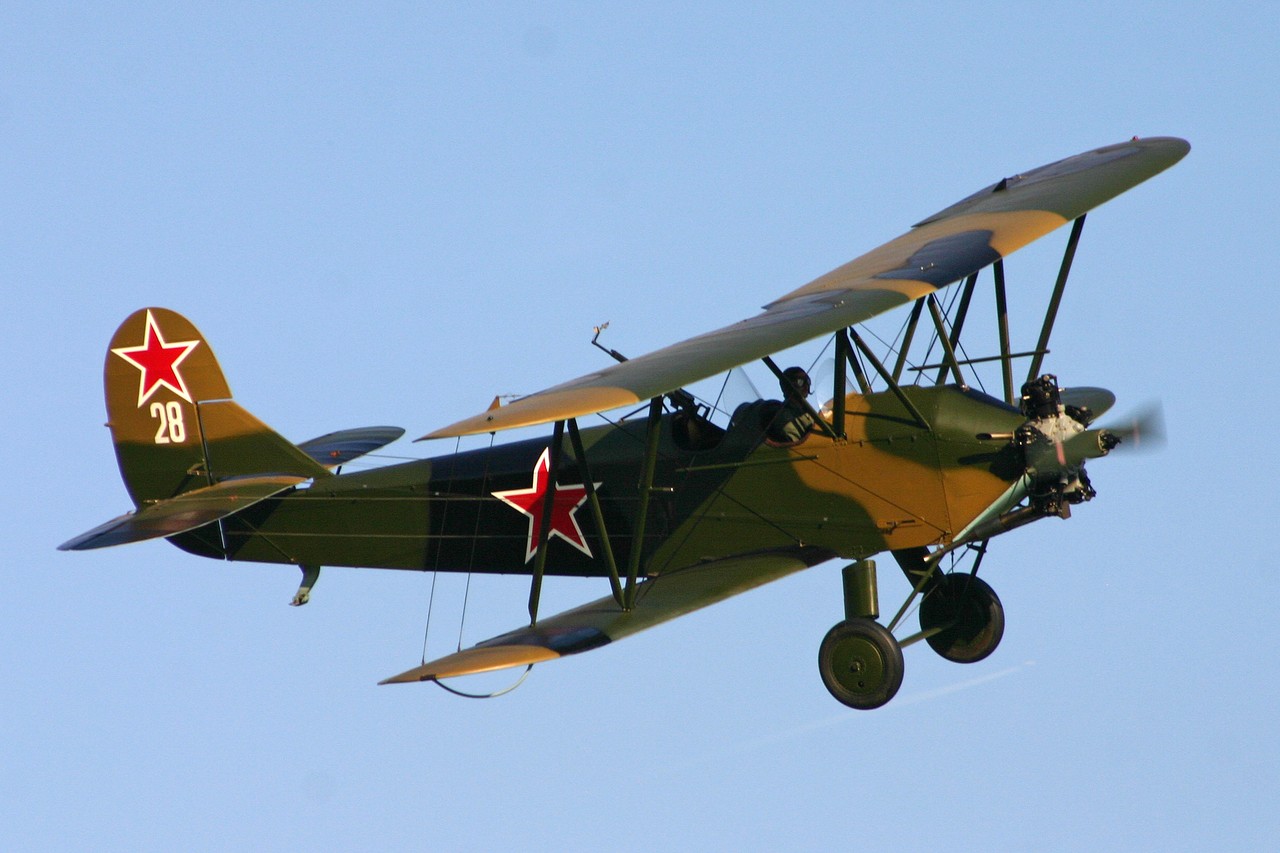
Service History
The Po-2 dominated Soviet aviation training and utility operations for over three decades, becoming the backbone of flying clubs that proliferated across the USSR during the 1930s. By the outbreak of World War II, the aircraft had established itself as indispensable to Soviet aviation, with production ramping up dramatically during wartime. Between 1941 and 1945, four separate plants manufactured the aircraft, including facilities in Leningrad and Kazan, the latter chosen to avoid German bombing raids.
Wartime Operations
Despite being completely outclassed by contemporary military aircraft, the Po-2 served extensively during World War II in roles never envisioned by its designers. Soviet forces employed it for liaison duties, medical evacuation, supply transport, reconnaissance, and even light bombing missions behind enemy lines. The aircraft's STOL capabilities proved invaluable for supporting partisan operations in occupied territory.
The Po-2 achieved a unique distinction in aviation history as the only biplane to shoot down a jet aircraft, a remarkable feat that underscored its unexpected versatility. Perhaps most famously, it served with the 46th Guards Night Bomber Regiment, the all-female unit known as the "Night Witches," who conducted harassment bombing raids under cover of darkness. The Po-2GN variant featured loudspeakers for psychological warfare operations, broadcasting propaganda messages over enemy positions.
The Manufacturer
Nikolai Nikolayevich Polikarpov led the aircraft's development in 1927-1928 within the Soviet state-controlled aircraft industry. Originally designated U-2 (from the Russian "Uchebny," meaning training), the aircraft was posthumously renamed Po-2 in July 1944 following Polikarpov's death from cancer. The designer had created what would become his most successful aircraft, replacing the aging U-1 trainer, itself a copy of the British Avro 504.
Production expanded internationally with Poland obtaining manufacturing rights in 1948. Polish factories WSK Mielec and WSK Okęcie Warszawa produced over 550 CSS-13 variants between 1948 and 1955 under license from Centralne Studium Samolotów in Warsaw.
Engine and Technical Innovation
The aircraft's success stemmed largely from its powerplant, the Soviet-designed Shvetsov M-11 air-cooled five-cylinder radial engine. The prototype flew with a 99-horsepower M-11, while later variants employed the 115-horsepower M-11K and eventually the 160-horsepower M-11FR. This engine family's reliability and simplicity perfectly matched Polikarpov's design philosophy of creating an uncomplicated aircraft suitable for mass production and operation in remote locations.
The Po-2's forgiving flight characteristics made it ideal for training inexperienced pilots, while its robust construction allowed operations from unprepared airstrips across the vast Soviet territory. These qualities ensured its longevity in service well beyond its apparent obsolescence.
Civilian Applications
Beyond military service, the Po-2 earned the nickname "Kukuruznik" (maize cutter) for its extensive agricultural applications. The U-2AP agricultural variant, a single-seat crop duster introduced by 1933, saw 1,235 units built between 1930 and 1940. Aeroflot operated the type for civilian transport and communication duties, with assembly continuing in the airline's repair workshops until 1959, a full decade after primary Soviet production ended in 1949.
Production Legacy
The Po-2's production figures remain debated, with estimates ranging from 20,000 to over 40,000 aircraft when including all variants and international production. This massive output likely makes it the most-produced aircraft in history, certainly among biplanes. As of 1978, it held the record for the longest production run of any Soviet-era aircraft.
Yugoslav forces operated Po-2s until 1959, while Polish CSS-13 variants served until 1955. The aircraft's global reach extended far beyond the Soviet sphere, with multiple countries adopting the reliable trainer for their own aviation programs.
Current Status
Despite enormous production numbers, fewer than 20 Po-2s survive today, with only approximately a dozen remaining airworthy. One notable survivor operates in New Zealand as the only flying example in the Southern Hemisphere, a testament to dedicated preservation efforts. The aircraft's rarity today contrasts sharply with its ubiquity during the Soviet era, when it seemed destined to train pilots indefinitely across the communist world.