
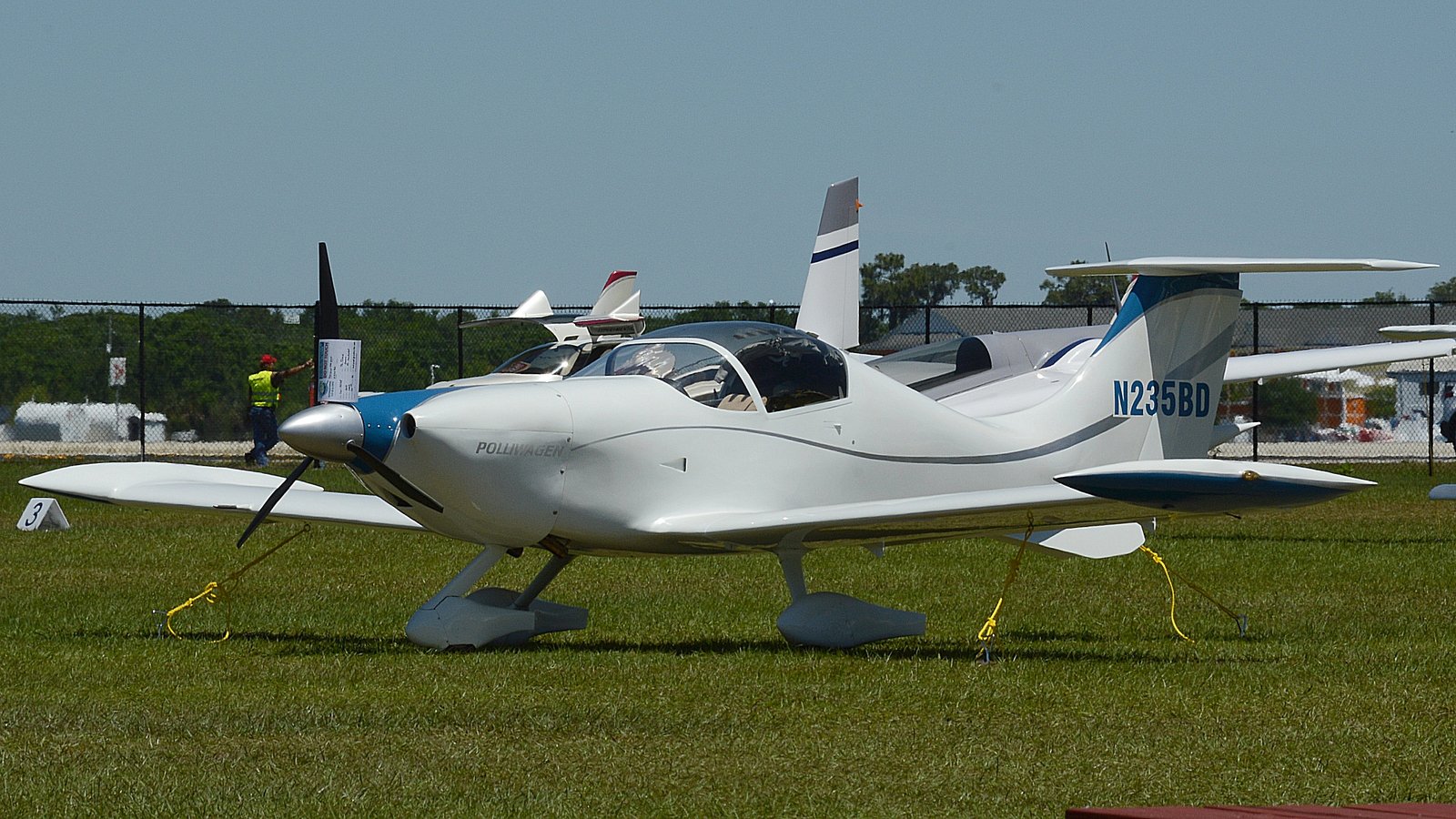
Development and Innovation
Joseph P. Alvarez, an Argentine-born designer based in Chino, California, developed the Polliwagen to address a significant gap in homebuilt aviation: achieving high performance while maintaining the cost advantages of Volkswagen powerplants. Unlike typical VW-powered aircraft of the era, Alvarez incorporated advanced sailplane technology, including Wortmann wing sections, drooping ailerons, and flaps capable of 90-degree deflection.
Alvarez conducted extensive preliminary testing using a one-quarter scale radio-controlled model before beginning full-scale construction. The prototype, registered as N176PW, required approximately 1,200 working hours to complete. After three years of developmental work following the first flight, Alvarez officially introduced the design at the Oshkosh fly-in in 1980.
Market Reception and Production
The homebuilding community showed immediate interest in the Polliwagen's promise of 170 mph cruise speeds from a Volkswagen engine. By the end of 1980, Polliwagen Inc. had sold over 500 sets of plans. A second prototype, N1035S, was registered by Alvarez and partner Paul on June 16, 1979, demonstrating the design's refinement.
The aircraft's international appeal extended to Australia, where kits were imported in the mid-1980s. The first Australian-built example, VH-PWG, was registered on November 9, 1998, powered by a Continental O-200 engine. Two additional Australian aircraft followed: VH-JPH with a Volkswagen 2100D engine in July 1999, and VH-WPW featuring an innovative Subaru EA-81 conversion in November 2003.
Construction and Configuration
The Polliwagen represented a significant advancement in homebuilt construction techniques. The fuselage and wings utilized fiberglass epoxy composite construction with foam cores, pre-molded in vacuum-bagged female molds. This manufacturing approach was relatively sophisticated for homebuilt aircraft of the early 1980s.
The aircraft's distinctive configuration featured integral tip tanks, a swing-up canopy for cockpit access, and fully retractable tricycle landing gear. With a wing area of 90 square feet and empty weights ranging from 600 to 950 pounds depending on engine installation, the design achieved wing loadings of approximately 14 pounds per square foot.
Powerplant Options
While originally designed around the 75-horsepower Revmaster 2100 D Turbo, a modified Volkswagen 2,100cc automobile engine, the Polliwagen proved adaptable to various powerplants. Alternative installations included the Continental O-200 producing 100 horsepower and the 160-horsepower Lycoming O-320. Many builders later upgraded to Lycoming O-360 engines, often requiring fuselage modifications to accommodate the larger powerplant.
The original configuration featured a sophisticated Maloof two-blade controllable-pitch propeller with two positions plus feathering capability. Later variants adopted three-bladed constant-speed Airmaster Composite propellers, reflecting the evolution toward more powerful engine installations.
Performance and Handling Challenges
The Polliwagen achieved impressive performance figures for its class, with maximum speeds reaching 250 mph and cruise speeds between 160-180 mph. The aircraft demonstrated remarkable climbing ability, with rates between 700-1,400 feet per minute, and service ceilings extending to 28,000 feet in high-performance configurations. Low-speed handling proved equally impressive, with stall speeds as low as 33 mph.
However, the design's notably short fuselage aft of the wing created significant pitch control challenges. This characteristic became the aircraft's primary limitation, contributing to handling difficulties that many builders addressed through fuselage extensions. The National Transportation Safety Board recorded only six Polliwagen accidents, but four occurred during first or second flights, suggesting the importance of pilot familiarity with the aircraft's unique characteristics.
Legacy and Decline
Despite initial enthusiasm, the Polliwagen's popularity proved short-lived. Of approximately 45 aircraft added to the U.S. registry over the production period, only two remained registered as of January 2021. The rapid decline reflected both the aircraft's challenging handling characteristics and the complexity of its composite construction, which required skills beyond those of many amateur builders.
The Polliwagen's historical significance lies in its pioneering use of composite construction techniques and sailplane-derived aerodynamics in homebuilt aviation. While the design failed to achieve lasting success, it demonstrated the potential for sophisticated amateur-built aircraft and influenced subsequent composite homebuilt designs. Today, the few remaining examples serve as testaments to an ambitious attempt to revolutionize Volkswagen-powered aviation through advanced materials and aerodynamic refinement.