
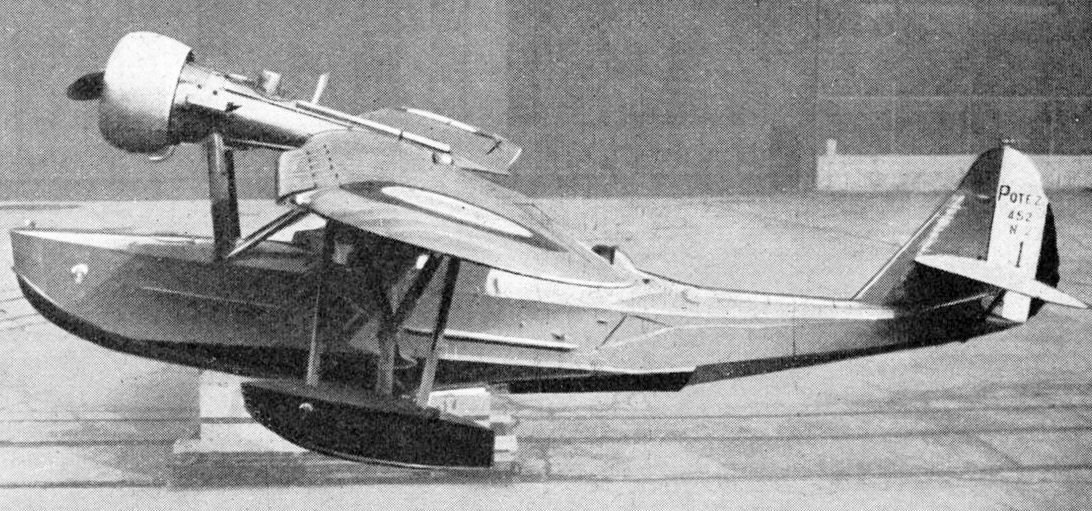
The Potez 452 was developed in 1929 as a compact, two-seat observation aircraft specifically tailored for the requirements of the French Marine Nationale. Its primary design objective was to serve as a shipboard reconnaissance seaplane capable of being launched via catapult from various naval vessels, a specialized operational role common in interwar naval aviation. While the Potez 450 first flew in March 1932, the Potez 452 itself is recorded as having its first flight on April 15, 1932.
Production of the aircraft was handled through a partnership between Potez and Chantiers Aéro-Maritimes de la Seine (CAMS). The type was officially adopted for service in 1935, with the first production batch delivered to the navy in 1936. Records indicate that at least 17 aircraft were completed in the initial run. Subsequent orders for an additional six aircraft suggest a total production target of 23 units, although it remains unconfirmed if every aircraft in that second order was delivered.
Technically, the Potez 452 was powered by a Hispano-Suiza 9 Qd, a 9-cylinder air-cooled radial piston engine producing 350 ch (approximately 260 kW). The aircraft's physical dimensions included a wingspan of 12.995 meters, a length of 10.230 meters, and a height of 3.400 meters, with a total wing area of 24.30 square meters. It had an empty weight of 1,102 kg and a maximum takeoff weight of 1,750 kg, though its gross weight was limited to 1,701 kg when configured for catapult launch. For defense, the aircraft was equipped with a single 7.5 mm flexible machine gun located in the rear cockpit.
In operational service, the Potez 452 was deployed aboard the cruiser La Motte-Picquet and several colonial avisos starting in 1936. By the start of World War II, at least nine aircraft remained active, including four stationed in Indochina. The aircraft achieved a top speed of 217 km/h at an altitude of 2,000 meters and a cruise speed of roughly 100 km/h. Its performance specifications included a service ceiling of 5,500 meters and a climb rate of 2,000 meters in 7 minutes and 15 seconds, with a total flight endurance of 5 hours and 10 minutes. All surviving airframes were lost during wartime operations, with the final recorded flights occurring between 1943 and 1944. No examples of the Potez 452 are known to have survived into the modern era.