
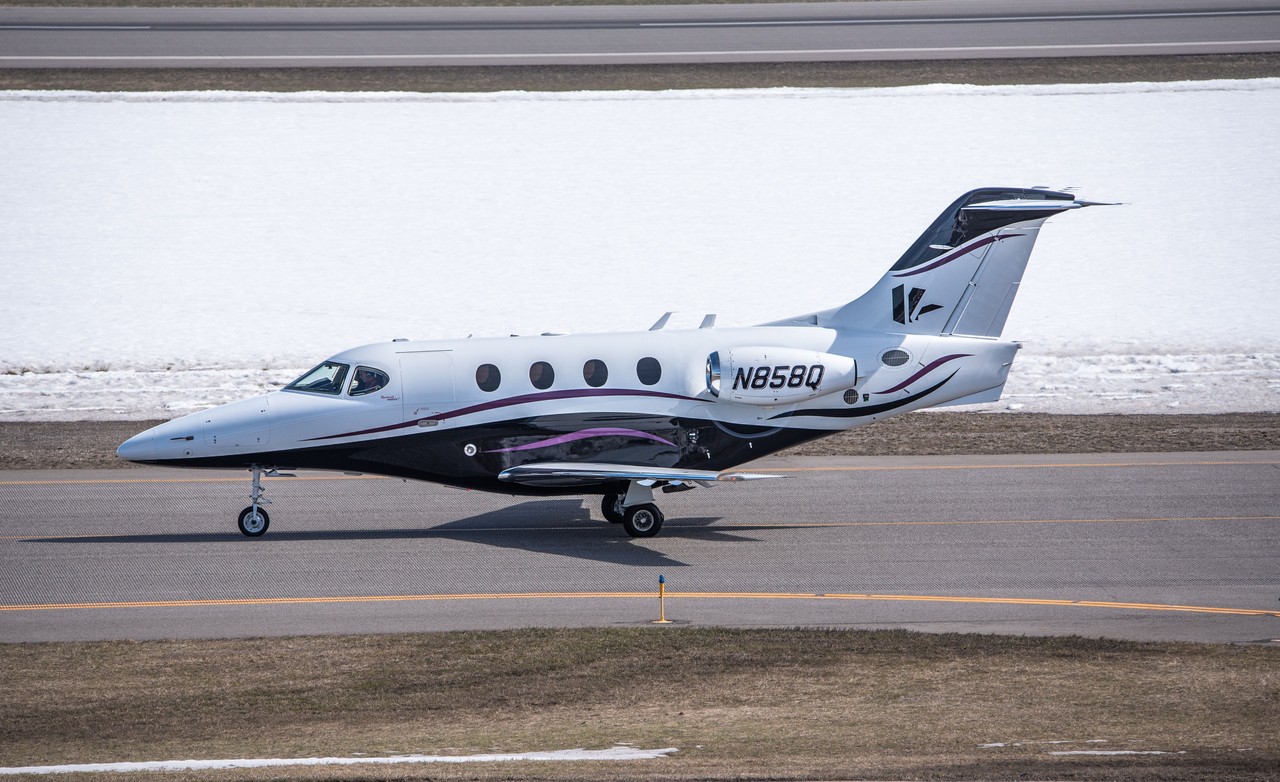
Development and Innovation
Design work on the Premier I began in early 1994 under the project designation PD-374, later changed to PD-390. Raytheon Aircraft's engineering teams in Wichita, Kansas aimed to create a light business jet that could compete directly with the Cessna CitationJet while incorporating revolutionary composite construction. The aircraft was initially priced at $5 million, later rising to $7 million for the improved IA variant.
The prototype N390RA, construction number RB-1, was rolled out on August 19, 1998, and achieved first flight on December 22, 1998. Four prototypes accumulated over 1,400 flight hours during the certification program before the FAA granted FAR Part 23 certification on March 23, 2001. The Premier I represented several aviation firsts, including the first composite-fuselage business jet certified by the FAA and innovative manufacturing techniques such as high-speed wing machining at 93 square meters per minute.
Manufacturing Heritage
The Premier I emerged from a complex corporate lineage beginning with Beech Aircraft Corporation, founded in 1932 by Walter and Olive Ann Beech. Raytheon acquired Beech in 1980, and the Premier I became the first aircraft to carry solely the Raytheon name rather than the traditional Beechcraft branding. Following a management buyout in 2006, the company became Hawker Beechcraft, operating until bankruptcy in 2012. Textron Aviation acquired the assets in 2014 and continues business jet production under the Beechcraft brand.
All 290-295 Premier I aircraft were manufactured at the Wichita facility, with deliveries commencing in the third quarter of 2001. The first three production aircraft went to Tyrose Investments, Raytheon, and Town & Country Food Markets. Production milestones included the 100th fuselage completion on July 24, 2003, with 65 aircraft delivered by September 2003.
Technical Specifications and Performance
Power comes from twin Williams FJ44-2A turbofan engines, each producing 2,300 pounds of thrust and flat-rated to ISA +13°C. These compact powerplants feature 3,500-hour inspection intervals and enabled the Premier I to achieve single-pilot certification in the sub-20,000 pound category. The Williams FJ44 series became widely adopted across multiple business aircraft platforms for its reliability and efficiency.
The aircraft's composite fuselage construction provided significant weight savings compared to traditional aluminum designs. The cabin measures 13 feet 6 inches long, 5 feet 6 inches wide, and 5 feet 5 inches high, accommodating six to seven passengers in typical configurations. Fuel capacity reaches 3,670 pounds with a maximum payload of 1,400 pounds and baggage volume of 76.9 cubic feet.
Operational Characteristics
Pilots praised the Premier I for bringing twin-turbofan capability to single-pilot operations, though early aircraft experienced challenges with runway performance, braking systems, and noise levels. These issues were addressed in the Premier IA variant, certified on September 22, 2005. The IA incorporated upgraded brakes, improved avionics, and enhanced cabin appointments while maintaining the same basic performance envelope.
With a top speed of 451 knots and maximum range of 1,365 nautical miles, the Premier I found its niche in short business trips typically lasting one to two hours. Charter operators frequently employed the type for routes like London to Nice, completed in 1 hour 40 minutes. The aircraft's service ceiling exceeds 41,000 feet, providing access to efficient cruise altitudes above most weather systems.
Production Variants
Two main variants entered production during the program's eleven-year run. The original Premier I served as the foundation model with deliveries from 2001 through 2005. The Premier IA, representing the majority of production with 163 units built between 2006 and 2012, carried serial numbers from 160 through 305 and beyond. The IA variant addressed early operational concerns while expanding the aircraft's capabilities in the competitive light jet market.
Legacy and Current Status
Production concluded in 2012 as Hawker Beechcraft faced financial difficulties, with the final aircraft delivered in early 2013. The Premier I's legacy centers on its pioneering composite construction and successful integration of advanced systems into an affordable business jet platform. Many of the 290-295 aircraft built remain active with charter operators and private owners, with pre-owned values ranging from $1.5 to $2.6 million.
The Premier I influenced subsequent light jet development by proving the viability of composite construction and single-pilot twin-turbofan operations. While Hawker Beechcraft planned a Premier II successor, the company's bankruptcy ended further development. Today, surviving aircraft continue serving the charter and corporate markets, testament to the design's fundamental soundness despite its abbreviated production run.