
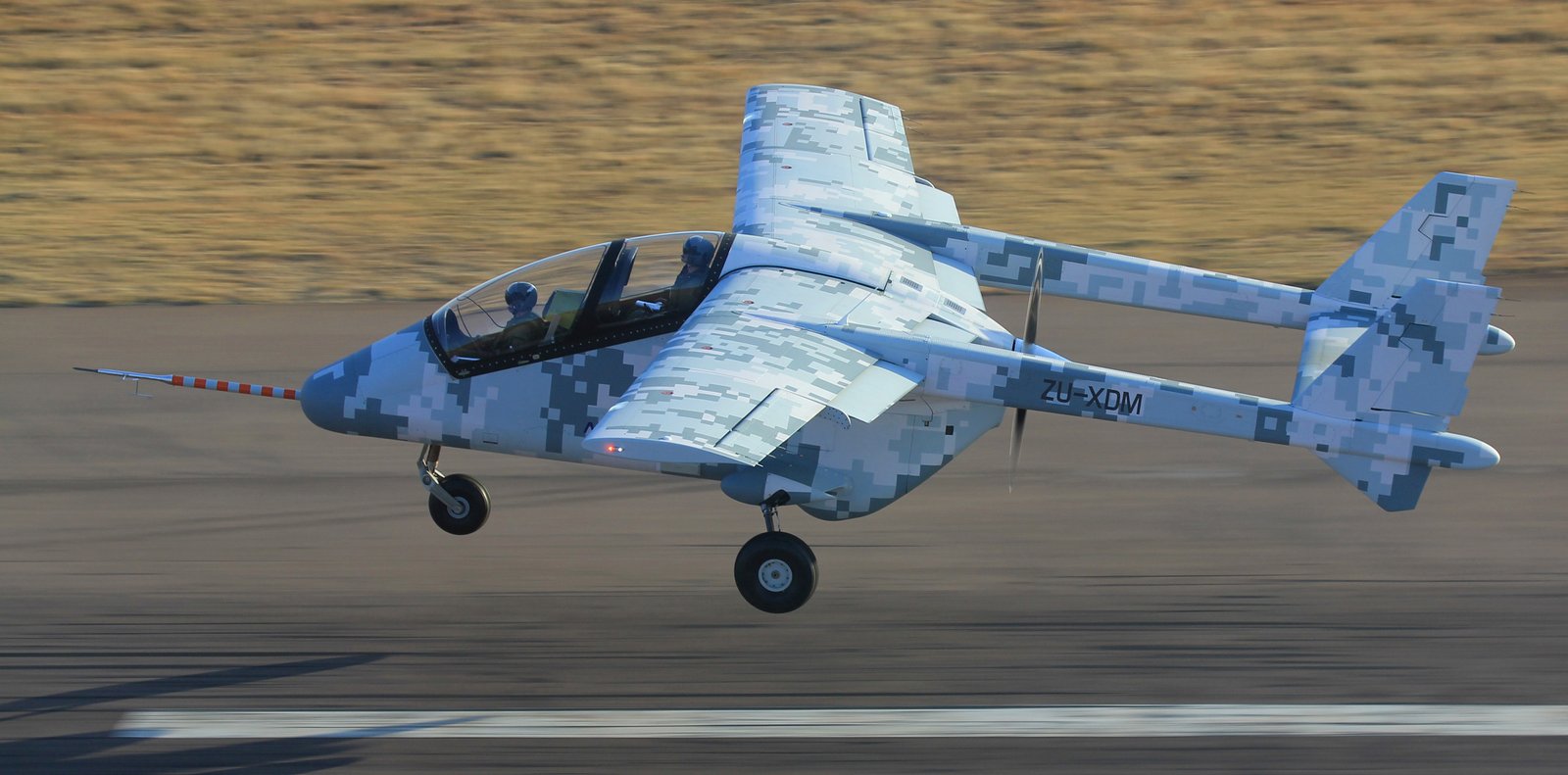
The Paramount Mwari (ICAO: PRMN) is a multi-role light reconnaissance and counter-insurgency (COIN) aircraft developed by Paramount Aerospace Industries, a joint venture between the Paramount Group and Aerosud. The program began in 2009, aiming to create a low-cost, manned alternative to unmanned aerial vehicles (UAVs) and high-end attack jets. The aircraft's prototype, originally designated as the AHRLAC (Advanced High Performance Reconnaissance Light Aircraft), performed its maiden flight on July 26, 2014, followed by a public display at Wonderboom Airport on August 13, 2014. The development process included an Experimental Demonstrator (XDM) and an Advanced Demonstrator (ADM) used for testing mission systems and weaponry.
Designed for operations in austere environments, the Mwari features a twin-boom airframe with a high-mounted, slightly forward-swept wing and a pusher-propeller configuration. The aircraft is powered by a Pratt & Whitney Canada PT6 series turboprop engine, with secondary sources indicating variants such as the PT6A-66B (950 hp) or PT6A-67F (1,700 hp). Its tandem two-crew cockpit is equipped with modern glass avionics and ejection seats. A key design innovation is the Interchangeable Multi-Mission Pod System (IMPS) located under the cockpit, which allows the aircraft to be rapidly reconfigured for roles including signals intelligence, electronic intelligence, and cargo transport.
Production is centered at Paramount's aerospace factory at Wonderboom International Airport near Pretoria, South Africa. While the company reported full-scale production between 2016 and 2018, Bloomberg reported in September 2022 that military deliveries were beginning after an 11-year development cycle. Although exact production totals are not fully disclosed, records indicate at least five airframes were built early on, with orders for nine aircraft supplied to two air forces by 2022.
Operationally, the Mwari has been deployed to northern Mozambique as of December 2022, where it provided reconnaissance and surveillance support for counter-insurgency operations. The aircraft is capable of carrying a 20 mm GI-2 cannon and utilizing six under-wing hardpoints for ordnance such as Mokopa anti-tank guided missiles, 70 mm guided rockets, and Mk 81 or Mk 82 general-purpose bombs. With a maximum takeoff weight of 4,500 kg and a service ceiling of 31,000 feet, the Mwari is designed for high endurance, with the ability to remain airborne for over seven hours.