
Development and Design
The SW-4's development journey spanned four decades, beginning as a concept in the 1960s before being shelved due to insufficient market demand. PZL-Świdnik resurrected the project in 1981, with formal development launching in 1985 under the company's engineering team. The design process included construction of a full-scale mockup in 1987, followed by a major redesign during 1989-1990 to address structural and performance requirements.
The aircraft incorporated innovative materials for its era, featuring an all-metal monocoque fuselage with 20 percent glass-fiber reinforced plastic (GFRP) components, including the rotor blades. Engineers designed a new three-blade main rotor head and integrated a SAMM hydraulic flight control system to enhance handling characteristics. The robust skid landing gear was engineered to withstand sink rates of 3.1 meters per second, addressing demanding operational requirements.
Flight Testing and Certification
Prototype c/n 600103, registered SP-PSW, achieved first flight on October 26, 1996, marking a milestone for Polish rotorcraft development. Initial flight testing revealed handling issues that prompted further design modifications, including an enlarged horizontal stabilizer and refined rotor head configuration. By late 1997, the prototype had accumulated 70 flight hours, with total test time reaching 640 hours by May 2002.
The certification process proved lengthy but successful. Polish domestic certification under JAR 27 standards was achieved on November 14, 2002, followed by European Aviation Safety Agency (EASA) certification on September 27, 2007. This certification opened European markets and validated the aircraft's compliance with international safety standards.
Production and Manufacturing
Serial production commenced on October 1, 2002, at PZL-Świdnik's facility in Świdnik, Poland. The company manufactured 41 new airframes through a production program that continues at approximately six aircraft annually. Initial production aircraft were completed in the first quarter of 1999, preceding the formal production launch.
International expansion began in 2010 through a co-production agreement with China established in 2006. Jiujiang Hongying Technology Development Ltd. in Jiujiang began manufacturing SW-4s for the Chinese market, delivering five aircraft by March 2015 under an agreement permitting up to 150 helicopters.
Military Service
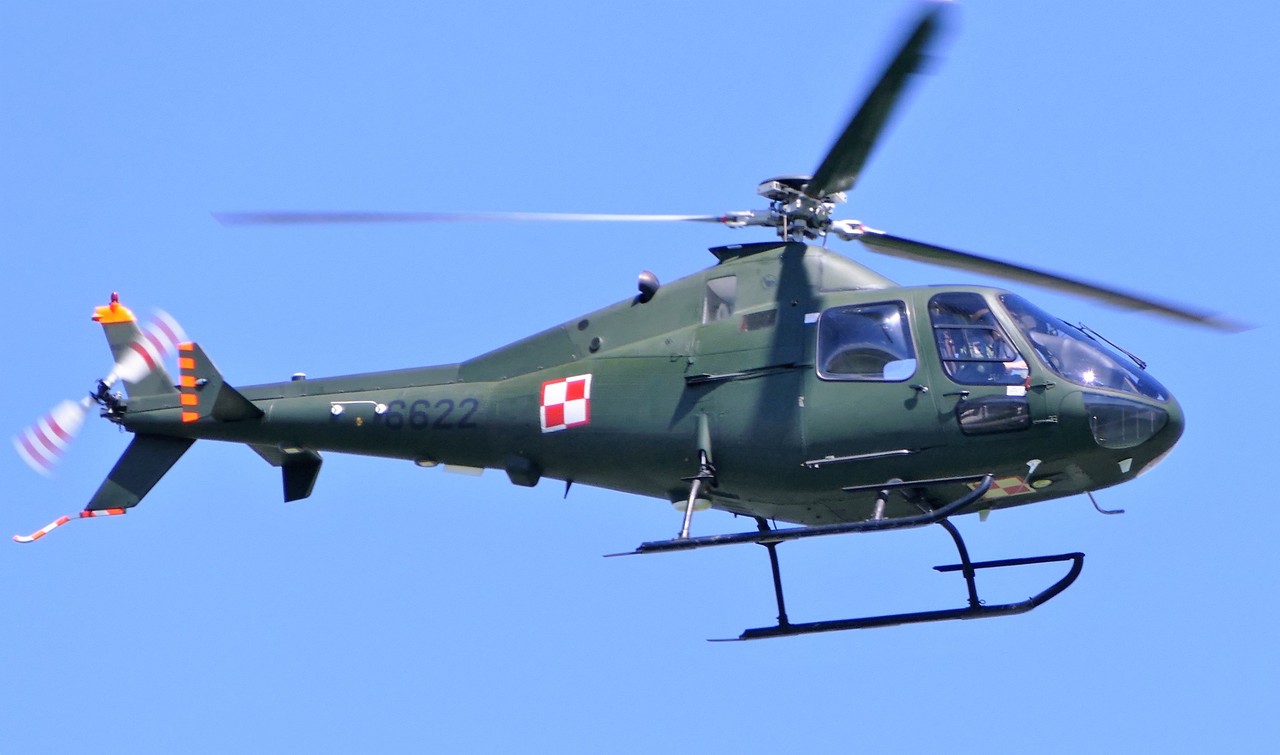
The Polish Air Force became the SW-4's primary military operator, acquiring 24 examples for pilot training beginning around 2003-2005. The service initially planned to procure 47 aircraft by 2010, receiving seven in 2005 and 14 in 2006. Military variants retain the SW-4 Puszczyk designation, with individual aircraft receiving service numbers such as 6607 for c/n 660303.
Military applications focus on non-combat roles including pilot training, medical evacuation, police support, and border patrol missions. The aircraft's multi-mission capability supports various utility functions while providing cost-effective training for rotorcraft pilots.
Technical Specifications
The SW-4 is powered by a single Rolls-Royce 250-C20R/2 turboshaft engine, producing 336 kilowatts (450 shaft horsepower) for takeoff and 283 kilowatts maximum continuous power. Alternative powerplant options included the Pratt & Whitney Canada PW200 series, specifically the PW200/9 rated at 615 shaft horsepower, pursued for potential re-certification and local assembly by PZL-Rzeszów.
Operational capacity includes one pilot plus four passengers in transport configuration, or one stretcher patient with medical attendant for evacuation missions. The cabin features doors on each side for improved accessibility. Standard fuel capacity of 500 liters provides operational flexibility for various mission profiles.
The Manufacturer
WSK "PZL-Świdnik" S.A. traces its origins to the 1950s as part of Poland's state-owned PZL (Państwowe Zakłady Lotnicze) aviation group. The company specialized in light helicopters and rotorcraft development, maintaining operations through Poland's political transitions. In 2010, AgustaWestland (later Leonardo S.p.A.) acquired PZL-Świdnik while preserving the facility's name and operations.
Today, PZL-Świdnik S.A. operates as part of Leonardo Helicopters, continuing production and support of the SW-4 program. The company represents Poland's continued presence in international rotorcraft manufacturing despite foreign ownership.
Innovation and Legacy
Development of an unmanned variant culminated in the SW-4 Solo, with prototype c/n 60.01.04 (SP-PSZ) achieving first flight in 2016. This remotely piloted variant addresses emerging requirements for unmanned rotorcraft operations. Post-2016, the civil variant was redesignated AW009 following Leonardo's acquisition.
The SW-4 Puszczyk established Poland as a certified producer of modern light helicopters, overcoming decades of development challenges to achieve international recognition. While production numbers remain modest compared to major manufacturers, the program demonstrates successful technology transfer and international cooperation through the Chinese co-production agreement. The aircraft continues serving training and utility roles across multiple operators, fulfilling its original design objectives for versatile light helicopter operations.