
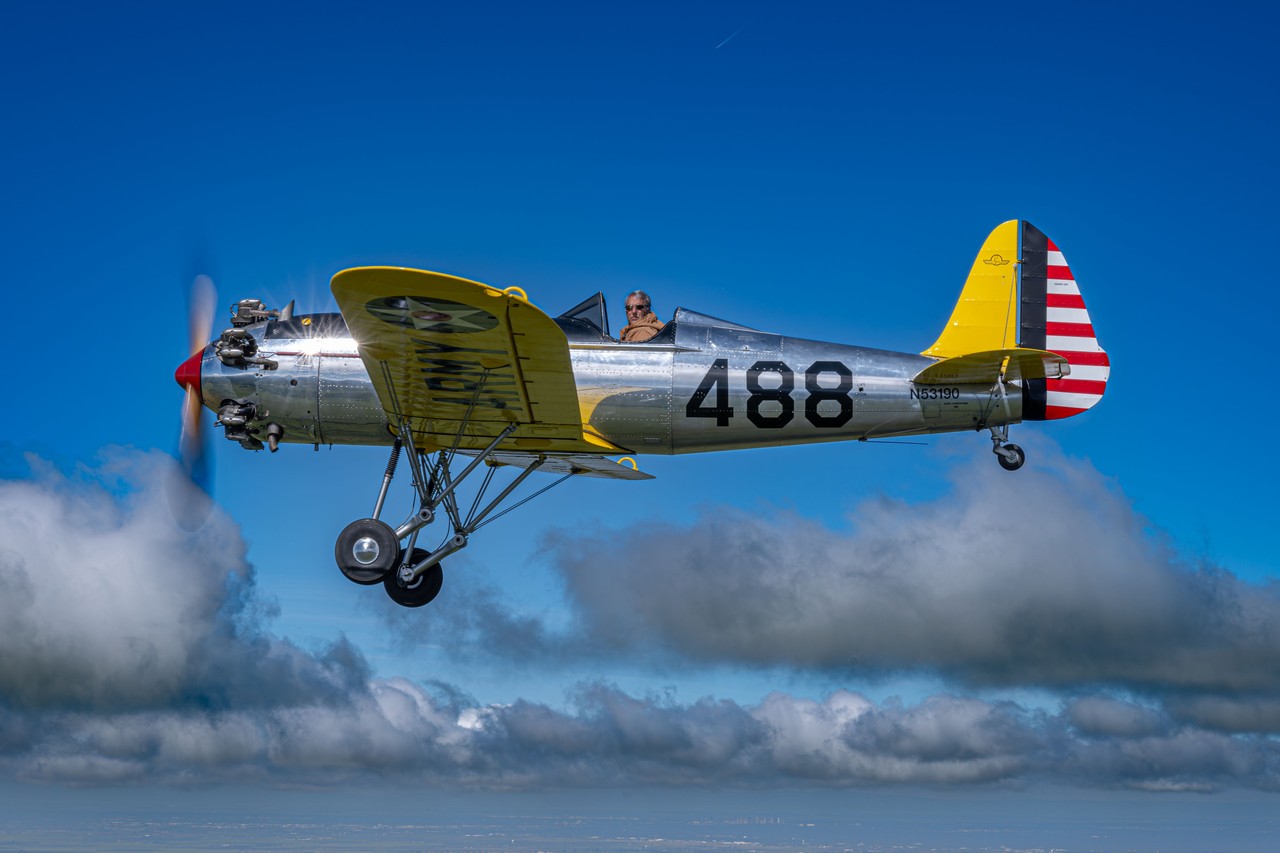
Revolutionary Training Design
The PT-22 Recruit emerged from Ryan Aeronautical's civilian ST series as a purpose-built military trainer addressing critical needs in American aviation preparedness. Unlike previous high-wing primary trainers, the PT-22's low-wing configuration provided student pilots with handling characteristics similar to the fighters they would eventually fly in combat. This design philosophy proved instrumental as the United States rapidly expanded its pilot training programs in anticipation of World War II.
Ryan engineers developed the PT-22 to overcome limitations of its predecessor, the PT-20, which had been built in only 100 examples during 1940. The new trainer featured enhanced stability and significantly more power, addressing concerns about inadequate performance in rigorous training environments.
Wartime Service Excellence
The U.S. Army Air Corps and its successor, the U.S. Army Air Forces, operated the PT-22 exclusively as a primary trainer from 1941 through 1945. Training bases across the United States, including Ryan Field in Hemet, California, Springfield, Illinois, and San Bernardino, California, utilized the Recruit to transform civilian volunteers into military aviators. The 5th Army Air Force Flying Training Detachment at Ryan Field became particularly associated with PT-22 operations.
International orders initially included 25 PT-22A floatplane variants designated for the Netherlands Navy and aircraft intended for China under Lend-Lease arrangements. However, Axis conquests in 1941-1942 redirected these orders to American forces. The U.S. Navy also operated variants designated NR-1 until 1944, while the diverted Netherlands aircraft received the designation NR-3.
One documented example, construction number 1683 delivered on January 30, 1942, accumulated 2,177 hours of training time before being declared surplus in 1944, demonstrating the intensive utilization these aircraft experienced during wartime training operations.
Ryan Aeronautical Legacy
Ryan Aeronautical Company, founded by T. Claude Ryan in San Diego during the late 1920s, had previously achieved fame through Ryan Airlines' construction of the Spirit of St. Louis for Charles Lindbergh. The company's innovative approach to trainer design, beginning with the civilian ST series in the 1930s, positioned it perfectly for military contracts as war approached.
All 1,023 PT-22 aircraft plus the 25 PT-22A variants were manufactured at Ryan's San Diego facility. The company's contribution to wartime pilot training proved significant, though post-war consolidation eventually absorbed Ryan into larger aerospace entities. Teledyne acquired Ryan Aeronautical in 1969, and the company later became part of Northrop Grumman before its assets were distributed among various aerospace organizations.
Technical Innovation
The Kinner R-540-1 five-cylinder radial engine, producing 160 horsepower, powered the PT-22 and represented a substantial improvement over earlier trainers. Manufactured by Kinner Engines of Los Angeles, California, this powerplant provided reliable performance throughout the demanding training environment of World War II. The engine's distinctive sound earned the PT-22 its nickname "Maytag Messerschmitt" among pilots and ground crews.
The aircraft's tandem open cockpits allowed direct communication between instructor and student while maintaining the authentic flying experience essential for primary training. Unlike later PT-22 models, early variants featured wheel spats that were eventually eliminated to simplify maintenance and reduce manufacturing costs.
At a unit cost of $9,098 in 1942 dollars (equivalent to approximately $128,651 in 2011), the PT-22 represented significant value for military training programs, offering superior performance compared to its 125-horsepower predecessors.
Pilot Experience
The PT-22's low-wing configuration provided student pilots with their first exposure to landing and takeoff characteristics similar to operational fighters. This design feature proved invaluable as pilots transitioned from primary training to advanced aircraft and eventually to combat types. The aircraft's stable handling characteristics built confidence while introducing necessary complexity for military aviation careers.
With dimensions of 22 feet 5 inches in length and 6 feet 10 inches in height, the PT-22 offered manageable size for novice pilots while providing sufficient performance for comprehensive training programs. Empty weight of 1,313 pounds and maximum takeoff weight of 1,860 pounds created realistic weight and balance considerations for student instruction.
Enduring Legacy
Post-war surplus sales through organizations like the Reconstruction Finance Corporation in 1944-1945 placed many PT-22s in civilian hands. Hancock College of Aeronautics acquired examples in 1945, continuing their training mission in civilian flight instruction. One preserved aircraft, construction number 1683, eventually accumulated 3,069 total flight hours, demonstrating the type's durability and continued utility.
Today, PT-22s remain popular airshow attractions across North America, the United Kingdom, and Australia. Major museums preserving examples include the National Museum of the U.S. Air Force, which acquired its specimen in 1969, and the National Air and Space Museum, which displays PT-22A serial number NASM A20060083000, originally part of the Netherlands order.
The Fagen Fighters WWII Museum, Vintage Flying Museum, and Commemorative Air Force Minnesota Wing maintain operational examples, allowing modern audiences to experience the sights and sounds that trained thousands of World War II pilots. These surviving aircraft represent not merely historical artifacts but continuing symbols of American aviation training excellence during the nation's greatest military challenge.