
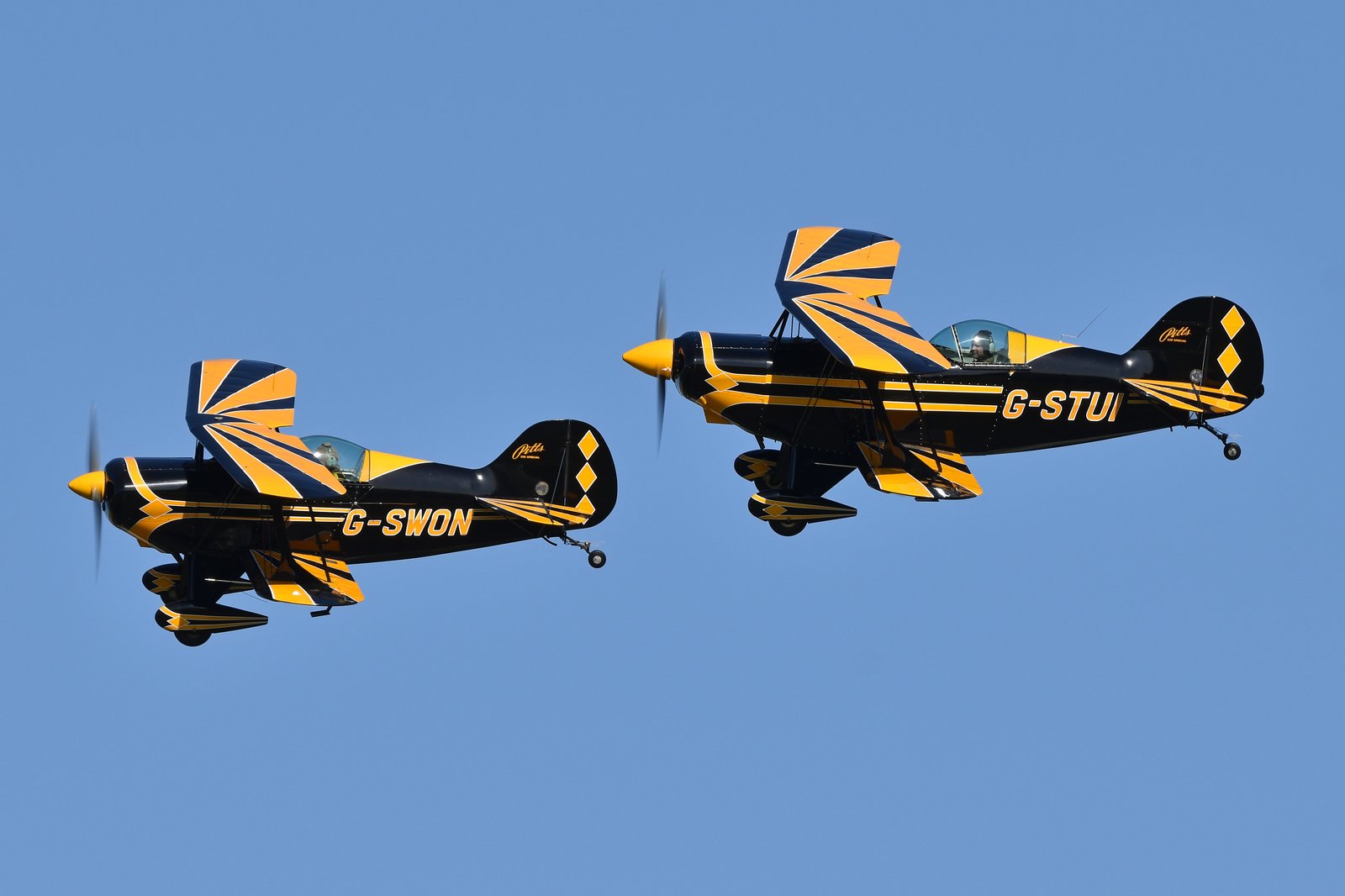
Design Genesis and Final Vision
Curtis Pitts began developing the Model 12 in 1993 at age 77, driven by a vision to create the ultimate aerobatic touring biplane. The legendary designer completed his initial three-view drawings that year and presented the finished design to friends at his 80th birthday celebration in December 1995. This ambitious project aimed to address the primary limitation of existing Pitts aircraft: their restricted baggage capacity and range for cross-country travel.
The prototype took its maiden flight in March 1996 with test pilot Ben Morphew at the controls. Morphew was so impressed with the aircraft's performance that he immediately commissioned Jim and Kevin Kimball to construct a personal example. This enthusiastic reception validated Curtis Pitts' belief that aerobatic pilots desired a larger, more capable biplane without compromising aerobatic performance.
Russian Power and American Engineering
The S-12's heart is the Russian-manufactured Vedeneyev M14P radial engine, producing 360 horsepower and driving a three-bladed MT propeller. This powerplant selection represented a departure from traditional American engines, chosen specifically for its robust construction and high power-to-weight ratio. Engine specialist Monty Barrett developed significant modifications that increased output to 410 horsepower through forged pistons, optimized valve work achieving a 7.8:1 compression ratio, and an Airflow Performance fuel injection system with automotive spark plugs.
Barrett's modifications transformed the engine's reliability and economy. Oil consumption dropped dramatically from one quart per hour to one quart per six hours, while fuel efficiency improved substantially. These enhancements made the S-12 practical for extended cross-country flights, fulfilling Curtis Pitts' original vision of a touring aerobatic aircraft.
Construction Philosophy and Innovation
The S-12 employs traditional Pitts construction methods elevated to accommodate its larger scale. The fuselage consists of fabric-covered welded steel tubing, while the wings feature fabric-covered wooden spars with formed plywood leading edges. The landing gear utilizes solid aluminum construction for durability under the stresses of aerobatic flight and heavy landings.
Jim and Kevin Kimball refined the original design through careful engineering analysis. They relocated the pilot and passenger positions relative to the wing structure, moved the engine aft while advancing the tail section forward, and reduced overall fuselage length by 10 inches. The rudder size was increased to maintain control authority with the powerful radial engine, ensuring the aircraft remained manageable throughout its aerobatic envelope.
Production Variants and Availability
Production commenced in 1996 following successful prototype testing, with 59 examples completed and flying by December 2011. The aircraft became available in multiple configurations to suit different builder preferences and budgets. Plans-built versions feature a 23-foot wingspan and 20-foot 6-inch length, while kit versions measure 22 feet span and 19 feet 8 inches in length.
The factory-built Model 12S variant from 92nd West Aviation incorporates advanced materials including carbon fiber and titanium components. This single-seat configuration spans 21 feet with a 19-foot 8-inch length, reducing empty weight to 1,400 pounds while maintaining structural strength. Jim Kimball also constructed "The Beast," a specialized single-place variant that demonstrated the design's adaptability.
Performance Excellence
The S-12 delivers impressive performance figures that justify its "Macho Stinker" nickname. Cruise speed reaches 150 knots while maintaining a gentle 56-knot stall speed, providing a comfortable operating envelope for both experienced and developing aerobatic pilots. The aircraft climbs at 2,900 feet per minute, enabling rapid altitude recovery between aerobatic sequences.
With 54 gallons of fuel capacity in plans and kit versions, the S-12 achieves a 430-nautical-mile range, finally delivering the cross-country capability Curtis Pitts envisioned. The 40-pound baggage compartment accommodates essential gear for extended trips, transforming the traditional day-only aerobatic mission into genuine touring capability.
Aerobatic Heritage and Legacy
The S-12 incorporates four generously sized ailerons with swept upper wings, providing exceptional roll rates and control authority throughout the aerobatic envelope. This configuration enables precise execution of advanced aerobatic maneuvers while maintaining the stability necessary for formation flying and airshow demonstrations. The aircraft regularly appears at aerobatic competitions and airshow performances, continuing the Pitts tradition of public aerobatic excellence.
As Curtis Pitts' final design achievement, the S-12 Macho Stinker represents the culmination of five decades of aerobatic aircraft development. The nickname continues Pitts' tradition of skunk-themed aircraft names while reflecting the aggressive capability of his most powerful design. Aviation enthusiasts widely regard the S-12 as the finest biplane Curtis Pitts ever created, combining his lifetime of aerobatic knowledge with modern materials and powerplant technology.