
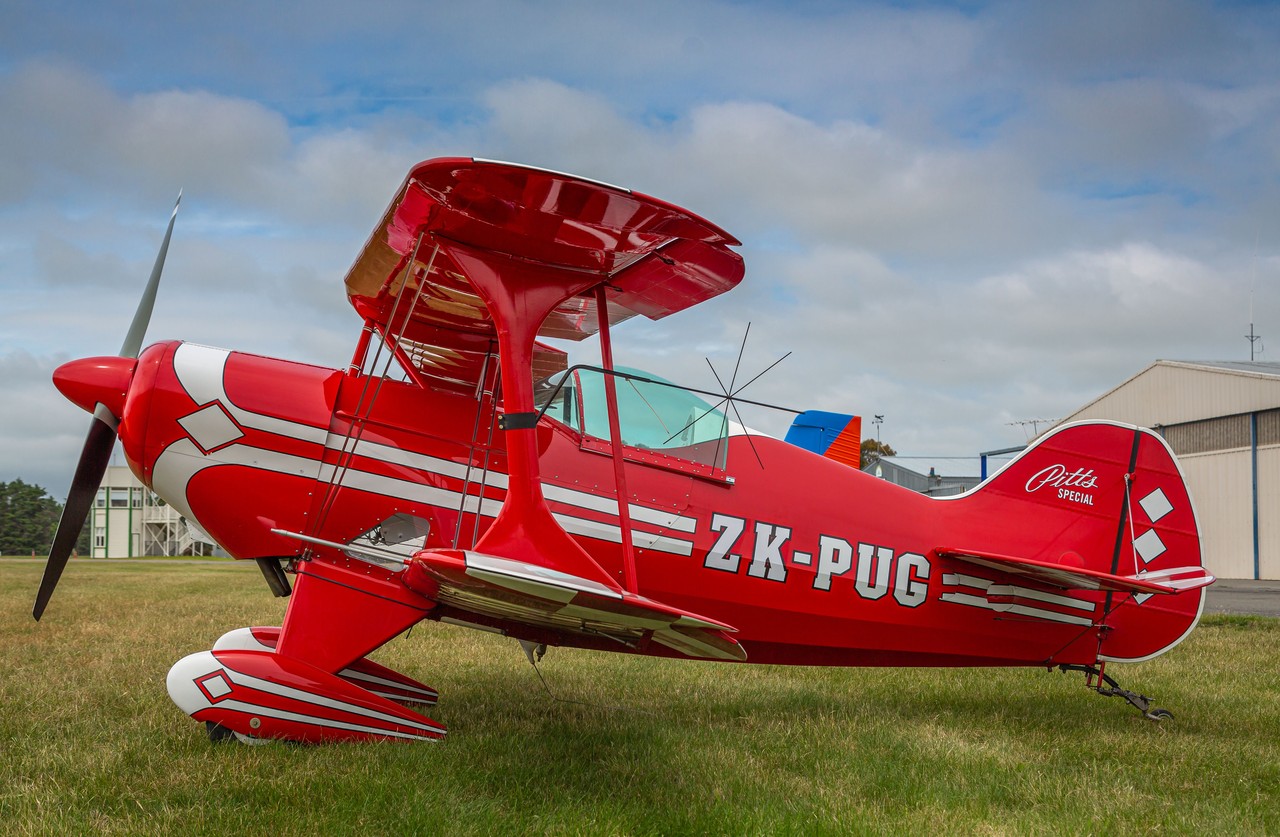
Service History
The Pitts S-1 Special achieved unprecedented dominance in competitive aerobatics, fundamentally changing how the sport was practiced and judged. By the late 1960s, Pitts aircraft claimed victories in virtually every major aerobatic competition worldwide, including multiple world championship titles. The aircraft's superior roll rate and precision handling capabilities rendered older converted military trainers and touring aircraft obsolete in serious competition. This dominance extended through the 1970s, establishing aerobatic performance benchmarks that influenced aircraft design for decades.
The Designer and Early Development
Curtis Pitts, a self-taught engineer with World War II military aircraft inspection experience, began developing the S-1 concept in 1943 while working as a crop duster and flight instructor. His vision centered on creating an aircraft specifically optimized for aerobatic maneuvers rather than adapting existing designs. The first prototype, simply named "Special," took flight in 1944, followed by a second aircraft dubbed "Li'l Stinker" in 1945. Phil Quigley served as test pilot for these early examples, helping refine the design's unprecedented agility.
Pitts initially worked from rough hand-drawn plans, producing only a handful of aircraft through the 1950s. The breakthrough came in 1962 when professionally drafted plans for the S-1C variant went on sale, enabling widespread homebuilder construction. This transition from limited factory production to plans-built aircraft became the foundation for the design's proliferation throughout amateur aviation.
Technical Innovation and Evolution
The original S-1 employed a flat-bottom M6 airfoil on the lower wings with ailerons only on the bottom surfaces, paired with a conventional steel tube fuselage and fabric covering. Early examples used a 55-horsepower Lycoming engine, quickly upgraded to a 90-horsepower Franklin in the second prototype. The rigid landing gear design eliminated the weight and complexity of retractable systems while maintaining structural integrity during high-G maneuvers.
The S-1S "Roundwing" variant, introduced through Aerotek production in 1973, represented a quantum leap in performance. This version featured symmetrical airfoils on both upper and lower wings, with four ailerons providing exceptional roll authority. Pitts incorporated a patented upper-wing stall-first design that enhanced safety during aggressive maneuvers. Power increased substantially, with most S-1S examples using Lycoming AEIO-360 engines producing 180 to 200 horsepower.
Manufacturing History
Aerotek acquired production rights in the early 1970s, establishing factory operations in Afton, Wyoming. The company built approximately 65 "Roundwing" S-1S aircraft between 1973 and 1981, when production ceased in favor of releasing plans to homebuilders. Aerotek also manufactured 64 examples of the S-1T trainer variant and 259 two-seat S-2A aircraft during this period.
Aviat Aircraft currently maintains limited production capabilities in Afton, Wyoming, producing S-1T and S-1S variants on demand as of 2008. Meanwhile, Steen Aero Lab in Palm Bay, Florida, supplies plans and components for the S-1C variant to homebuilders worldwide.
Pilot Experience
Pilots consistently praise the Pitts S-1 for its exceptional responsiveness and predictable handling characteristics during aerobatic sequences. The aircraft's light weight and powerful engine combination provides outstanding power-to-weight ratios, enabling vertical maneuvers and sustained inverted flight that challenged contemporary designs. The fuel-injected AEIO engine series, specifically designed for aerobatic applications, maintains consistent power delivery during negative-G maneuvers.
The compact cockpit and sensitive controls demand precision from pilots, making the S-1 both a capable competition machine and an excellent training platform for aspiring aerobatic pilots. Roll rates exceeding 400 degrees per second require careful technique, while the aircraft's inherent stability provides confidence during complex maneuver sequences.
Legacy and Current Operations
Hundreds of Pitts S-1 variants remain active worldwide, with numerous examples appearing at airshows and aerobatic competitions annually. The National Air and Space Museum houses a 1969 S-1S Special built by J. Dawson Ransome and donated in 1973, recognizing the type's historical significance. Additional examples are preserved at the Wings of History Air Museum and other aviation institutions.
Active U.S. registrations include aircraft spanning from 1960s homebuilts to recent factory examples, demonstrating the design's enduring appeal and structural longevity. The aircraft continues influencing modern aerobatic design, with its fundamental proportions and configuration remaining largely unchanged after eight decades of refinement.