
Design Innovation
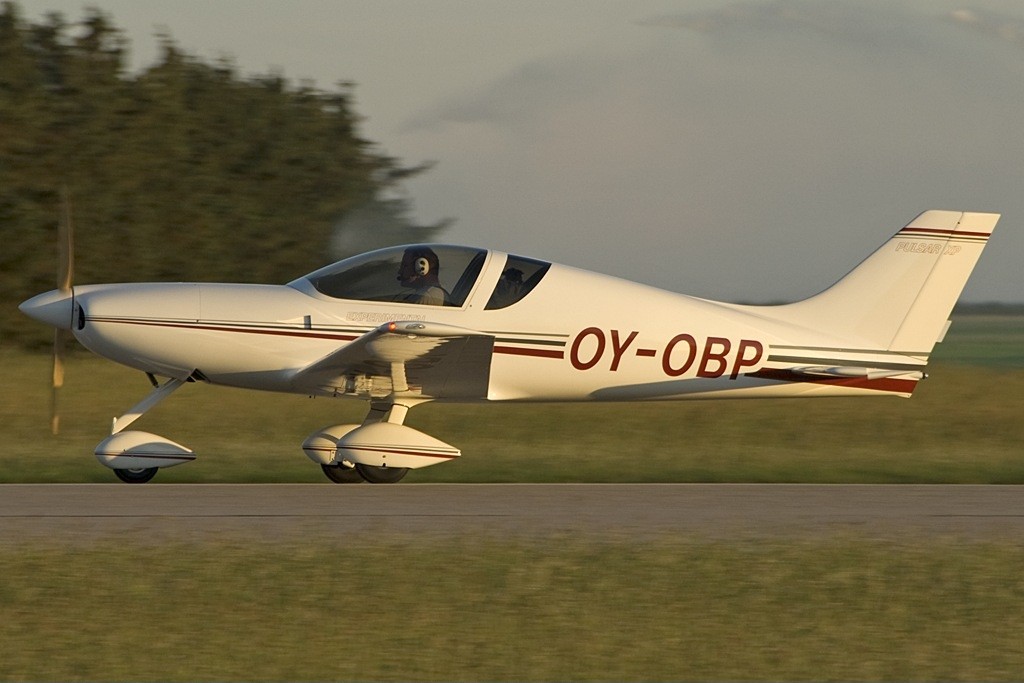
Mark Brown's design team at Aero Design Inc. created the Pulsar as an evolution of their single-seat Star-Lite, which had won the Experimental Aircraft Association Outstanding New Design Award after its 1983 first flight. The Pulsar represented a significant advancement in homebuilt aircraft construction, pioneering the use of pre-preg fiberglass composite materials for exceptional strength-to-weight ratios. The fuselage utilized foam-core sandwich composite construction with pre-preg molds, while the wings featured factory-manufactured composite spars with integrated aluminum fittings.
Production Evolution
Aero Design Inc. produced the Pulsar in kit form from 1988 to 1999, with manufacturing centered in San Antonio, Texas. The original Pulsar 582 featured a 49 kW (66 hp) Rotax 582 two-stroke engine, but the design quickly evolved to meet market demands. The Pulsar II introduced the smoother-running 60 kW (80 hp) Rotax 912 UL four-stroke engine, while the Pulsar III offered the turbocharged 86 kW (115 hp) Rotax 914 for enhanced performance.
Engineering Excellence
The Pulsar's innovative design addressed practical concerns of homebuilders and sport pilots. Its removable wings allowed the aircraft to be trailered behind a car, making it particularly popular in space-constrained locations. More than 30 examples were built in Great Britain alone, where hangar space commanded premium prices. The aircraft featured a distinctive slide-forward one-piece canopy and unidirectional glass landing gear that proved remarkably resilient to hard landings.
Fuel capacity varied by engine configuration, with the Rotax 582 version carrying fuel in the forward fuselage, while Rotax 912-equipped aircraft utilized wing leading-edge tanks holding 72-105 liters (15.8-23 imperial gallons). Standard propellers were GSC ground-adjustable wooden units - 56-inch diameter for the 582 and 60-inch for the 912, with optional in-flight adjustable propellers available.
Corporate Transitions
In 1996, manufacturing rights transferred to SkyStar Aircraft Corporation of Caldwell, Indiana, marking the beginning of a complex ownership evolution. SkyStar later sold the rights to Pulsar Aircraft Corporation, which developed the ambitious Super Pulsar 100. This four-seat variant, designated N601SP, first flew in August 2000 but suffered damage on August 20, 2000. After repairs, testing resumed on April 2, 2001, and the aircraft debuted at Sun 'n' Fun on April 13, 2001.
Parallel to American developments, Germany's HK Aircraft Technology AG modified the Pulsar XP design for type certification as the Wega 100. However, this promising project ended tragically in 2001 when the second prototype crashed, killing pilot and company owner Hans Keller, while the first prototype suffered engine failure after takeoff damage.
Global Impact
By mid-2003, more than 250 Pulsar variants were flying worldwide, with an additional 300 under construction, representing over 550 total units in various stages of completion. The aircraft found operators across multiple continents, with notable examples including Australia's first Pulsar (VH-JPA, construction number 153/W162) delivered in mid-1995, and New Zealand's inaugural example (ZK-RUS, construction number 325/MAANZ/510).
International registrations demonstrated the type's global appeal, including F-WSDT in France, HB-YHN in Switzerland, and G-XPXP (construction number PFA 202-11958) in the United Kingdom. American examples like N204BH, N912XL, and N353 (later re-registered as VH-BTS3 in Australia) showcased the aircraft's international mobility.
Performance Characteristics
The Rotax 912-powered Pulsar XP delivered impressive performance figures that attracted sport pilots seeking efficiency and speed. With an empty weight of just 231 kg (510 lb) and maximum takeoff weight of 481 kg (1,060 lb), the aircraft achieved a maximum cruise speed of 241 km/h (150 mph). Stall speed with full flaps dropped to a docile 74 km/h (46 mph), while climb rate reached 366 meters per minute (1,200 feet per minute).
The aircraft's service ceiling of 4,572 meters (15,000 feet) and range of 966 km (600 miles) made it suitable for serious cross-country flying, while takeoff and landing runs of just 244 meters (800 feet) enabled operations from short airstrips. Design load limits of +6/-4G provided generous safety margins for sport aerobatics.
Legacy and Current Status
The Pulsar's influence extended beyond its direct production numbers, inspiring a generation of composite homebuilts and demonstrating the viability of factory-assisted kit construction. While Aero Design Inc. ceased operations and subsequent corporate owners faced various challenges, the aircraft's fundamental design proved sound enough to spawn multiple variants and international derivatives.
Today, numerous Pulsar variants remain active on civil aircraft registers worldwide, testament to the type's durability and continued appeal among sport aviation enthusiasts. The aircraft's combination of modern composite construction, practical design features, and strong performance characteristics established it as a significant milestone in homebuilt aviation history.