
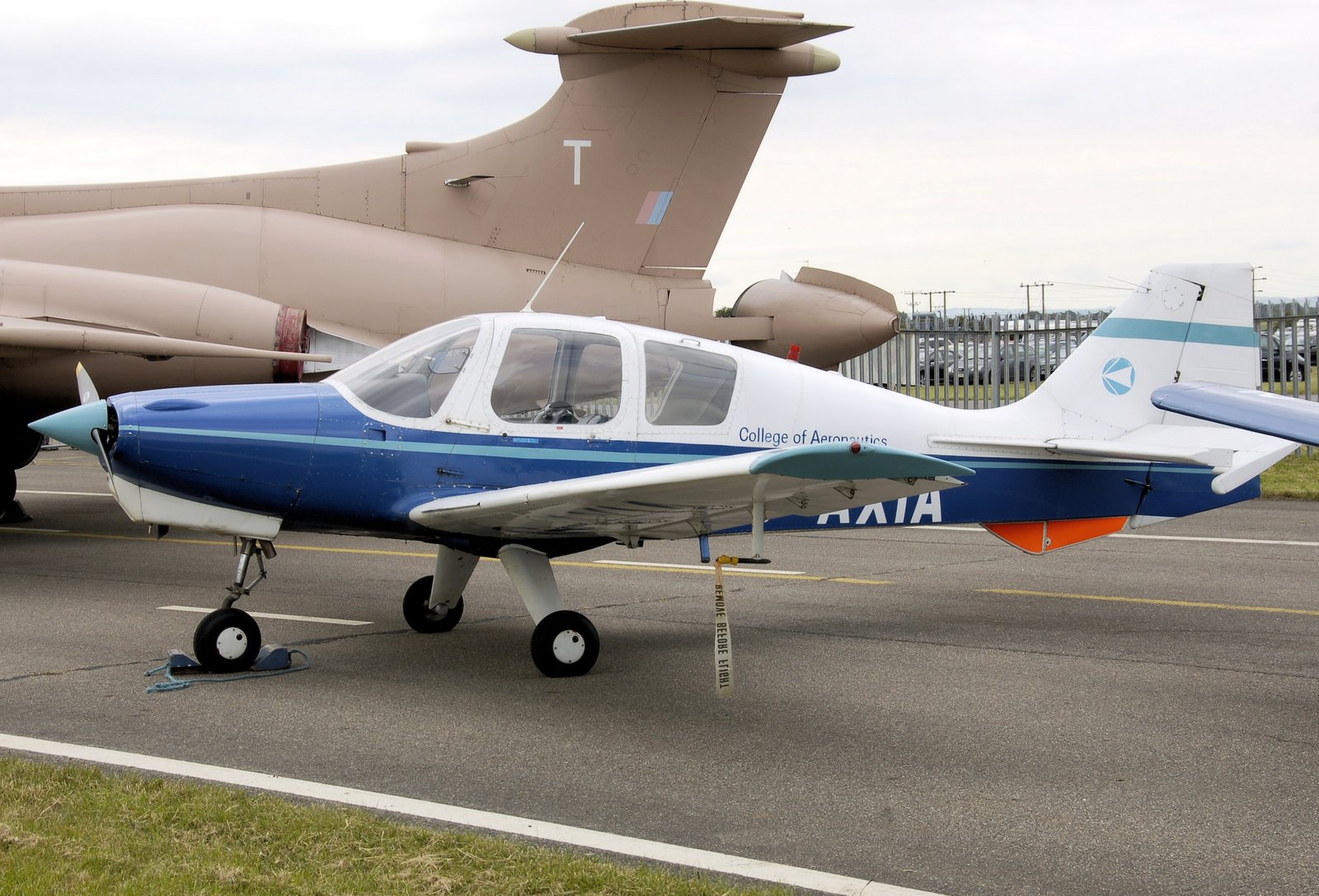
A Modern Trainer for British Aviation
The Beagle Pup emerged from Britain's government-backed effort to consolidate its fragmented light aircraft industry. Beagle Aircraft Limited, formed in 1960 through the merger of several manufacturers including F.G. Miles and Beagle Aviation, undertook the Pup as a private venture to capture the training aircraft market worldwide.
On April 8, 1967, test pilot 'Pee Wee' Judge lifted the prototype Series 1 (G-AVDF) from Shoreham Airport for a 75-minute maiden flight. The aircraft represented a significant departure from fabric-covered biplanes, featuring stressed-skin aluminum construction, a low-wing configuration, and modern tricycle landing gear.
Production Variants and Development
Beagle developed the Pup through three main series to meet different market segments. The initial Series 1 used a 100-horsepower Rolls-Royce Continental O-200 engine in a two-seat, semi-aerobatic configuration. The Series 2, which constituted the bulk of production with approximately 150 units, incorporated the 150-horsepower Lycoming O-320 engine and could accommodate up to four occupants.
The final Series 3 (Pup 160) featured a 160-horsepower Lycoming O-320-D2C engine and targeted the four-seat touring market. Engineers also designed variants that never reached production, including the Pup Major with a Continental O-300 powerplant and the aerobatic Bull Pup featuring a 210-horsepower Continental IO-360.
Global Market Penetration
Despite its brief production run, the Pup found customers across multiple continents. Shoreham Flying School received the first production aircraft on April 12, 1968, launching the type's career in flight training. International sales included aircraft delivered to Australia, Sweden, Switzerland, and Iran's Civil Air Training Organisation, demonstrating the design's global appeal.
The aircraft competed directly with established American trainers like the Cessna 150 and Piper Cherokee, though it achieved greater success in European markets than in the United States. Flying schools appreciated the Pup's forgiving handling characteristics and spin-resistant design, enhanced by anti-spin strakes that became standard equipment.
Technical Innovation and Design Philosophy
Beagle's engineers emphasized creating "a pilot's aeroplane" with predictable handling throughout the flight envelope. The low-wing design incorporated several thoughtful touches, including an enlarged fin and rudder for improved directional stability and a pointed spinner for enhanced aerodynamics.
The aircraft's all-metal construction represented modern manufacturing techniques, though this approach contributed to the company's financial difficulties. Production costs exceeded £8,850 per aircraft for the first 150 units—more than twice the retail selling price—highlighting Beagle's fundamental business model problems.
The Manufacturer's Demise
Beagle Aircraft Limited faced mounting financial pressures throughout the late 1960s, losing approximately £1 million annually by 1969. Poor cost control plagued operations, exemplified by the decision to paint aircraft at the remote Rearsby facility rather than at the main Shoreham production line.
The company's inefficient "one-off special" manufacturing methods proved unsuitable for mass production economics. Despite holding 276 unfilled orders, Beagle entered liquidation in January 1970, ending Pup production after just 176 aircraft reached customers. An additional 50 airframes were used for spare parts or left incomplete, though some nearly-finished examples were completed by private parties, with the final aircraft (HB-NBA) registered on March 8, 1977.
Military Development
The Pup's design formed the foundation for the more successful Beagle Bulldog military trainer. Powered by a 200-horsepower Lycoming IO-360-A1B6 engine, the Bulldog attracted international military interest, with Sweden ordering 58 aircraft plus 45 options. After Beagle's collapse, Scottish Aviation acquired the Bulldog design rights in 1970 and continued production.
Legacy and Survivors
Approximately 150 Pup aircraft remain in various conditions today, with many still active in private ownership and flight training roles. The aircraft earned a reputation for solid construction and pleasant flying characteristics, though early production examples suffered from quality control issues including cracking engine mounts and doors that could open during flight.
The Pup's brief production run symbolizes the challenges facing Britain's post-war aviation industry consolidation efforts. Despite receiving enthusiastic initial reviews and demonstrating sound aerodynamic design, financial mismanagement and production inefficiencies prevented the aircraft from achieving its market potential. The type serves as a cautionary example of how engineering excellence cannot overcome fundamental business shortcomings in competitive aviation markets.