
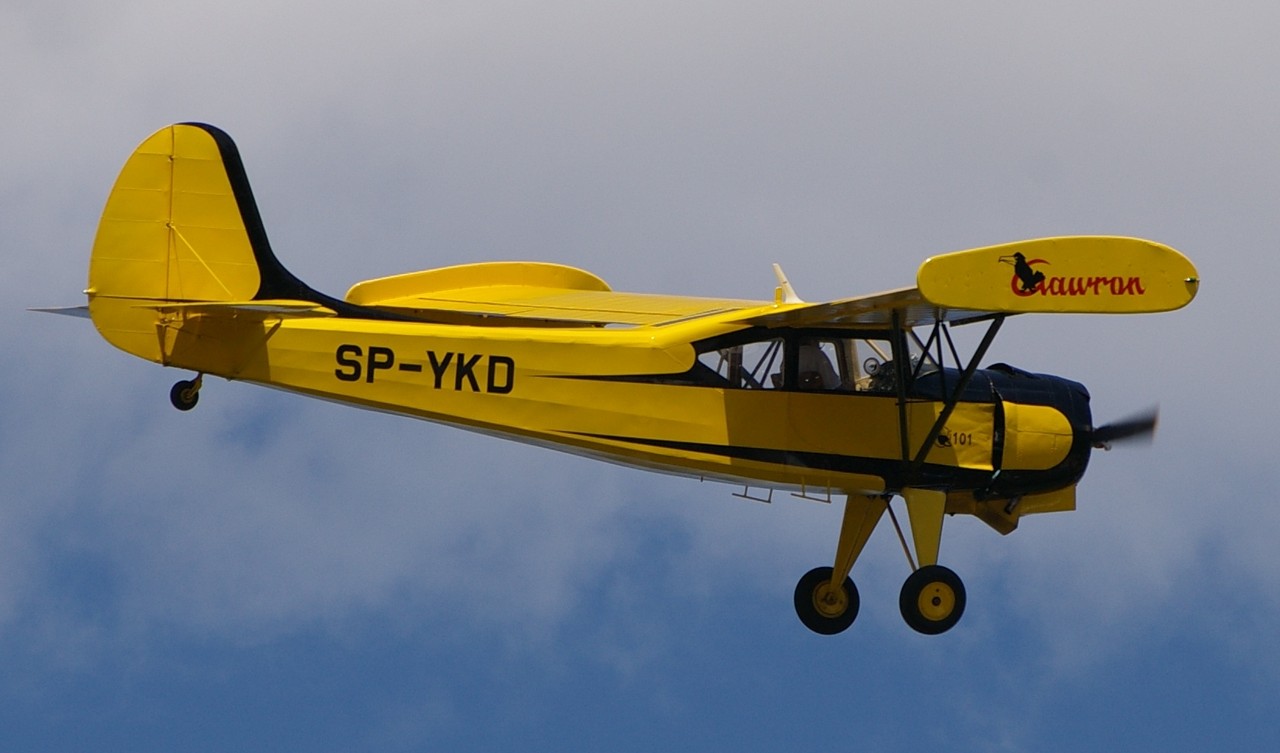
Development and Design Innovation
The PZL-101 Gawron emerged from Poland's need for a dedicated agricultural aircraft in the late 1950s. Design team leader Stanisław Lassota based the aircraft on the Soviet Yakovlev Yak-12M, which Poland had been producing under license since 1956. However, the Gawron incorporated substantial modifications to optimize it for agricultural work, particularly the addition of a 500-kilogram chemical container positioned behind the crew seats.
This rearward weight shift necessitated innovative engineering solutions. Lassota's team developed new swept wings with prominent vertical end plates to improve airflow characteristics and moved the main landing gear rearward to maintain proper center of gravity. The aircraft's equipment was simplified and lightened to maximize useful load capacity. However, operational experience revealed that the vertical end plates increased side surface area, making crosswind landings problematic, leading to their removal from most production aircraft.
Production and Variants
WSK-Okęcie manufactured 325 PZL-101 Gawrons between 1960 and 1968, demonstrating the aircraft's commercial viability. The production breakdown reflected diverse operational needs: 215 agricultural variants for crop spraying and dusting, 78 utility aircraft for general transport duties, and 32 configured as air ambulances. Approximately 143 aircraft were exported internationally, reaching markets in Austria, Libya, Egypt, Hungary, India, Turkey, and Bulgaria.
Three distinct variants evolved during the production run. The initial PZL-101 (1960-1962) featured basic equipment and lacked a right-side door. The improved PZL-101A (1962-1965) added enhanced equipment, a raised pilot's seat, and the previously missing right-side door. The final PZL-101B (1965-1968) incorporated further refinements including removal of the fuselage "hump" and installation of a larger air intake below the engine.
The Manufacturer Legacy
WSK-Okęcie, later renamed PZL "Warszawa-Okęcie," traced its aviation heritage to 1928 as Poland's oldest aircraft manufacturer. Established as the Transport Equipment Plant in 1948, the Warsaw-based company specialized in aircraft production and overhaul during the post-war reconstruction period. Throughout the 1950s and 1960s, the company produced an impressive range of aircraft including the Junak series, CSS-13, TS-8 Bies, license-built Yak-12M variants, the TS-11 Iskra jet trainer, and the Gawron itself.
Following the Gawron's production end, WSK-Okęcie achieved even greater success with the PZL-104 Wilga, manufacturing nearly 1,000 examples for worldwide distribution. However, corporate changes eventually affected legacy aircraft support. In 2007, EADS PZL "Warszawa-Okęcie" S.A. announced discontinuation of flight certificate support for several aircraft types including the PZL-101 Gawron. Since June 28, 2007, remaining Gawrons have been restricted to experimental aircraft classification.
Engine and Performance
The heart of the Gawron was the Soviet-designed Ivchenko AI-14R, a nine-cylinder air-cooled radial engine producing 191 kilowatts (260 horsepower) for takeoff and 161 kilowatts (220 horsepower) for cruise operations. This powerplant drove a two-blade propeller and provided the aircraft with respectable performance characteristics. Fuel capacity totaled 180 liters distributed between two wing tanks of 90 liters each.
Operational performance proved well-suited to agricultural work. The aircraft achieved a range of 525 kilometers and demonstrated impressive short-field capabilities with takeoff runs of just 102 meters and landing distances of 90 meters when configured for agricultural operations. The empty weight of 642 kilograms allowed for a maximum loaded weight of 1,660 kilograms, providing substantial payload capacity for chemical dispersal operations.
Operational Service and Replacement
The Gawron served as the backbone of Polish agricultural aviation throughout the 1960s and early 1970s. Its 800-liter chemical container accommodated 500 kilograms of spraying or dusting materials, with exchangeable equipment sets allowing operators to switch between liquid spraying and powder dusting applications. Beyond agricultural work, utility variants provided four-seat transport capability, while specialized air ambulance configurations served medical evacuation needs.
By the late 1970s, advancing agricultural aviation technology led to the Gawron's replacement by more capable aircraft. The PZL-106 Kruk and PZL-Mielec M-18 Dromader assumed the agricultural spraying role, offering greater chemical capacity and improved performance characteristics. Despite its retirement from commercial agricultural service, the Gawron had proven Polish capability in designing specialized aircraft for demanding operational environments.
Current Status and Legacy
Today, surviving PZL-101 Gawrons continue serving in private hands across Eastern Europe as general aviation aircraft. One notable example, registration HA-SBM (construction number 119295), operated skydiving services in Hungary before relocating to New Zealand in late 2019. Registered as ZK-ORO to BOP Marine Life Trust in Tauranga on May 6, 2021, this aircraft represents the type's continued utility decades after production ended.
The Polish Aviation Museum in Krakow preserves aircraft SP-WAK as a testament to Polish aviation achievement. The Gawron's legacy extends beyond its operational service to represent successful adaptation of foreign technology for domestic needs, demonstrating Poland's growing aviation industry capabilities during the Cold War period.