
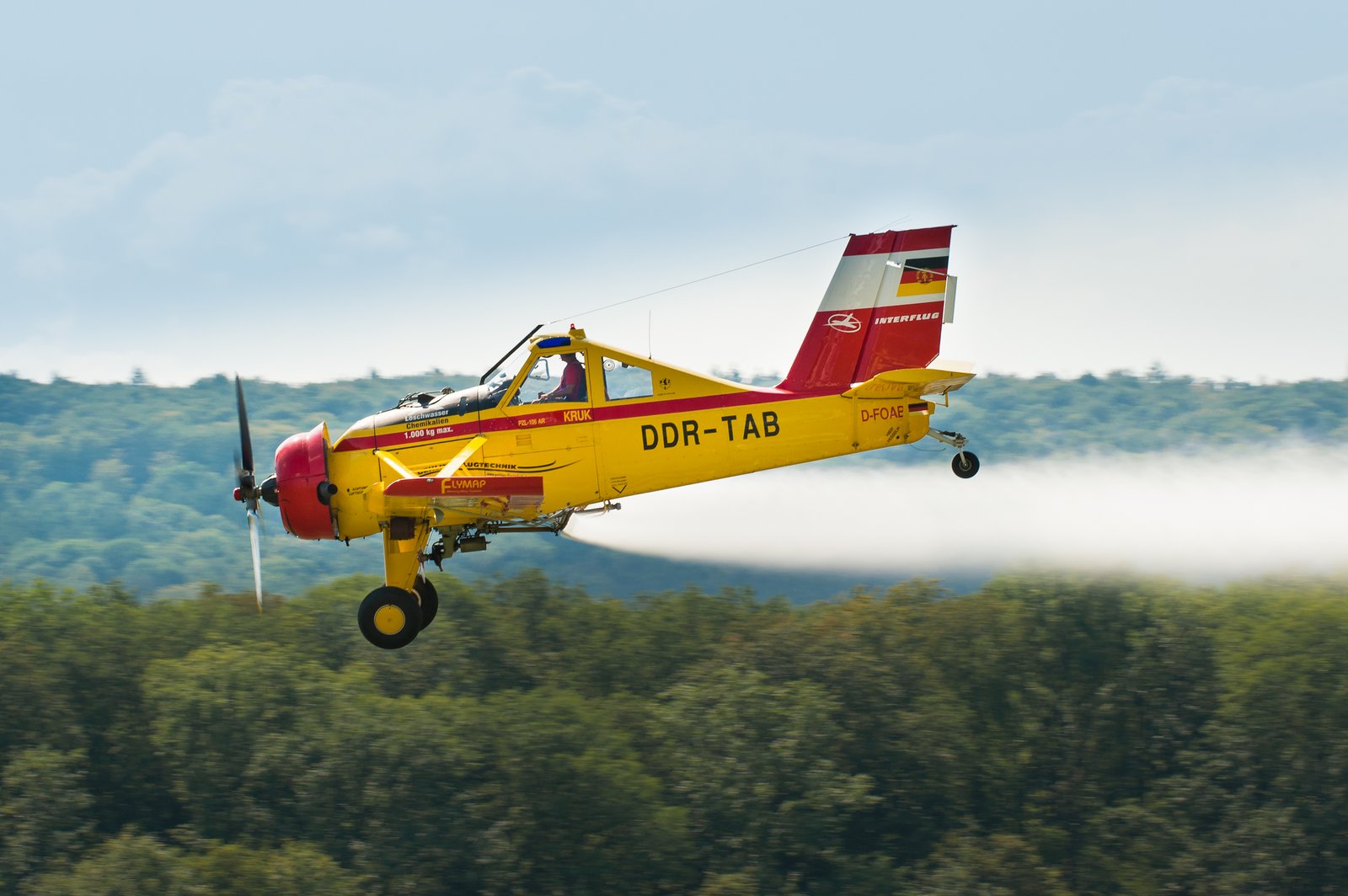
Agricultural Aviation Dominance
The PZL-106A Kruk established itself as the premier agricultural aircraft across the Soviet sphere of influence and beyond, with Polish state aviation firms operating fleets of 60 or more aircraft in international contracts spanning from Egypt to Sudan. East Germany became the largest foreign operator with 54 aircraft imported for domestic agricultural operations, while additional exports reached Czechoslovakia, Hungary, Argentina, Spain, and Brazil. The Kruk's robust design made it particularly suited for the demanding conditions of agricultural aviation, where aircraft face corrosive chemicals, low-altitude operations, and frequent takeoffs and landings.
Development and Design Innovation
Design work commenced in 1972 under the leadership of Andrzej Frydrychewicz, who sought to create a modern replacement for the aging PZL-101 Gawron. The initial prototype configuration featured an imported 298 kW Lycoming O-720 flat engine and distinctive T-tail arrangement, but flight testing revealed the need for substantial modifications. The breakthrough came with the October 12, 1974 flight of the revised prototype, which incorporated a conventional tail unit and the Polish-built PZL-3S radial engine that would define production aircraft.
The final production configuration represented a careful balance of performance and practicality. Engineers enlarged the chemical hopper capacity while maintaining the low-wing monoplane layout that provided excellent ground clearance for agricultural equipment. The fixed tailwheel landing gear offered simplicity and durability essential for operations from improvised airstrips in remote farming regions.
WSK-Okęcie Manufacturing Heritage
WSK-Okęcie, established in 1948 as the successor to Central Aircraft Studies workshops, brought decades of aviation manufacturing experience to the Kruk program. The company had previously produced the PZL-101 Gawron, PZL-104 Wilga, and the TS-11 Iskra jet trainer, establishing expertise in both civilian and military aircraft production. This manufacturing foundation proved crucial during the Kruk's production run from 1976 to 1982, when 144 PZL-106A aircraft rolled off the assembly lines.
Production resumed in 1995 after a temporary halt, with the aircraft remaining in the manufacturer's catalog as late as 2007. This longevity reflected both the basic design's soundness and continued demand for specialized agricultural aircraft in developing markets.
Engine Variants and Technical Evolution
The PZL-3S radial engine delivering 441 kW provided the PZL-106A with the power necessary for heavy agricultural loads while maintaining the reliability essential for remote operations. However, the basic airframe's adaptability led to multiple engine configurations addressing specific operational requirements. The PZL-106AR incorporated a geared PZL-3SR engine for improved propeller efficiency, while the PZL-106AS utilized the more powerful 736 kW ASz-62IR radial engine, a Soviet Shvetsov design that several aircraft received as modifications during African operations.
The most significant evolution came with turboprop variants. The PZL-106BT Turbo Kruk first flew on September 18, 1985, powered by a 544 kW Walter M601D engine, followed by the PZL-106BTU-34 in 1998 with its Pratt & Whitney PT6A-34AG powerplant. These turboprop versions offered improved fuel efficiency and reduced maintenance requirements, extending the Kruk's operational relevance into the modern era.
Operational Characteristics and Pilot Experience
Pilots praised the Kruk's reputation for robustness, reliability, and safety in the demanding agricultural aviation environment. The aircraft's conventional control layout and predictable handling characteristics made it suitable for the precision flying required in crop dusting operations, where pilots must maintain consistent altitude and spacing while managing chemical dispersal systems. The enclosed cockpit provided protection from agricultural chemicals while offering adequate visibility for low-level operations.
The Kruk's fixed landing gear and rugged construction proved invaluable for operations from unpaved strips common in agricultural regions. Aircraft regularly operated in harsh environments, from the sandy conditions of Egyptian cotton fields to the varied terrain of Eastern European collective farms, consistently demonstrating the design's versatility.
Production Legacy and Current Status
By 1990, total production across all Kruk variants reached approximately 250 aircraft, with the figure eventually exceeding 266 units. Although production faced interruption in 1992, the design's renewal in 1995 demonstrated its continued relevance in specialized markets. The aircraft's international success established Poland as a significant player in agricultural aviation manufacturing, with the Kruk serving alongside and eventually being supplemented by the larger PZL-Mielec M-18 Dromader.
Today, the Polish Aviation Museum displays a PZL-106A, preserving the legacy of this important chapter in Eastern European aviation history. The Kruk's influence extends beyond its production numbers, representing the successful development of specialized aircraft tailored to specific operational requirements during an era of rapid agricultural modernization.