
Development and Design
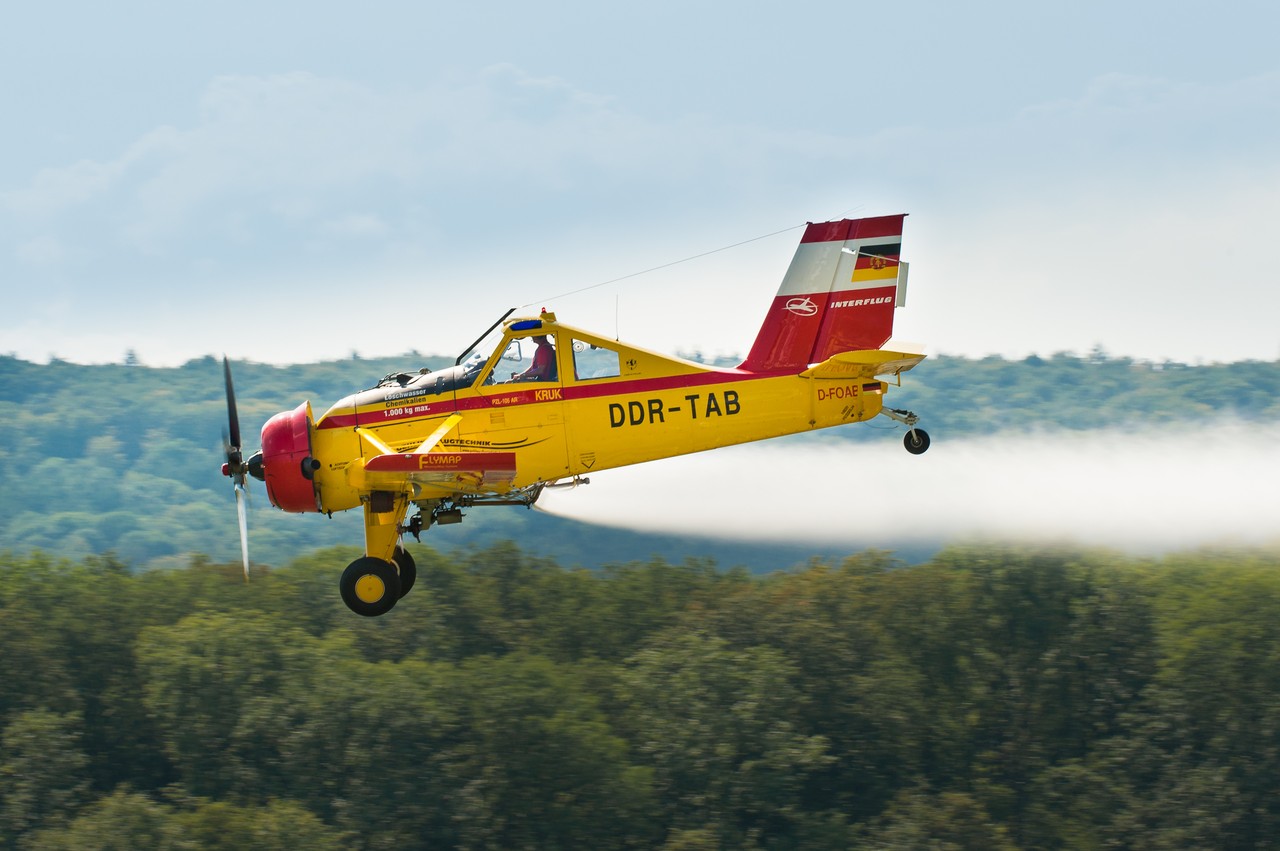
The PZL-106AT Turbo Kruk emerged from a comprehensive agricultural aviation program launched by Polish engineer Andrzej Frydrychewicz in early 1972. Frydrychewicz aimed to create a modern replacement for the aging PZL-101 Gawron, developing a more capable platform for Poland's expanding agricultural sector. The original PZL-106 prototype took its maiden flight on April 17, 1973, powered by an Avco Lycoming IO-720 engine, establishing the foundation for what would become a diverse family of agricultural aircraft.
The turboprop variant represented a significant technological leap when it first flew in 1981. Unlike earlier radial-engined versions that used the Polish-built PZL-3S producing 441 kilowatts, the AT model incorporated the proven Pratt & Whitney Canada PT6A-34AG turboprop. This engine choice provided superior power-to-weight ratio and hot-and-high performance capabilities essential for agricultural operations in challenging environments.
Manufacturing Heritage
WSK-Okęcie, the aircraft's manufacturer, traced its origins to 1928 when Polish Prime Minister Józef Piłsudski established the state aviation works. Operating under the full designation Państwowe Zakłady Lotnicze Warszawa-Okęcie, the company had produced virtually every significant Polish aircraft design throughout its history. During the communist era, it operated as part of the WSK (Wojskowe Zakłady Lotnicze) system before eventually becoming integrated into what is now Airbus Poland S.A.
Production of the PZL-106 family spanned from 1976 to the early 2000s, with a notable renewal period beginning in 1995. The Warsaw facility manufactured exactly 266 airframes across all Kruk variants, with the turboprop AT model representing a limited but significant portion of this total production run.
Engine Technology and Performance
The PT6A-34AG powerplant distinguished the Turbo Kruk from its radial-engined siblings through its advanced turboprop technology. Pratt & Whitney Canada had launched the PT6 series in 1963, and by 2023, the engine family had accumulated over 55,000 units produced across all variants. The agricultural-specific PT6A-34AG variant offered reverse thrust capability for enhanced short-field performance, crucial for operations from remote airstrips near agricultural sites.
Operational specifications included a cruise speed of 150 kilometers per hour optimized for agricultural work patterns, combined with the 900-kilometer range that enabled coverage of extensive farming regions. The single-pilot configuration maximized payload capacity while maintaining safe operational standards for low-level chemical application missions.
International Service and Operators
The PZL-106 family, including the Turbo Kruk variant, achieved notable export success throughout Eastern Europe and developing nations. East Germany imported between 54 and 100 units starting in 1978, operating them until the political changes of 1989. Other significant operators included Czechoslovakia, Egypt, Hungary, Argentina, Spain, Brazil, and Sudan.
In Egypt, the Polish firm Pezetel operated more than 60 Kruk aircraft providing commercial agricultural services, later supplementing their fleet with Antonov An-2 and PZL M-18 Dromader aircraft. These international operations demonstrated the aircraft's capability to perform reliably in diverse climatic conditions, from European temperate zones to African desert environments.
Technical Innovation
The Kruk family incorporated several design innovations that set it apart from competing agricultural aircraft. The low-wing configuration provided stable flight characteristics essential for precise chemical application, while the robust "indestructible" construction philosophy ensured durability under the demanding conditions of agricultural aviation. Early prototypes featured T-tail configurations, though production aircraft typically employed conventional tail arrangements.
The enclosed pilot cockpit offered superior protection compared to open-cockpit designs still common in agricultural aviation during the 1970s and 1980s. Chemical hopper capacity reached approximately 1,900 liters, enabling extended operational periods between refilling cycles.
Production Legacy and Current Status
Production of the PZL-106AT effectively ceased by 1992, though the broader Kruk program experienced renewed activity in 1995. As of 2007, limited production continued with variants including the PZL-106BT-601 equipped with the Czech Motorlet M601D turboprop and the BTU-34 featuring the PT6A-34AG powerplant.
Many aircraft retired from service following the political changes in Eastern Europe, particularly those operated in East Germany. Current airworthy numbers remain uncertain, though examples are preserved in aviation museums including the Polish Aviation Museum in Warsaw. The Turbo Kruk's legacy lies in demonstrating Poland's capability to produce competitive agricultural aircraft incorporating advanced Western turboprop technology during the final decade of the Cold War era.