
Combat Dominance
The MQ-1 Predator established unprecedented dominance in armed reconnaissance, accumulating more than 2 million flight hours over its 24-year operational lifetime with 87 percent flown in combat conditions. By March 2009, the fleet had surpassed 500,000 total flight hours, demonstrating reliability that fundamentally changed military aviation doctrine. The aircraft proved so effective that it became the most combat-proven unmanned aerial system ever produced, operating continuously in Afghanistan, Iraq, and other global conflict zones.
Operational History
Predator number 3034 made aviation history on January 23, 2001, conducting the first static firing test of a Hellfire missile by an unmanned aircraft. Following successful airborne trials in February 2001, this same aircraft evolved into the first armed MQ-1 configuration by April 2001, equipped with a new sensor ball and laser targeting system. After the September 11 attacks, Predator 3034 became one of the first three UAVs to fly operational missions over Afghanistan, ultimately completing 164 operational sorties between September 2001 and January 2003.
The aircraft's combat missions averaged over 14 hours each, with some extending beyond 20 hours. During a detached deployment between August and November 2002, Predator 3034 flew 32 additional missions from Uzbekistan, demonstrating the system's global reach and operational flexibility. The 432nd Wing and 432nd Air Expeditionary Wing operated MQ-1 Predators throughout these combat operations, establishing new precedents for unmanned warfare.
The Manufacturer
General Atomics Aeronautical Systems, Inc. (GA-ASI) developed the Predator from an unconventional origin story. Israeli emigrant Abraham Karem initiated the project as a garage-based effort, creating a prototype called the Albatross for DARPA by 1983. This small long-endurance tactical reconnaissance UAV eventually evolved into the Predator system when GA-ASI refined Karem's design into production form. The company built upon their proven GNAT system experience to create the Predator's mature configuration.
GA-ASI delivered the first MQ-1 to the U.S. Air Force in July 1994, initially designated as the RQ-1 for reconnaissance-only missions. The company redesignated it as the MQ-1 in 2002 to reflect its new armed reconnaissance capability. Today, GA-ASI continues operating as a leading manufacturer of unmanned aircraft systems, having established the foundation for modern drone warfare.
Engine and Technical Innovation
The MQ-1's Austrian-built Rotax 914F engine provided the reliability essential for extended-endurance missions. This naturally aspirated, air-cooled, four-stroke piston engine delivered 115 horsepower to a two-bladed pusher propeller, enabling the aircraft to remain airborne for 40 continuous hours. The engine's proven durability in light aircraft applications translated perfectly to UAV requirements, where maintenance accessibility was limited.
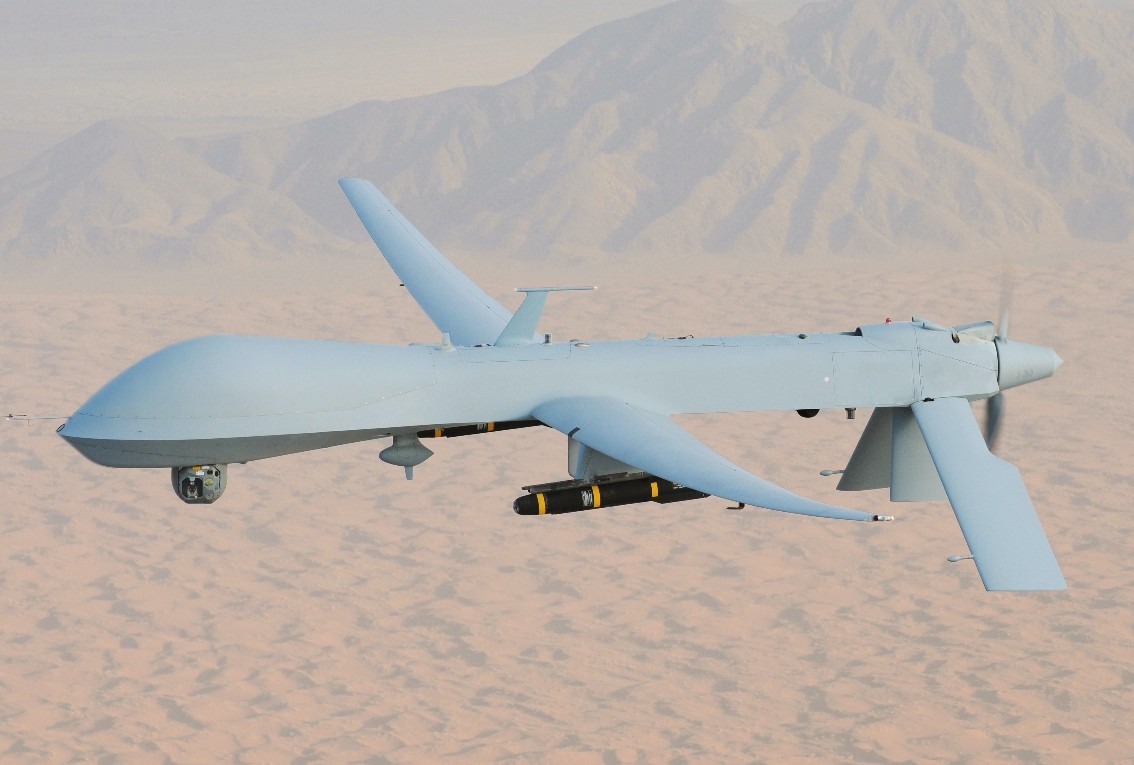
The complete Predator system consisted of four air vehicles with sensors, a ground control station, and satellite data link systems, representing a $20 million investment in 2009 dollars. The armed configuration carried laser-guided Hellfire missiles and featured an Electro-Optical/Infrared stabilized gimbal containing color and infrared video cameras, plus laser designation, laser spotting, and laser range-finding capabilities integrated into the nose section.
Performance Characteristics
The MQ-1 achieved a maximum speed of 135 mph with a service ceiling of 25,000 feet and operational range of 454 miles. These specifications enabled over-the-horizon, long-endurance, medium-altitude surveillance and reconnaissance missions that redefined military intelligence gathering. The aircraft's moderate performance figures masked its revolutionary impact on warfare, as its persistence and remote operation capability proved more valuable than raw speed or altitude performance.
Remote pilots operated the Predator from ground control stations thousands of miles from the combat zone, eliminating pilot risk while maintaining continuous battlefield presence. This operational model established the template for modern unmanned combat aircraft, proving that endurance and sensor capability could be more tactically significant than traditional performance metrics.
Production Legacy
GA-ASI manufactured 365 total MQ-1 Predators between 1994 and 2011, with the U.S. Air Force receiving 268 airframes. Additional unarmed variants were delivered to allied nations including the United Kingdom, Italy, Morocco, Turkey, and the United Arab Emirates. As of September 2015, the Air Force maintained 150 MQ-1s in its total force inventory, though approximately 97 remained operationally active.
The MQ-9 Reaper began replacing the Predator in 2007 as General Atomics' more capable "Predator B" variant, while the Army developed the MQ-1C Gray Eagle derivative beginning operations in 2012. Historic Predator number 3034, the first to fire Hellfire missiles in combat and the first to fly operational missions over Afghanistan after 9/11, is now preserved at the Smithsonian Institution's National Air and Space Museum, commemorating its pivotal role in military aviation history.