
Development Origins
The MQ-25 program emerged from the Navy's earlier Unmanned Carrier-Launched Airborne Surveillance and Strike (UCLASS) initiative, which began in 2006 as an ambitious attempt to create a stealthy carrier-based strike platform. However, shifting strategic priorities led the Navy to refocus the program in 2012 toward intelligence and surveillance missions before ultimately settling on aerial refueling as the primary requirement. This evolution reflected the Navy's recognition that extending the range of existing manned aircraft represented a more immediate operational need than developing new strike capabilities.
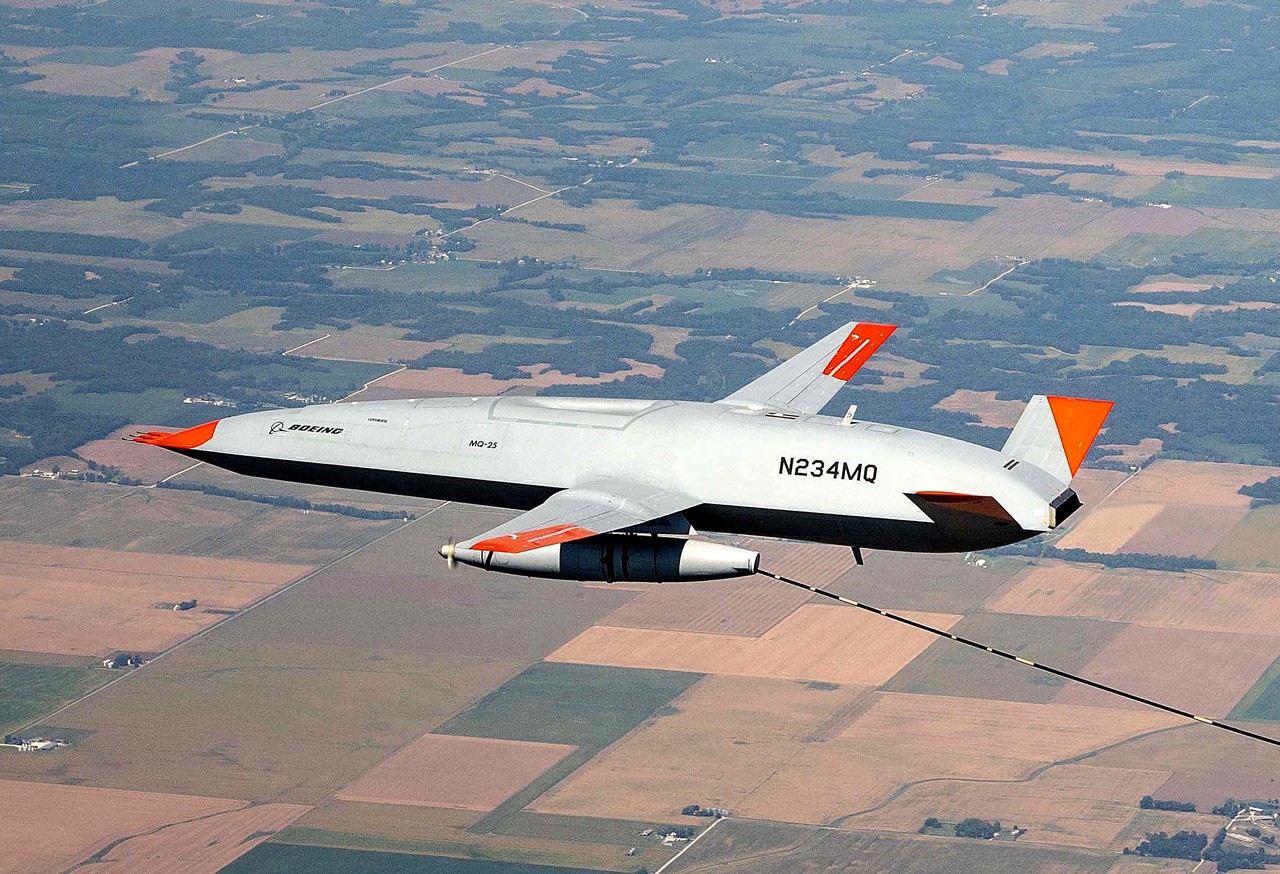
Boeing's Phantom Works division had quietly completed their wing-body-tail design concept as early as 2014 during a pause in the UCLASS program, drawing upon lessons learned from their earlier Phantom Ray experimental aircraft. When the Navy formally launched the renamed MQ-25A Stingray competition in July 2016, Boeing possessed a significant head start over competitors Lockheed Martin, Northrop Grumman, and General Atomics.
Historic Selection and Testing
On August 30, 2018, the U.S. Navy awarded Boeing the $805 million development contract for four Engineering Development Models, with potential program value reaching $13 billion for a planned fleet of 72 aircraft. The selection validated Boeing's blended wing-body approach, which prioritized fuel capacity and carrier compatibility over the more exotic flying-wing designs proposed by competitors.
The first test aircraft, designated T-1, achieved its maiden flight on September 19, 2019, from MidAmerica St. Louis Airport in Mascoutah, Illinois, completing a two-hour evaluation flight. More significantly, on June 4, 2021, the MQ-25 made aviation history by becoming the first unmanned aircraft to successfully refuel another aircraft in flight, transferring 325 pounds of fuel to an F/A-18F Super Hornet during a 4.5-hour mission over Missouri. The test included multiple connection attempts lasting more than 10 minutes, demonstrating the precision required for autonomous aerial refueling operations.
Boeing's Manufacturing Approach
Boeing established production operations at MidAmerica St. Louis Airport, investing $200 million in a dedicated manufacturing facility that opened in 2024. The company's approach leveraged decades of experience in both manned military aircraft and experimental unmanned systems, particularly knowledge gained from the X-45 and Phantom Ray programs. In March 2025, Boeing successfully relocated the first Navy Engineering Development Model aircraft to the new production facility, marking a transition from prototype development to manufacturing preparation.
The company's systematic approach to carrier integration testing has involved multiple Naval facilities, including Naval Air Station Patuxent River in Maryland, Lakehurst Naval Air Engineering Station in New Jersey, and Eglin Air Force Base in Florida. This distributed testing strategy reflects the complexity of integrating an autonomous system into the highly demanding carrier aviation environment.
Technical Innovation and Design
The MQ-25's blended wing-body configuration represents a departure from traditional aircraft design, optimizing internal volume for fuel storage while maintaining the structural requirements for carrier operations including catapult launches and arrested landings. The aircraft achieves a maximum speed of approximately 385 mph with operational speeds ranging from 200 to 400 mph, providing the flexibility to match speeds with various receiver aircraft.
Unlike purely autonomous systems, the MQ-25 incorporates multiple levels of human oversight, allowing ground-based operators to monitor and intervene in refueling operations when necessary. The aircraft's refueling boom and drogue system can accommodate the Navy's standard probe-and-drogue refueling method used by F/A-18 Super Hornets, EA-18G Growlers, and F-35C Lightning II fighters.
Operational Integration
The Navy established Unmanned Carrier Launched Multi-Role Squadron 10 (VUQ-10) at Naval Air Station Patuxent River on October 1, 2022, creating the first operational unit dedicated to unmanned carrier aviation. This Fleet Replacement Squadron serves as the training organization for MQ-25 operators and maintenance personnel, establishing procedures that will be replicated across the fleet as the aircraft enters service.
The MQ-25's operational concept addresses a critical limitation in carrier air wing range, allowing strike aircraft to fly deeper into contested airspace without requiring vulnerable manned tanker aircraft to operate near enemy threats. By delivering fuel at distances up to 500 nautical miles from the carrier, the Stingray effectively extends the combat radius of the entire air wing.
Production Timeline and Future
As of 2026, the MQ-25 program remains in engineering and manufacturing development, with Boeing delivering seven test aircraft under the initial contract. The first production aircraft flight testing has been scheduled for early 2026, followed by carrier integration trials later that year. Full-rate production authorization is planned for Fiscal Year 2026, making the MQ-25 the Department of Defense's first production unmanned aircraft system.
The program represents more than technological advancement; it signals the Navy's commitment to unmanned carrier aviation as a fundamental component of future naval air power. Success of the MQ-25 will likely influence development of additional unmanned carrier aircraft, potentially including strike platforms that resurrect concepts from the original UCLASS program.