
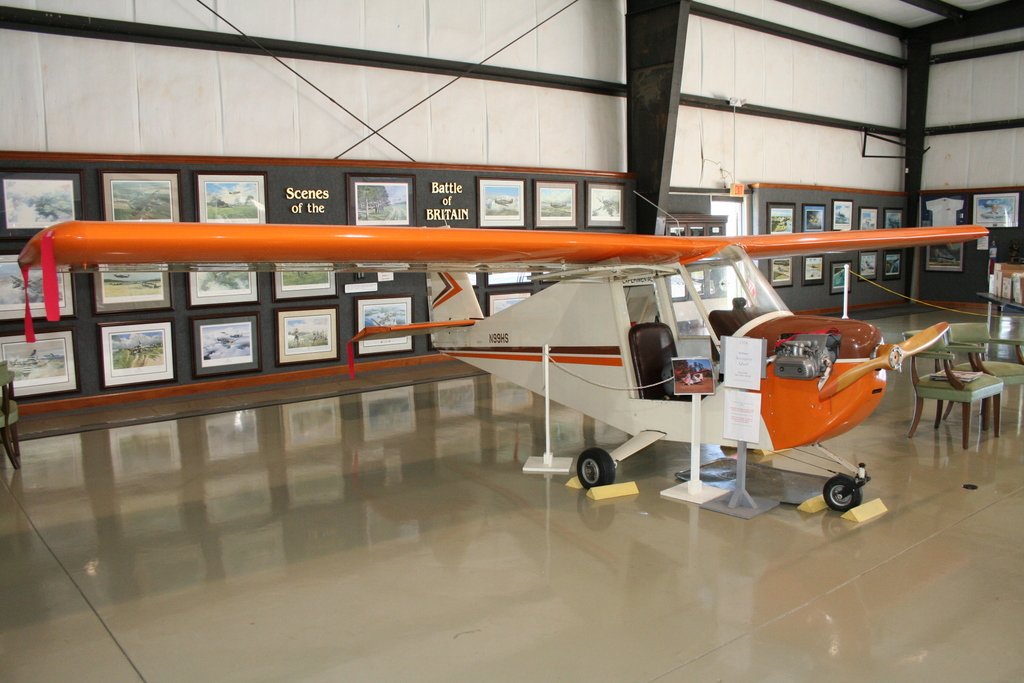
Development and Design Philosophy
Harris L. Woods, an aerospace engineer, founded Aerosport Inc. in 1970 in Holly Springs, North Carolina, with a clear mission: to create affordable aircraft that amateur builders could construct in their garages. The Quail represented Woods' vision of democratizing aviation by combining an enclosed cabin with automotive powerplants, making personal flight accessible before the ultralight movement gained momentum.
The Quail's design centered on practicality over performance. Woods chose a high-wing configuration for stability and ease of construction, while the enclosed cabin distinguished it from the open-cockpit designs common among homebuilts of the era. The aircraft's most distinctive feature was its stubby, compact fuselage that gave it an almost cartoonish appearance—hence the "Quail" designation that perfectly captured its diminutive, rounded profile.
Engine Innovation and Powerplant Options
The Quail's most revolutionary aspect was its powerplant flexibility. Woods designed the aircraft around modified Volkswagen 1600 and 1700cc automotive engines, which offered homebuilders an affordable alternative to expensive aviation engines. These air-cooled, four-cylinder engines had proven their reliability in millions of automobiles since 1937, and their conversion for aviation use opened new possibilities for budget-conscious builders.
Aerosport also offered more exotic powerplant options through a collaboration with Rockwell International. The Aerosport-Rockwell O-32 engine, produced from 1972 to 1976, delivered 38-45 horsepower from its two-stroke, two-cylinder design based on a JLO snowmobile engine. The LB600/2 variant provided either 38 horsepower with a single carburetor or 45 horsepower with dual carburetors, weighing just 56-57 pounds. These engines found applications beyond the Quail, powering aircraft like the Aerosport Rail and the French Calvel Frelon motorglider.
Production and Market Success
Aerosport entered the kit aircraft market in 1971 with an innovative business model. Rather than offering only complete aircraft or basic plans, the company provided three purchasing options: detailed construction plans for the budget-conscious builder, partial kits with pre-fabricated components, or complete packages that included modified engines and all necessary materials.
By 1979, Aerosport had sold approximately 375 sets of Quail plans, making it a modest success in the homebuilt market. While this number paled in comparison to the 1,050 sets of plans sold for the company's Scamp design, the Quail found its niche among builders seeking a simple, enclosed-cabin aircraft for personal recreation.
The Aerosport Family
The Quail was part of a broader product line that showcased Woods' design philosophy. The company also produced the Rail, introduced alongside the Quail in 1971, and the Scamp, which debuted in 1973. Woods had previously designed the Woody Pusher, demonstrating his commitment to unconventional configurations that prioritized builder-friendliness over conventional aesthetics.
Each Aerosport design shared common DNA: simplified construction techniques, automotive powerplant compatibility, and emphasis on affordable personal aviation. This approach reflected the grassroots homebuilt movement of the early 1970s, when experimental aircraft regulations encouraged individual innovation and creativity.
Legacy and Current Status
Aerosport's operational period remains somewhat mysterious, with the company definitely active through 1979 based on plan sales records, and engine collaboration projects continuing into the mid-1970s. Harris Woods' ultimate fate and the company's closure date are not well documented, reflecting the informal nature of many early kit aircraft manufacturers.
Today, the Quail's legacy lives on in museums and private collections. The Pima Air & Space Museum in Tucson, Arizona, displays a restored Quail as part of their general aviation collection, representing the innovative spirit of 1970s homebuilt aviation. The exact number of Quails still flying remains unknown, as tracking homebuilt aircraft proves challenging due to their experimental registration status and private ownership.
Impact on Homebuilt Aviation
While the Quail never achieved the widespread recognition of designs like the Van's RV series or Burt Rutan's creations, it played an important role in proving that enclosed-cabin aircraft could be built affordably by amateur constructors. The design's emphasis on automotive engine conversions influenced later homebuilt designs and helped establish the viability of non-certified powerplants in experimental aircraft.
The Quail represents a specific moment in aviation history when innovative designers like Harris Woods believed that personal flight should be accessible to anyone with basic mechanical skills and modest financial resources. Though production numbers remained limited, the aircraft fulfilled its mission of bringing enclosed-cabin flying to the grassroots level of American aviation.