
Design Innovation and Development
The Q2 emerged from the innovative partnership between Quickie Aircraft Corporation founders Tom Jewett and Gene Sheehan, who commissioned Canadian designer Garry LeGare to create their vision of an efficient two-seat homebuilt. Building upon the success of their single-seat Q1, which had won EAA's Outstanding New Design award in 1978, the team sought to develop a cross-country capable aircraft that maintained exceptional efficiency while accommodating a passenger.
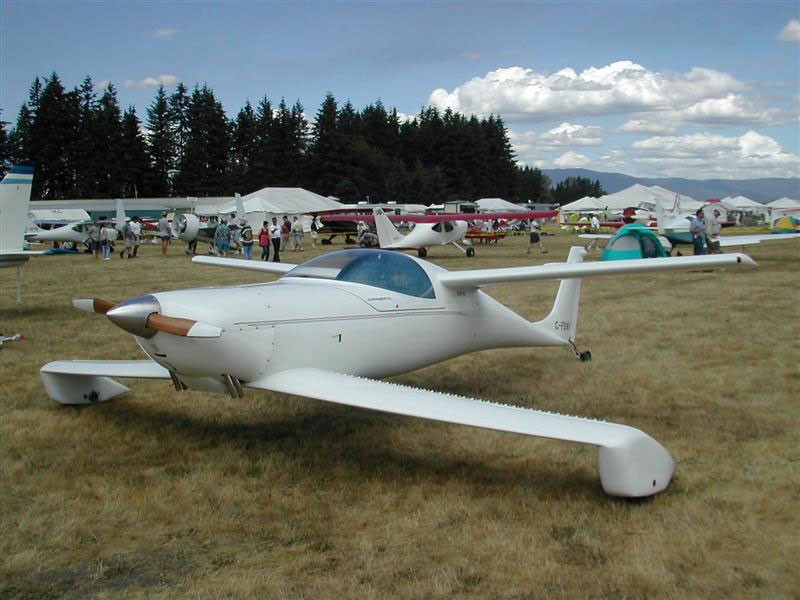
LeGare's design incorporated a distinctive tandem-wing canard configuration, featuring negative stagger that resembled a biplane arrangement. The aircraft utilized full fiberglass composite construction throughout its fuselage and wings, an advanced technique for homebuilt aviation in 1980. Construction of the prototype began after receiving approval in February 1980, with LeGare completing the aircraft in his Surrey, British Columbia workshop in just four and a half months.
First Flight and Performance
The prototype Q2 took to the skies around July 1, 1980, at Abbotsford, British Columbia, accumulating eight hours of initial flight testing at that location. The aircraft immediately demonstrated impressive performance characteristics, achieving cruise speeds of 165 mph indicated airspeed while consuming minimal fuel. Despite being only 2.5 feet longer than the single-seat Q1, the Q2 actually featured 15 percent less wing area than its predecessor while maintaining superior performance.
The aircraft's efficiency proved remarkable for its era. With an empty weight of 537 pounds when equipped with full electrical systems and radio equipment, the Q2 achieved a wing loading of 14.54 pounds per square foot and a power loading of 15 pounds per horsepower. Climb performance exceeded twice that of the Q1, approaching the capabilities of Burt Rutan's VariEze while maintaining lower drag characteristics.
Engine and Technical Specifications
Powering the Q2 was the Revmaster 2100-D, a specially modified Volkswagen-derived aviation engine producing 64-65 horsepower. Revmaster had detuned the engine by removing the blower and limiting maximum RPM to 3,200 to enhance reliability for aircraft applications. Despite the modest power output, the engine proved highly responsive and efficient, enabling the Q2 to achieve a range of 480 nautical miles.
The cockpit accommodated pilots up to six feet six inches tall with three inches of headroom, while the 43-inch cabin width provided comfortable side-by-side seating. Retractable landing gear housed in wingtip pants reduced drag during flight, while the aircraft's trailerable design allowed owners to transport their planes behind automobiles when disassembled.
Quickie Aircraft Corporation
Quickie Aircraft Corporation operated under the philosophy of providing "more flying enjoyment for less money," pioneering affordable composite kit aircraft during the late 1970s and early 1980s. The company had established itself with the Q1 in 1978 before expanding their lineup with the two-seat Q2. QAC handled manufacturing and distribution primarily throughout the United States, while Leg-Air Aviation Limited managed Canadian sales and support.
The partnership proved highly successful during the early 1980s. QAC began Q2 production in 1980, maintaining manufacturing through the mid-1980s before market conditions and company challenges led to cessation of operations. The company's closure by the late 1980s or early 1990s effectively ended Q2 production, causing the type to largely disappear from the homebuilt market.
Production Success and Record Setting
More than 2,000 Q2 kits were sold during the production run, contributing to the overall Quickie program total of 3,000 one- and two-seat kits sold by the late 1990s. The aircraft's performance capabilities were demonstrated publicly through record-setting flights, including achievements in the under-500 kilogram class during 1980, its introduction year.
Demonstration flights showcased the Q2's short-field capabilities with takeoffs completed in as little as 500 feet, impressive performance for a cross-country touring aircraft. The combination of efficiency, performance, and reasonable construction costs attracted significant attention within the experimental aircraft community.
Legacy and Current Status
The Q2's influence on homebuilt aviation extended far beyond its production numbers. The aircraft helped popularize composite construction techniques among amateur builders while demonstrating that canard designs could provide practical transportation rather than merely experimental novelties. The type appeared prominently in aviation publications including Homebuilt Aircraft magazine in 1981 and various EAA publications throughout the decade.
Today, the Q2 has "virtually disappeared" from active flying, though examples persist in private hands and museums. The Canada Aviation and Space Museum in Ottawa preserves Q2 registration C-GGLC (artifact 1990.0246), which was built in 1984 and acquired by the museum in 1990. This particular example represents one of the most accessible Q2 specimens for public viewing, serving as a testament to the innovative spirit of 1980s homebuilt aviation.