
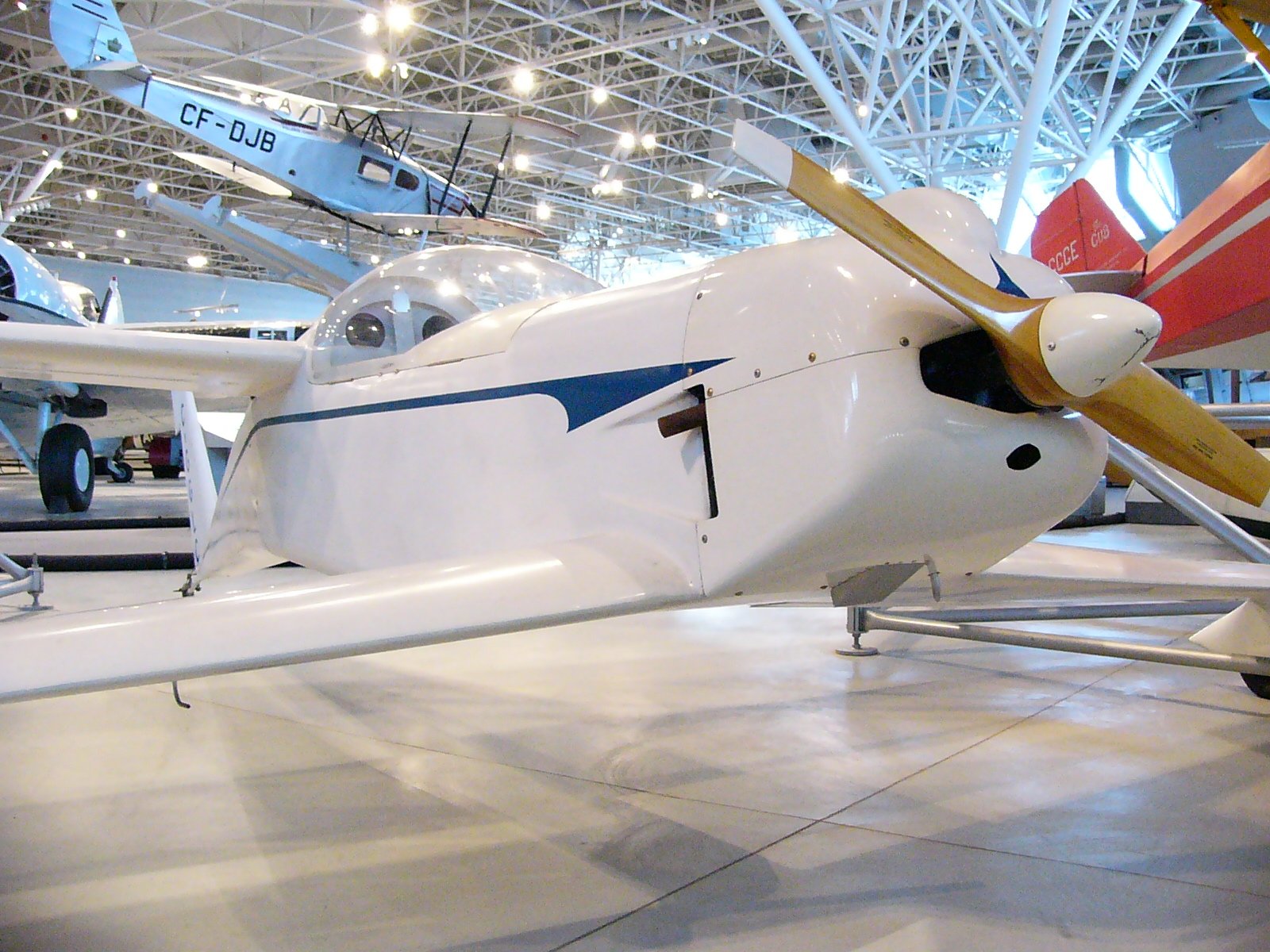
Design Innovation
The Quickie emerged from the collaborative efforts of three visionary designers: Burt Rutan, Gene Sheehan, and Tom Jewett. Design work commenced in 1975 with ambitious objectives to create an ultra-efficient, low-cost homebuilt aircraft. Rutan designated it Model 54 in his design series, incorporating his signature tandem-wing configuration with a canard foreplane and main wing positioned aft. The prototype N77Q required approximately 400 hours to complete at Rutan Aircraft Factory, with construction beginning in August 1977.
The aircraft's revolutionary composite construction utilized foam-and-glass-fiber materials, creating an exceptionally lightweight yet strong airframe. The designers employed the GU25-5(11)8 airfoil developed by Terence Nonweiler, though this profile later demonstrated performance limitations in wet weather conditions. The tailless configuration represented a departure from conventional homebuilt designs of the era.
The Manufacturer
Quickie Aircraft Corporation launched in June 1978 in Mojave, California, founded by Gene Sheehan and Tom Jewett as co-founders. The company capitalized on the prototype's success by offering complete kits to homebuilders. Operations continued successfully through the early 1980s, with the company expanding its offerings to include the two-seat Q2 variant designed by Garry LeGare, Jewett, and Sheehan.
Tragedy struck the company when Tom Jewett perished in the crash of the Free Enterprise prototype on July 2, 1982. This experimental variant, powered by a PZL-Franklin PZL-F 4A-235 turbocharged engine producing 135 horsepower, was designed for long-range record attempts. A subsequent lawsuit following a Q1 crash, though eventually overturned on appeal, inflicted severe financial damage on the company. Quickie Aircraft Corporation filed for bankruptcy in 1986, ending eight years of innovative kit aircraft production.
Engine and Performance
The Q1's powerplant consisted of a modified Onan 18-horsepower industrial four-stroke engine, weighing 70 pounds and operating at 3,600 rpm. Onan Corporation provided assistance in adapting their industrial engine for aviation use. This modest powerplant enabled the aircraft to achieve its design goal of 7 miles per hour per horsepower, resulting in cruise speeds around 126 miles per hour.
The engine's reliability proved exceptional for low-power aviation applications, though later variants in the 1980s received more powerful engines. The Q2 variant utilized a more robust powerplant that significantly enhanced performance capabilities, contributing to its commercial success.
Production Success
Quickie Aircraft Corporation sold approximately 1,000 Q1 kits during the aircraft's production run from June 1978 through the mid-1980s. The two-seat Q2 variant achieved even greater commercial success, with combined sales of Q1 and Q2 kits reaching between 2,000 and 3,000 units before production ceased around 1986-1987. The Q2 became the company's bestseller, praised by builders and pilots for its enhanced performance and practical two-seat configuration.
The Q2 prototype first flew on July 1, 1980, at Abbotsford, British Columbia, following development work that began in 1979. Its success in the marketplace demonstrated the viability of tandem-wing composite aircraft for the homebuilt market.
Builder Experience
Typical construction projects required substantial time investments from amateur builders. The example of C-GGLC, built by J.D. Vos in Brantford, Ontario, illustrates the typical builder experience. Vos constructed his kit between 1983 and 1984, achieving first flight in October 1984. His completed aircraft participated in local flights and appeared at the 1986 Hamilton air show, demonstrating the aircraft's capability as a sport flying machine.
Legacy and Museum Preservation
The Quickie's influence extended beyond its production numbers, popularizing composite construction techniques and tandem-wing configurations among homebuilt aircraft enthusiasts. The design philosophy emphasized efficiency and innovation over raw performance, inspiring subsequent generations of experimental aircraft.
Today, C-GGLC resides in the Canada Aviation and Space Museum's Reserve Hangar, donated in 1990 as a representative example of 1980s homebuilt aviation innovation. The aircraft continues to receive attention from aviation enthusiasts through specialized publications and online communities dedicated to preserving the type's legacy.
While exact numbers of airworthy examples remain unknown, the Quickie's impact on homebuilt aviation far exceeded its modest production numbers, establishing composite construction and efficient design as fundamental principles in experimental aircraft development.