
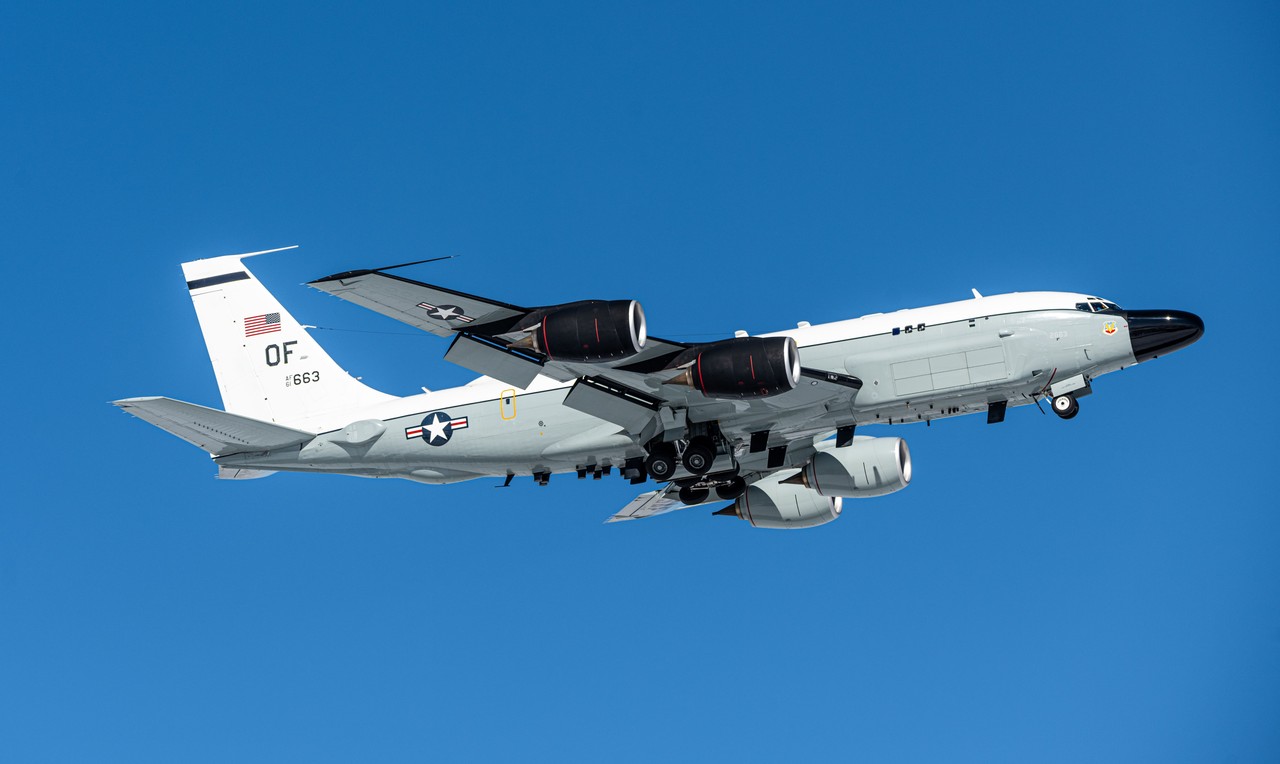
Service History
The RC-135 achieved an unparalleled record of operational excellence, with the Rivet Joint program establishing the longest unbroken presence of any aircraft in Air Force inventory. On August 9, 2010, the RC-135W variant marked its 20th anniversary of continuous service in Central Command, a streak beginning with Desert Shield operations. During this remarkable period, RC-135 aircraft flew more than 8,000 combat missions supporting ground and air forces across multiple theaters.
The aircraft proved indispensable during major conflicts including Operations Desert Storm, Northern Watch, Southern Watch, Iraqi Freedom, and Enduring Freedom. Its sophisticated signals intelligence capabilities made it the backbone of electronic reconnaissance operations, gathering critical intelligence that shaped tactical and strategic decisions throughout these campaigns.
Operational Variants
Boeing delivered the original RC-135 fleet in multiple configurations, each serving distinct reconnaissance roles. The RC-135B represented the initial production version, with ten aircraft manufactured but never used operationally due to lack of mission equipment. These aircraft were transported to Martin Aircraft in Baltimore, Maryland, where the Big Safari program transformed them into operational RC-135C variants with full mission capabilities.
The RC-135D entered service in 1962 as an improved production variant, while six RC-135M aircraft (tail numbers 62-4131, 62-4132, 62-4134, 62-4135, 62-4138, and 62-4139) underwent extensive modifications by the early 1980s to become RC-135W Rivet Joint aircraft. This latest variant continues as the primary signals intelligence platform for both American and British forces.
International Operations
The Royal Air Force recognized the RC-135's exceptional capabilities, acquiring three aircraft for their own reconnaissance operations. The first British RC-135W (ZZ664) arrived on November 12, 2013, followed by the second (ZZ665) in September 2015. The third aircraft (ZZ666) joined the fleet in June 2017, entering full operational service by December 2017, expanding the platform's global reach.
The Manufacturer
Boeing Aircraft Company developed the RC-135 as part of their highly successful C-135 family, which also spawned the legendary KC-135 Stratotanker and commercial 707 and 720 aircraft. The C-135 airframe first took flight in August 1956, providing Boeing with a versatile platform adaptable to multiple military and civilian roles.
Boeing continues operations today under its original name, though the company has undergone significant corporate transformations since the RC-135's development. The durability of Boeing's original C-135 design demonstrates the company's engineering excellence, with variants remaining in active service more than 65 years after the initial flight.
Design Innovation
The RC-135's design philosophy centered on creating a long-range reconnaissance platform capable of extended electronic surveillance missions. Boeing engineers adapted the proven C-135 airframe specifically for signals intelligence operations, incorporating sophisticated electronic equipment while maintaining the aircraft's operational flexibility and reliability.
The four-engine configuration provided the power and redundancy necessary for extended missions over potentially hostile territory. With a crew of 27 personnel, the aircraft could accommodate the substantial number of specialists required to operate complex electronic surveillance systems during lengthy reconnaissance flights.
Performance Characteristics
The RC-135 demonstrated impressive performance capabilities across its operational envelope. Maximum speed reached 581 miles per hour, though operational speeds varied from 375 to 750 miles per hour depending on specific variants and mission requirements. The aircraft's 41.1-meter length and 39.9-meter wingspan provided substantial internal volume for mission equipment and crew accommodations.
These performance characteristics enabled the RC-135 to conduct missions requiring both high-speed transit to operational areas and extended loitering time over areas of interest. The aircraft's operational ceiling and range specifications allowed it to operate effectively in diverse geographic regions and weather conditions.
Production Legacy
Boeing's production of 32 RC-135 aircraft between 1961 and the early 1960s created a reconnaissance fleet that would serve for decades beyond its original design life. The limited production run reflected the specialized nature of signals intelligence operations and the substantial cost of equipping each aircraft with cutting-edge electronic systems.
Service introduction began in 1961 with the RC-135S model, establishing a reconnaissance capability that would prove invaluable through the Cold War and into modern conflicts. The aircraft's longevity demonstrates the wisdom of Boeing's engineering approach and the Air Force's commitment to maintaining these critical intelligence-gathering platforms through continuous upgrades and modifications.