
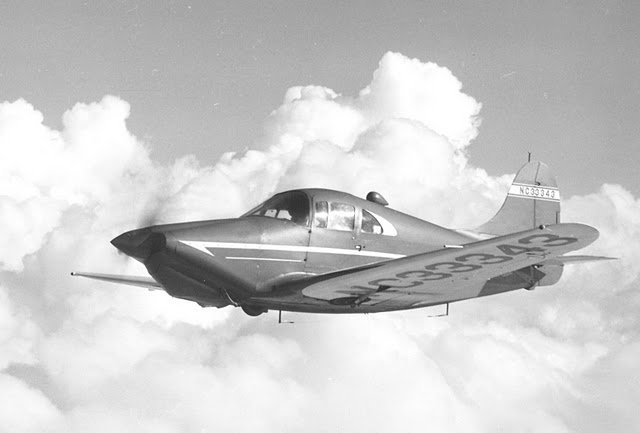
Development and Design Origins
The Rocket 185 emerged from the creative efforts of designer "Pop" Johnson, who initially developed the concept through his homebuilt Rocket 125 prototype in 1942. Johnson's original design featured a low-wing cabin monoplane configuration with tail-wheel landing gear, registered as N41674 and powered by a Lycoming O-290 engine. This prototype, which never received commercial certification, remains on the aircraft register today and is preserved at the Swift Museum in Athens, Tennessee.
Johnson's design philosophy centered on creating a high-performance aircraft accessible to civilian pilots at the relatively modest price of $5,000—a significant achievement in the immediate post-war aviation market. The transition from the Rocket 125 to the more powerful Rocket 185 was announced in August 1945, with Johnson incorporating aerobatic-strength construction capable of withstanding 9G loads despite its civilian designation.
Manufacturing and Certification
Johnson Aircraft began production at their Fort Worth, Texas facility, with the prototype achieving first flight in August 1945. The certification process proceeded rapidly, with the aircraft receiving FAA Type Certificate A-776 on September 10, 1946. Fred Pittera, an experienced military pilot who had served as an Advanced Military Pilot Training instructor on B-24 Bombers at nearby Fort Worth Army Air Field, joined the company as test pilot in August 1945 and conducted the crucial certification flights.
The corporate structure underwent significant changes during the certification period. Around 1946, Rocket Aircraft Sales Corp., the national distributor, acquired controlling interest in Johnson Aircraft and renamed the operation Rocket Aircraft, Inc. This transition marked the effective end of Rocket 185 production, with the type certificate subsequently passing to J.C. Pirtle.
Technical Innovation and Performance
The Rocket 185's construction utilized advanced materials and techniques for its era. The fuselage featured 4130 steel tubing covered with plywood and fabric, while the wings employed primarily wooden construction with fabric covering. The aircraft incorporated retractable tricycle landing gear, an innovative feature that distinguished it from many contemporary designs.
Powered by the Lycoming O-435-A, a six-cylinder, horizontally-opposed, air-cooled engine producing 185 horsepower, the aircraft achieved impressive performance figures. Maximum speeds reached 180-200 mph, with a cruise speed of 185 mph and a service ceiling of 24,500 feet. The rate of climb approached 2,000 feet per minute, while the stall speed remained manageable at 50-54 mph. Fuel consumption at cruise power settings of 25/25 averaged 14.5 gallons per hour from the aircraft's 55-56 gallon fuel capacity, providing a range of approximately 925 miles.
Limited Production and Market Challenges
Despite its impressive performance capabilities, the Rocket 185 faced significant market challenges that severely limited its commercial success. Production between 1946 and 1951 totaled only 18 to 19 aircraft, with poor sales attributed primarily to competition from four-seat alternatives that offered greater utility for the same price category. The aircraft's two-seat configuration, occasionally expanded to three seats, restricted its appeal in a market increasingly dominated by family-oriented general aviation aircraft.
The limited production run reflected broader challenges in the post-war aviation industry, where numerous manufacturers competed for a market that proved smaller than wartime projections had suggested. The Rocket 185 competed directly with established designs such as the Aeronca Arrow, Culver Cadet, and Globe GC-1 Swift, all representing the high-performance, low-wing monoplane category of the 1940s.
Subsequent Development and Legacy
In the early 1950s, the design rights transferred to Aircraft Manufacturing Company, based in Tyler, Texas, which developed a refined four-seat variant designated the Texas Bullet 205. This evolution incorporated a Menasco inline engine but failed to achieve commercial success, highlighting the persistent market challenges facing high-performance general aviation aircraft of the era.
The Rocket 185's historical significance extends beyond its limited production numbers. The aircraft represented the optimistic post-war belief in the potential for affordable high-performance aviation, incorporating advanced engineering concepts such as the innovative "jet assist" exhaust system that claimed to convert engine exhaust into useful thrust above 40 mph. This feature, while of questionable effectiveness, demonstrated the era's experimental approach to civilian aircraft design.
Operational History and Current Status
The Rocket 185 served exclusively in civilian roles, marketed primarily to experienced pilots seeking high-performance personal or business aircraft. The type's operational history includes at least one notable accident: on September 3, 1972, a Rocket 185 was destroyed in a stall accident while operating in the congested traffic pattern at Antique Air Field in Blakesburg, Iowa, resulting in the loss of both occupants.
Today, the Rocket 185 represents a significant chapter in American general aviation history, demonstrating both the innovation and market realities of the immediate post-war period. Its influence can be traced through subsequent high-performance general aviation designs, while its preservation in museums and continued registration of the original Rocket 125 prototype ensures its legacy remains accessible to aviation historians and enthusiasts.