
Service History
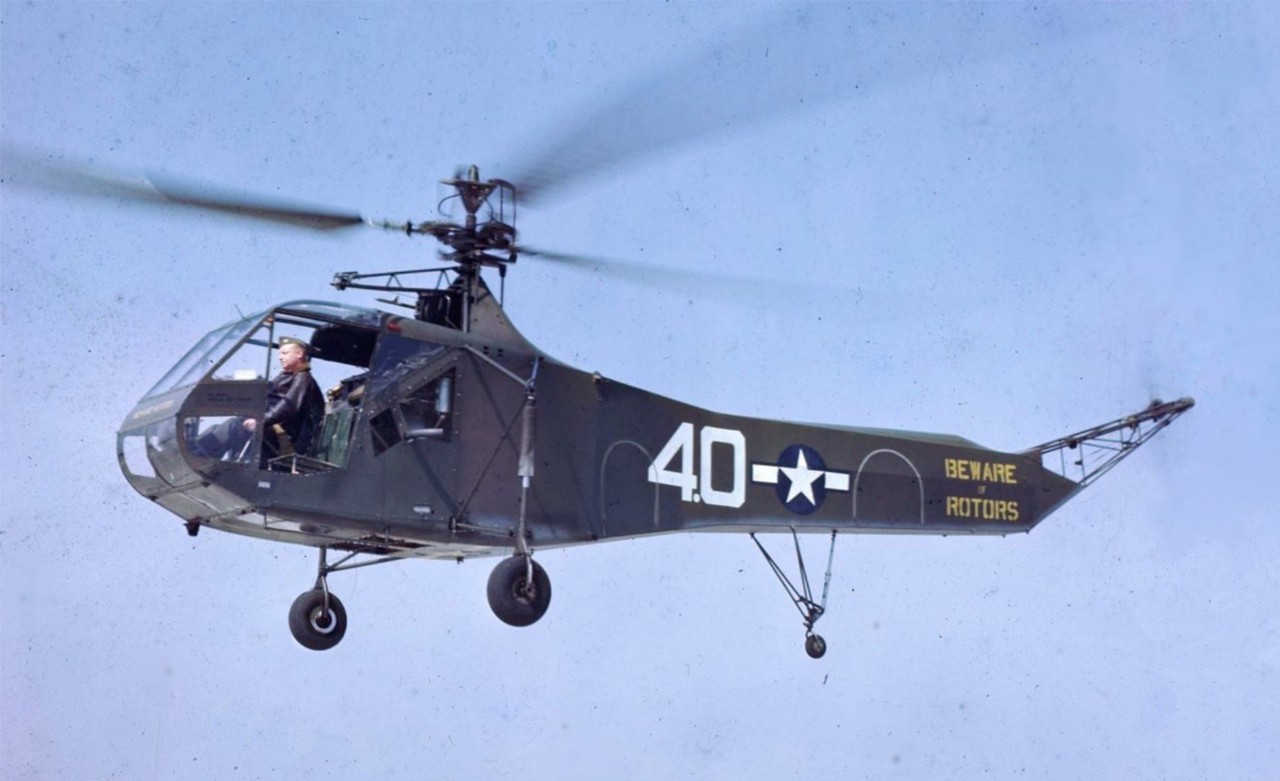
The R-4 dominated early helicopter operations across multiple military branches during World War II. The United States Army Air Forces received 35 R-4B aircraft for observation and liaison duties, while the U.S. Navy operated 20 HNS-1 variants for reconnaissance and air-sea rescue missions. Under the Lend-Lease program, 45 aircraft were supplied to Britain where they served as the Hoverfly I with the Royal Air Force and Royal Navy, replacing autogiros in No. 529 Squadron from August 1944.
Operational Milestones
The R-4 established the foundation of helicopter operations through a series of groundbreaking achievements. On May 7, 1943, Colonel Frank Gregory performed the first helicopter landing at sea aboard the tanker Bunker Hill in Long Island Sound. The prototype XR-4 completed a remarkable 761-mile cross-country flight from Connecticut to Wright Field, Ohio, on May 17, 1942, covering the distance in 16 hours and 10 minutes of flying time. Perhaps most significantly, on April 21, 1945, a single Canadian R-4 conducted the first helicopter rescue in Arctic conditions, establishing the life-saving role that would define helicopter operations for decades.
The Manufacturer
Sikorsky Aircraft, founded by aviation pioneer Igor Sikorsky, had been acquired by United Technologies Corporation in 1929. The company's Bridgeport, Connecticut facility became the birthplace of practical helicopter aviation. Under Igor Sikorsky's direct leadership, the engineering team developed the R-4 from the experimental VS-300 helicopter, which had been publicly demonstrated in 1940. Today, Sikorsky continues operations as a subsidiary of Lockheed Martin following the acquisition of UTC's aerospace division, remaining one of the world's premier helicopter manufacturers.
Engine and Technical Innovation
The R-4 utilized Warner R-550 series radial piston engines manufactured by Warner Aircraft Engine Company. The prototype XR-4 was powered by a 165-horsepower Warner R-500-3, while the developmental YR-4A received the 180-horsepower R-550-1. Production R-4B aircraft featured the definitive 200-horsepower Warner R-550-3 engine. The aircraft's revolutionary design included a fully-enclosed cabin with unprecedented dual controls, enabling proper flight training and operational flexibility.
The helicopter's construction featured a framework of heavy-gauge steel tubing with fabric-covered fuselage and rotor blades. This combination provided sufficient structural integrity while maintaining reasonable weight for the limited power available from contemporary piston engines. The main rotor diameter measured 38 feet, providing adequate lift for the two-crew configuration.
Performance Characteristics
Pilots found the R-4 to be a stable but underpowered platform that nonetheless proved the viability of helicopter flight. The aircraft achieved a maximum speed of 90 mph with a more practical cruise speed of 65 mph. Its service ceiling reached 8,000 to 12,000 feet depending on conditions and loading, while operational range extended to 130 miles. These performance figures, modest by later standards, represented remarkable achievements for the world's first production helicopter.
The R-4's handling characteristics required extensive pilot training, leading to the establishment of formal helicopter flight schools. The U.S. Coast Guard operated three YR-4B aircraft specifically for training purposes, while the RAF established a Helicopter Training School at Andover in early 1945 using Hoverfly I aircraft.
Production and Variants
Sikorsky manufactured between 130 and 133 R-4 helicopters during the three-year production run from 1942 to 1945. Production encompassed the single XR-4 prototype, developmental YR-4A and YR-4B variants, and the definitive R-4B production model. The U.S. Army Air Forces redesignated surviving R-4 aircraft as H-4B in 1948, though most had already been retired by that time.
Legacy and Preservation
The R-4's operational career proved brief, as improved designs like the Sikorsky R-5/S-51 series quickly superseded it in the immediate postwar years. However, its historical significance remains undiminished as the aircraft that established helicopter operations as a practical military capability. The National Air and Space Museum in Washington, D.C., preserves the XR-4C prototype, representing the culmination of Igor Sikorsky's decades-long pursuit of practical helicopter flight that began in 1909.
Few R-4 aircraft survive today, with most examples residing in museums rather than active flight status. The Air Force Museum maintains exhibits documenting the R-4B's pioneering military service. Despite its limited production numbers and short service life, the R-4 Hoverfly established the operational template for helicopter rescue, observation, and transport missions that continues to define rotorcraft aviation today.