
Development and Design Innovation
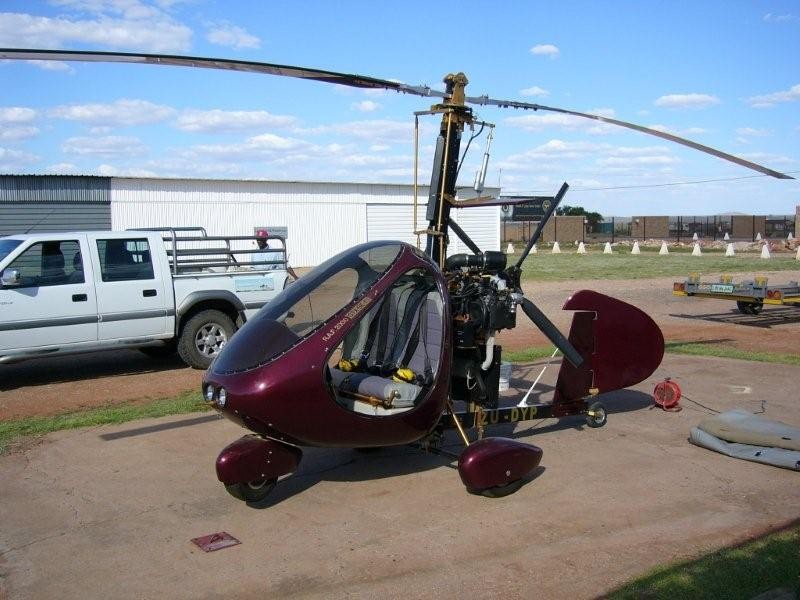
Bernard J. Haseloh designed the RAF 2000 based on extensive experience, having accumulated over 2,000 flight hours on experimental prototypes and 10,000 hours in gyroplane development. His design philosophy centered on creating a controllable, user-friendly trainer that would transition the autogyro from purely recreational use to serious cross-country flying. The RAF 2000 evolved from earlier open-frame designs to feature a fully enclosed side-by-side cabin configuration, a significant departure from traditional autogyro layouts.
Haseloh's engineering innovations included a patented two-part mast system utilizing a rigid 2x4-inch mast that replaced the unstable 2x2-inch designs common in earlier autogyros. This modification dramatically reduced control problems caused by rotor drag and lift variations. The aircraft also featured a Rotor Stabilator system that decoupled rotor and fuselage motion, making the transition easier for fixed-wing pilots accustomed to conventional aircraft handling characteristics.
Manufacturing History
Rotary Air Force Marketing Inc. launched the RAF 2000 in 1989 from their facility in Kindersley, Saskatchewan, Canada. The aircraft represented a natural evolution from the company's single-seat RAF 1000, expanding the market to include flight training and passenger-carrying operations. For 18 years, the Canadian operation sold kits globally to private builders and flight schools seeking a modern autogyro design.
The company faced significant challenges in 2005 when a Michigan lawsuit arose from the death of kit builder Ken Becker, who had bypassed mandatory flight training. Defense costs exceeded US$250,000, resulting in a default judgment that devastated the company's finances and reputation. Lost sales and mounting legal pressures forced Rotary Air Force Marketing Inc. to sell manufacturing rights in April 2007.
South African Revival
UMRTC Eben Mocke, operated by the Mocke Family in Upington, Northern Cape, South Africa, acquired the rights in April 2007. Operating as Rotary Air Force South Africa (RAFSA), the new owners revitalized production while emphasizing the RAF 2000 as the "world's finest cross-country gyroplane." RAFSA achieved a significant milestone in 2015 by gaining South African Civil Aviation Authority approval for both kit-built and factory-built versions, expanding market accessibility.
The South African operation has invested heavily in research and development, focusing on advanced airfoils and composite materials. This technical emphasis has maintained the RAF 2000's competitive position in the modern autogyro market, where safety and performance standards continue evolving.
Technical Specifications and Performance
The RAF 2000 utilizes a Subaru EA-82 four-cylinder horizontally-opposed engine, typically producing 97 kW (130 hp), though variants range from 75 kW (100 hp) to the full 130 hp output. This automotive-derived powerplant, manufactured by Fuji Heavy Industries from the late 1970s to early 1990s with approximately 1-2 million units produced for automotive applications, proved reliable when adapted for aviation use. The pusher configuration positions the engine behind the enclosed cabin, driving both the propeller and rotor spin-up system through a clutch mechanism.
The aircraft measures 4.11 meters (13 feet 6 inches) in length and 2.49 meters (8 feet 2 inches) in height, with removable composite and aluminum rotor blades spanning 9.14 meters (30 feet) in diameter. Empty weight reaches 331 kg (730 pounds), while maximum takeoff weight is certified at 698 kg (1,540 pounds). Performance includes a maximum speed of 161 km/h (100 mph), cruise speed of 121-130 km/h (75-80 mph), and minimum flying speed of just 65 km/h (40 mph).
With 87 liters (19 Imperial gallons) of fuel capacity, the RAF 2000 achieves a range of 382 km (237 miles) and endurance of 3-4.6 hours. Rate of climb reaches an impressive 1,000-1,200 feet per minute (5-6.1 m/s), providing strong performance for an autogyro in this class.
Regulatory Challenges
The RAF 2000 achieved the rare distinction of type approval from the UK Light Aircraft Association, unusual recognition for kit-built autogyros. However, regulatory issues emerged in 2009 when the UK Civil Aviation Authority issued an MPD (Mandatory Permit Directive) restricting unmodified aircraft following a fatal accident. The restrictions included prohibition of doors, maximum speed limitation to 70 mph, and crosswind limits of 7 knots or less, citing incomplete compliance with BCAR Section T requirements.
Current Status and Legacy
Production continues under RAFSA management, offering both kit and factory-built versions to global customers. While exact production numbers remain unavailable, examples operate worldwide, including aircraft like G-0615 (construction number H2-00-11-452/ASRA1197) based at Albion Park, New South Wales, Australia. The RAF 2000 represents modern autogyro evolution from Juan de la Cierva's 1919 concepts, emphasizing safety innovations and thrust-line stability for sport aviation applications.
Several variants exist, including the RAF 2000 STD-SE, GTX, and GTX SE models, each tailored to specific operational requirements. The aircraft's significance lies in demonstrating that kit-built autogyros could achieve professional standards previously reserved for certified aircraft, bridging the gap between experimental aviation and serious cross-country flying capabilities.