
Design Philosophy and Innovation
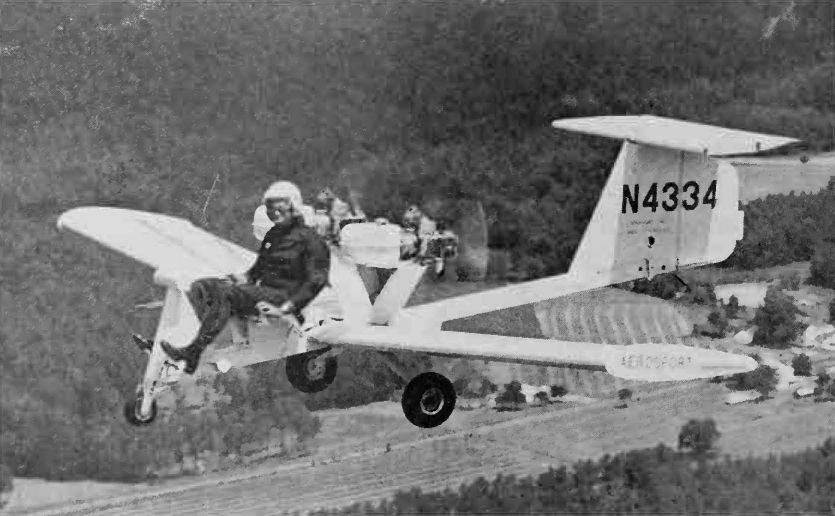
The Rail emerged from Harris Woods' revolutionary approach to aircraft design that deliberately stripped away every non-essential component. Woods, an aerospace industry engineer who founded Aerosport Inc., created what amounted to a flying rail—literally a 2 by 5 inch squared aluminum tube serving as both fuselage and pilot seat. This extreme minimalism eliminated traditional elements like windscreens, enclosed cockpits, and conventional fuselage structures to achieve unprecedented cost reduction and manufacturing simplicity.
Despite its primitive appearance, the Rail incorporated sophisticated engineering solutions. The T-tail configuration positioned the empennage out of propeller wash, eliminating buffet and reducing structural stress on the lightweight tail assembly. The twin-engine pusher layout reduced noise and vibration around the pilot while providing crucial redundancy—engine failures became manageable situations rather than emergencies. During flight testing, pilots successfully executed takeoffs with one engine shut down, maintaining full rudder authority down to the 42 mph stall speed.
Manufacturing and Commercial Reality
Aerosport Inc. sold approximately 175 sets of plans between 1970 and 1977, but the Rail never achieved commercial success as a completed aircraft. The complete kit, including both engines, cost $2,495—roughly 20 percent the price of a new Cessna 150. However, FAA records reveal that beyond the company prototype, only two additional examples received registration numbers: N44HW completed in 1976 and N27T (designated Rail II) finished in 1975.
The original prototype disappeared entirely after its registration cancellation in 1976, just six years after first flight. N44HW accumulated only 14 hours of flight time by June 1976 before deregistration four years later. The fate of N27T remains unclear, with no records confirming whether it ever flew.
Technical Specifications and Performance
The Rail's twin Aerosport-Rockwell LB600 engines represented another innovative element. These 2-cylinder, two-stroke powerplants, based on German-built JLO snowmobile engines, were developed through collaboration between Aerosport and Rockwell International. Though rated at 45 horsepower each, they were de-rated to 25 horsepower for aircraft use, with individual 4-gallon fiberglass fuel tanks mounted ahead of each engine.
Performance figures demonstrated the Rail's capabilities despite its unconventional configuration. The 650-pound gross weight aircraft achieved a takeoff run of 230 feet and could clear 50-foot obstacles within 1,230 feet. Its 900 feet-per-minute climb rate exceeded that of the Cessna 150, while cruise speed at 85 percent power reached 66 mph at 2,000 feet altitude. Total fuel consumption approximated seven gallons per hour, providing a 100-mile range with 220 pounds of payload.
Operational Concept and Legacy
Woods designed the Rail specifically for recreational flying over local terrain—what marketing materials described as flights "over hayfields and picturesque lakes." The aircraft's 12,000-foot service ceiling and 115 mph never-exceed speed provided adequate performance margins, while its 3.8+ G-load limits ensured structural integrity during recreational maneuvering.
Aerosport planned a floatplane variant that would have expanded the Rail's utility, potentially creating an affordable alternative to conventional seaplanes. However, this development never materialized as the company faced broader market challenges affecting private aircraft manufacturers during the mid-1970s.
The Rail's wing design found new life in Aerosport's follow-on aircraft, the Quail, which adapted the wing structure to a more conventional enclosed tractor configuration. This represents the Rail's most tangible legacy—proving that innovative design elements could succeed even when the overall aircraft concept failed commercially.
Historical Significance
The Aerosport Rail stands as a fascinating experiment in aircraft design philosophy, demonstrating how radical minimalism combined with thoughtful engineering could create safe, affordable recreational flying. While it never achieved commercial success, the Rail explored design territories that anticipated modern ultralight aircraft development by decades. Its emphasis on redundancy, simplified construction, and cost-effectiveness established principles that continue influencing recreational aircraft design today.
The Smithsonian Institution now documents the Rail alongside other Aerosport designs including the Scamp, Quail, and Woody Pusher, preserving its place in American aviation history. Whether any examples remain airworthy today is uncertain, but the Rail's influence on minimalist aircraft design philosophy extends far beyond its brief production run and minimal commercial impact.