
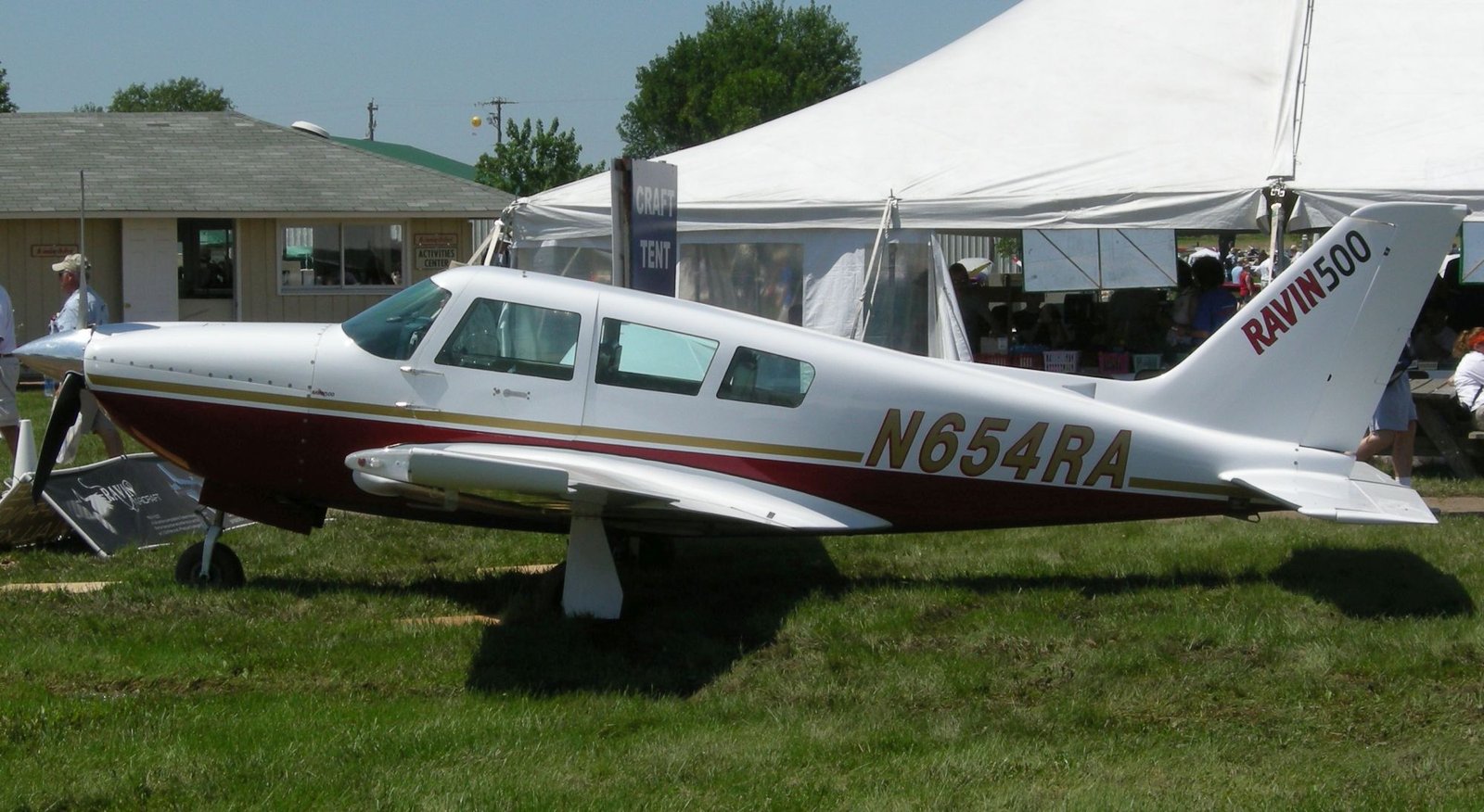
Development and Design
The Ravin 500 emerged from mechanical engineer Jan Troskie's vision to create a modern composite aircraft that captured the best qualities of the classic Piper Comanche. Around 2000, Troskie, himself a Comanche 260C owner, began developing what would become a sophisticated four-seat touring aircraft. He enlisted the expertise of Francois Jordaan, an experienced builder of Lancairs and Papa 51 Thunder Mustangs, to assist with the technical development.
Troskie's design objectives centered on creating an all-composite aircraft smaller than the PA-24 Comanche but with superior performance and modern systems. The team incorporated innovative features including optimized engine air intakes positioned to capture high-pressure pulses from the propeller, enhancing overall efficiency. The aircraft featured a distinctive left-side gull-wing door for passenger access and refined wing design for improved stability.
First Flight and Testing
The prototype Ravin 500, registered ZU-CTW (construction number 1), achieved first flight on September 15, 2002, from Pretoria. A second prototype, ZU-SBC (construction number 2), soon followed to support the test program. The flight testing revealed exceptional stability characteristics that made the aircraft particularly well-suited for autopilot systems, including the TruTrak units that became popular installations.
Performance testing demonstrated cruise speeds near 200 knots, with the aircraft achieving 213 mph at 75% power settings. At the optimum altitude of 6,500 feet, the Ravin 500 could cruise at 226 mph. The design's efficiency became evident in its remarkable 2,300-mile range with 10% fuel reserves, enabled by its 160-gallon fuel capacity.
The Manufacturer
SA Ravin Aircraft operated from Pretoria, South Africa, focusing exclusively on composite kit aircraft production. The company emerged during the early 2000s homebuilt aviation boom, targeting builders who desired Comanche-like performance in a modern composite airframe. While Reliance Aircraft International contributed to some innovations, the company remained primarily a South African operation throughout its active years.
The company's approach centered on offering both kit packages for amateur construction and ready-to-fly completed aircraft. By 2007, kit prices exceeded $90,000 USD, with completed aircraft commanding approximately $250,000. Production remained limited, with the company exporting kits to Australia and the United States alongside domestic South African sales.
Engine and Performance
The Ravin 500's primary powerplant was the proven Lycoming IO-540 six-cylinder horizontally-opposed engine, delivering 260 horsepower through a three-blade Hartzell propeller. This engine choice provided the performance foundation for the aircraft's impressive specifications, including takeoff rolls under 400 meters even at 4,000-foot elevation airports with heavy loads.
A variant model, designated the Ravin 300, utilized the smaller IO-360 engine, while experimental installations included a 300-horsepower upgrade tested on ZU-RMM. The fuel-injected IO-540 configuration proved particularly efficient, enabling the aircraft's exceptional range capabilities that would later be demonstrated on intercontinental flights.
Production and Variants
Production remained limited throughout the aircraft's manufacturing life, with at least six known examples completed by 2014. These included the two prototypes, ZU-RMM (the 300-horsepower variant), a fixed-gear model that first flew in January 2007, VH-LST (construction number 0705016) registered in Australia on July 13, 2009, and ZU-XML (construction number 0905021).
The aircraft achieved international recognition when it was featured on the cover of KITPLANES magazine in April 2007, showcasing its "composite Comanche" credentials and advanced autopilot integration capabilities. Export success included at least three aircraft delivered to Australia and examples reaching the United States, including N913RA.
Notable Operations
The Ravin 500 gained worldwide attention through ZU-XML's ambitious around-the-world flight beginning July 14, 2013, from Cape Town. Operated by Troll Aircraft CC, this aircraft demonstrated the type's long-range capabilities by visiting New Zealand on May 1, 2014, at North Shore Airport, along with stops at Lord Howe Island and Bankstown, NSW, Australia.
This global demonstration flight highlighted the aircraft's suitability for serious cross-country touring, with its combination of speed, range, and payload making it competitive with certified aircraft costing significantly more.
Legacy and Current Status
SA Ravin Aircraft appears to have ceased operations by 2014, with no documented production activity beyond that year. The limited production run means fewer than ten Ravin 500s likely remain airworthy today. Safety records include at least two documented incidents: ZU-XML experienced a non-fatal accident on October 13, 2010, while N913RA was involved in a fatal accident on May 7, 2011, claiming two lives.
The Ravin 500 represents an important chapter in South African aviation innovation, demonstrating how small manufacturers could create sophisticated composite aircraft that rivaled certified designs in performance and capability. While production limitations prevented widespread adoption, the aircraft's technical achievements influenced composite homebuilt design thinking and proved that exceptional performance could be achieved through careful engineering and modern construction techniques.