
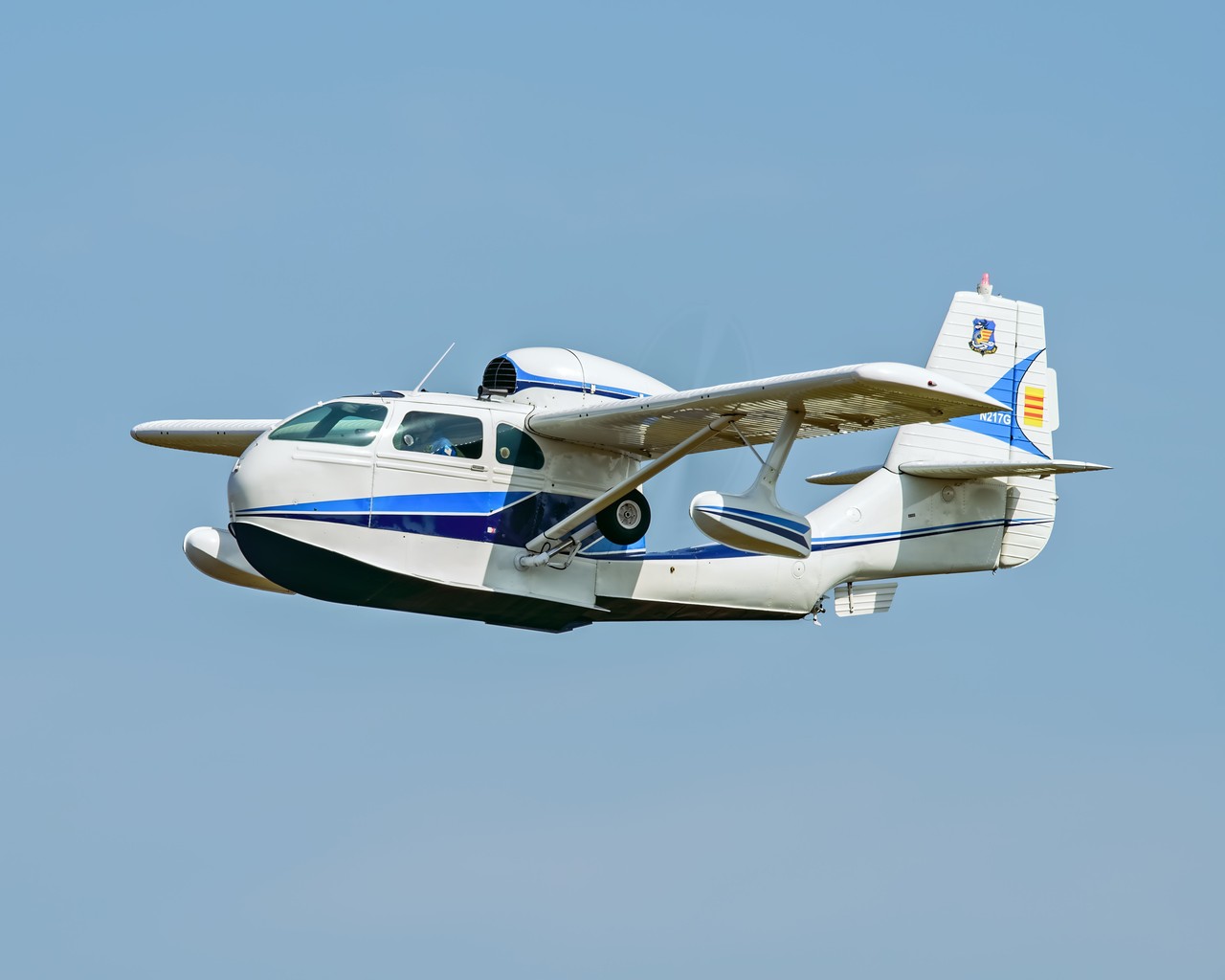
Production Triumph and Market Reality
Republic Aviation Corporation achieved remarkable manufacturing success with the Seabee, producing exactly 1,060 aircraft between 1945 and 1947 at their Farmingdale facility. The prototype (NX87451) rolled off the assembly line on November 22, 1945, followed by the first production model in March 1946. J.G. "Tex" Rankin of Rankin Aviation Industries in Tulare, California, received the inaugural delivery on July 25, 1946, taking possession of aircraft NC87463, production number 13.
Despite this manufacturing achievement, market reality proved harsh. Republic President Mundy I. Peale announced production termination on October 4, 1947, citing sluggish sales and the company's strategic pivot to military contracts. The final new Seabee found a buyer in 1948, marking the end of Republic's civilian aviation venture.
Designer's Vision
Percival Hopkins "Spence" Spencer, who first soloed in 1914, conceived the Seabee as an everyman's amphibian. His design philosophy emphasized practicality over luxury, creating what he termed an aircraft without "airplane frills." Spencer had previously developed the Spencer S-12 Air Car Amphibian, which first flew on August 8, 1941, serving as the foundation for his Republic design.
The Seabee emerged from Spencer's RC-1 Thunderbolt Amphibian, which completed its maiden flight on November 30, 1944, with Spencer at the controls. Republic initially marketed the aircraft under the "Thunderbolt" name before adopting "Seabee" following U.S. Navy approval on February 19, 1945.
Manufacturing Innovation
Republic applied automotive manufacturing principles to aircraft production, pursuing aggressive cost reduction through design simplification. The Seabee eliminated traditional wing ribs, instead relying on corrugated aluminum skin for structural stiffness. This approach, combined with volume component purchasing and assembly-line efficiency, targeted the anticipated postwar aviation boom.
Recognizing engine supply as critical, Republic acquired Aircooled Motors, the Franklin engine manufacturer, on December 27, 1945. This vertical integration ensured reliable access to the Franklin 6V-350-C31 powerplant, a six-cylinder, air-cooled, horizontally opposed engine producing 215 horsepower.
Military Interest and Cancellation
The U.S. military initially showed substantial interest in the Seabee concept. By 1944, Republic had secured 1,972 civilian orders at $3,500 each, while military contracts exceeded $20 million. The U.S. Army Air Forces designated their version OA-15 for air-sea rescue missions, making it the final aircraft to carry the OA designation before the service became the U.S. Air Force in 1947.
However, VJ Day in September 1945 eliminated military demand overnight. The anticipated postwar civilian aviation explosion never materialized, leaving Republic with sophisticated production capabilities but insufficient market demand.
International Service
While American civilian sales disappointed, several foreign military services operated Seabees. The Israeli Air Force, Paraguayan Navy, and Republic of Vietnam Air Force all flew the type, though specific operational details remain limited. These operators valued the aircraft's amphibious capability and robust construction for utility missions rather than combat roles.
Design Philosophy and Capability
Spencer designed the Seabee for maximum utility, accommodating one pilot and three to four passengers while providing generous cabin space for equipment, luggage, or cargo. The aircraft targeted business executives, sportsmen, and families seeking access to remote locations via both land and water. Its all-metal construction promised durability and low maintenance compared to fabric-covered contemporaries.
The high-wing configuration provided excellent water handling characteristics while maintaining adequate ground clearance for conventional landing gear operations. Republic's emphasis on simplicity extended to systems and controls, making the aircraft accessible to pilots with modest experience levels.
Legacy and Preservation
More than 30 Seabees remain airworthy today, testament to Spencer's emphasis on robust construction. The National Air and Space Museum preserves N6709K (serial 992, built June 1947) as a representative example. These surviving aircraft maintain popularity among seaplane enthusiasts who appreciate their utility and distinctive appearance.
The Seabee represents Republic Aviation's ambitious but ultimately unsuccessful attempt to capture civilian market share. While the company had projected annual production of 5,000 aircraft, the actual 1,060 units built highlighted the gap between industry optimism and postwar market reality. This experience influenced Republic's subsequent focus on military contracts, leading to successful programs like the F-84 Thunderjet.
Today, the RC-3 Seabee stands as a symbol of postwar innovation and the entrepreneurial spirit that characterized American aviation's transition from wartime production to peacetime dreams.