
Military Service Excellence
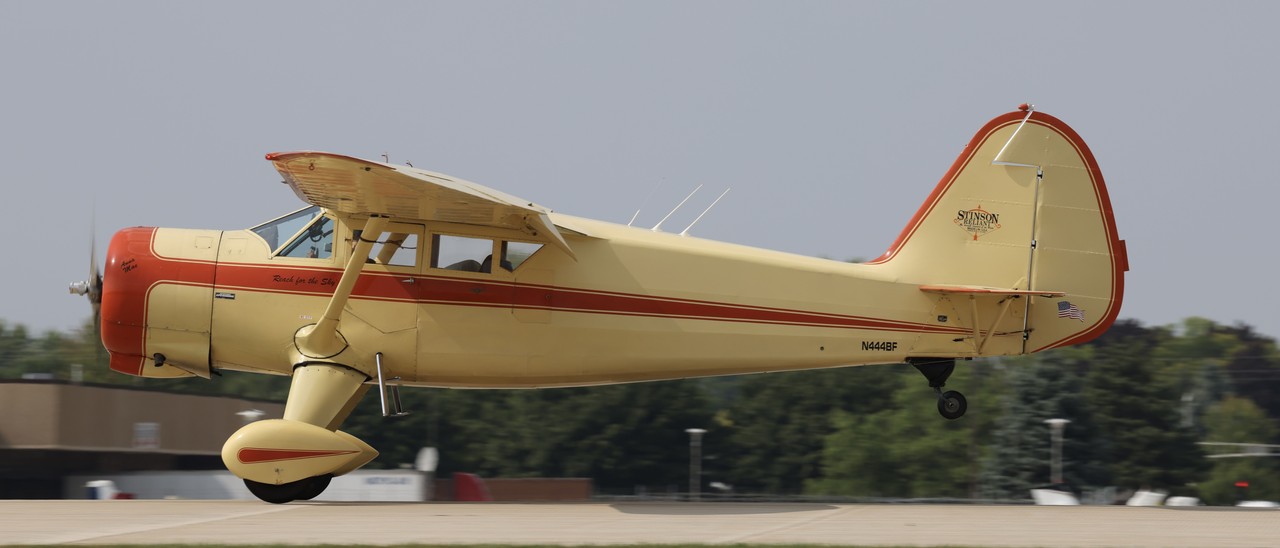
The AT-19 Reliant distinguished itself during World War II as a reliable utility aircraft and trainer, with exactly 500 units built exclusively for the Royal Navy under the Lend-Lease program. The U.S. Army Air Forces designated military variants as UC-81 for utility roles and AT-19 for training missions, while the Royal Air Force and Royal Navy employed them for light transport, communication, liaison, and reconnaissance duties throughout the war.
One documented example, FB768 (construction number 496, USAAF serial 43-44209), illustrates the aircraft's global reach during wartime. Manufactured in late 1944, this AT-19 shipped to England in December 1944 before deploying to India on March 1, 1945, demonstrating the type's versatility across diverse operational theaters.
The Stinson Legacy
Stinson Aircraft Division of the Aviation Manufacturing Corporation operated from Detroit, Michigan, establishing itself as a pioneer in affordable cabin monoplanes during the economically challenging 1930s. The company's original civilian Reliant series, priced at $3,995 in 1933, competed successfully against more expensive rivals by offering four-to-five seat capacity in an attractive, well-appointed aircraft.
Following World War II, Consolidated Vultee acquired Stinson's assets and re-certified wartime military Reliants as civilian V-77 models with new logbooks dated 1946. This corporate lineage eventually merged into General Dynamics and later Lockheed Martin, marking the end of the original Stinson identity. The company's production run from 1933 to 1943 yielded exactly 1,327 Reliants of all variants, representing a significant achievement in general aviation manufacturing.
Engineering Innovation
The AT-19's design incorporated several advanced features that distinguished it from contemporaries. The most notable innovation was the distinctive gull-wing configuration introduced in 1936 with the SR-7 variant, which improved low-speed handling characteristics and earned the aircraft its "Gullwing" nickname. Additional sophisticated features included vacuum-operated wing flaps, hydraulically-operated brakes, constant-speed propellers, leather upholstery, walnut instrument panels, and automobile-style roll-down windows in later models.
Powerplant options reflected the era's diverse engine availability, with manufacturers selecting from Lycoming R-680 series engines (245-300 horsepower), Wright R-760E-2 units producing 300 horsepower, Wright 350-horsepower variants, and Pratt & Whitney R-985 Wasp Junior engines delivering 450 horsepower. All powerplants were air-cooled radial designs from established American manufacturers, ensuring parts availability and maintenance familiarity.
Performance Characteristics
The AT-19 demonstrated impressive specifications for its era, with an empty weight of 2,530 pounds and useful load capacity of 1,345 pounds. These figures allowed operators to carry substantial cargo or passengers while maintaining acceptable performance margins. The aircraft's high-wing configuration provided excellent visibility and stable flight characteristics, making it particularly suitable for training inexperienced military pilots during wartime expansion.
The fixed tailwheel landing gear, while less sophisticated than retractable systems, offered simplicity and reliability crucial for military operations in austere conditions. This design philosophy emphasized maintainability over maximum performance, proving wise for widespread deployment across diverse operating environments.
Production Achievement
Stinson's Detroit manufacturing facility produced military Reliants from February 1942 through late 1943, with the 500 AT-19 trainers representing a substantial portion of total military production. The company's ability to transition from civilian to military manufacturing demonstrated American industry's wartime adaptability, contributing meaningfully to Allied training and utility aircraft requirements.
The production numbers, while modest compared to major combat aircraft programs, reflected the specialized nature of the AT-19's mission. Each aircraft required careful construction to meet military specifications while maintaining the reliability and handling qualities that made civilian Reliants popular with private operators.
Enduring Legacy
Today, numerous Stinson Reliants remain airworthy, testament to their robust construction and enduring appeal. The Museum of Flight in Seattle displays a 1933 SR model donated by Robert Richardson in 1990, while the Commemorative Air Force Nevada Wing continues restoring Royal Navy FB768, acquired in 1991. The National Museum of World War II Aviation maintains a V-77 variant, and Joint Base Elmendorf-Richardson operates N79458, a former Army UC-81 (serial 42-46675, British designation FK-845).
These surviving examples represent the AT-19's significance in bridging 1930s civilian executive aviation with World War II military requirements. The type's continued airworthiness into the 21st century demonstrates exceptional engineering and construction quality, earning recognition as a star of aviation's golden age and maintaining its place in both museum collections and active flying operations worldwide.