
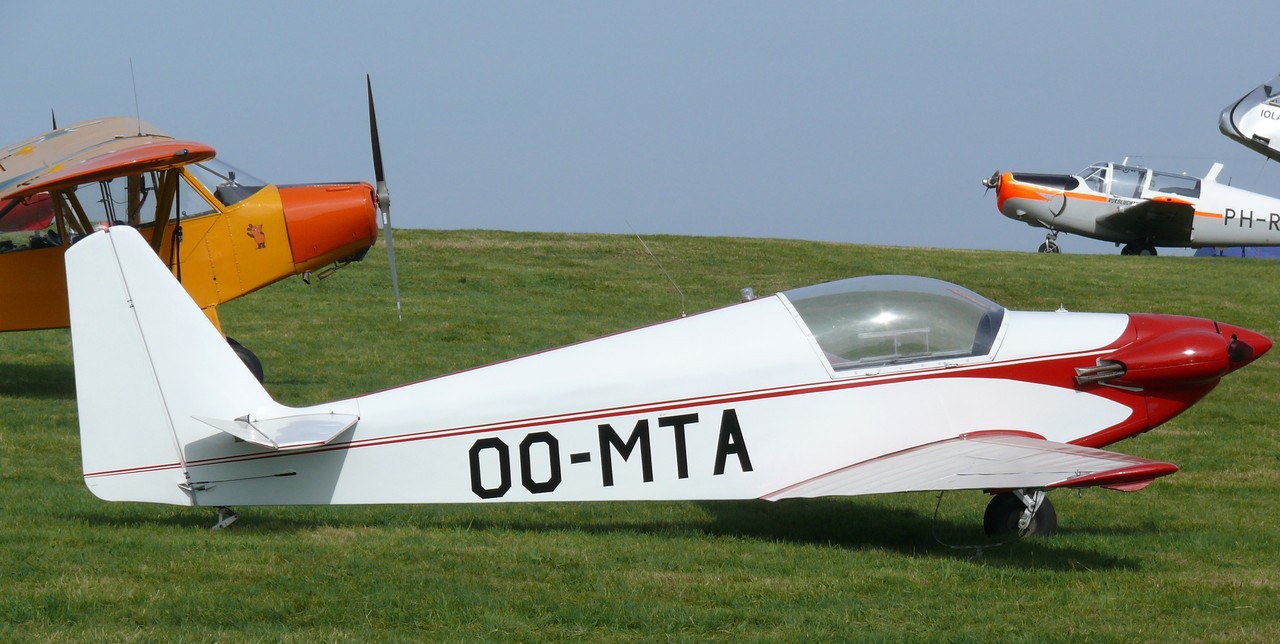
Breaking New Ground in Motor-Glider Design
The RF-3 emerged from René Fournier's systematic development program that began with the single-seat RF-1 prototype on July 6, 1960. After building two RF-2 variants in June 1962, Fournier partnered with Belgian Count Antoine d'Assche to form Alpavia specifically for RF-3 production. The first production aircraft debuted at the June 1963 Paris Air Show, where test pilot Bernard Chauvreau's demonstration flights captured international attention, particularly impressing German wooden aircraft builder Alfons Pützer.
Innovative Engine Solution
Fournier's most significant technical achievement was persuading Rectimo of Chambéry to modify the Volkswagen Beetle's 1,179cc engine for aviation use. The resulting Rectimo AR.1200 delivered 39 horsepower through a single-ignition system—unconventional for aviation but acceptable under new certification standards. This marked the first successful use of a converted automotive powerplant in a certified airplane, establishing a precedent that would influence general aviation for decades.
The engine choice reflected Fournier's pragmatic approach to cost-effective design. While traditional aircraft engines were expensive and complex, the modified Beetle engine offered reliability, parts availability, and affordability that made the RF-3 accessible to private pilots seeking motor-glider capabilities.
Certification Breakthrough
The RF-3 faced regulatory challenges as authorities struggled to classify the unconventional aircraft. Traditional glider certification would have prohibited the single-ignition engine, while standard aircraft rules seemed unnecessarily restrictive for an aircraft emphasizing glide performance. Fournier successfully lobbied for creation of a new category: "Aircraft with a good glide angle and capable of short landings."
This certification breakthrough enabled the RF-3's practical design features, including spoilers rather than heavier airbrakes for descent control. The wooden construction with fabric covering kept weight minimal while maintaining structural integrity for the aircraft's intended role.
Production Success at Gap-Tallard
Alpavia's facility at Gap-Tallard in southeastern France became the center of RF-3 production from 1963 through 1966. The company maintained steady output, completing 89 aircraft before ceasing operations in 1966. This production run demonstrated market demand for affordable motor-gliders while establishing Fournier's reputation as an innovative designer.
The aircraft's success attracted Bernard Chauvreau, whose skillful demonstrations at air shows highlighted the RF-3's unique capabilities. His flights showcased the aircraft's ability to operate from small airfields while offering both powered flight and soaring performance.
Technical Excellence
The RF-3's high-aspect-ratio wing design provided exceptional glide characteristics essential for motor-glider operations. Pilots could climb under power to find thermals, then shut down the engine for silent soaring flight. The spoiler system allowed precise descent control without the weight penalty of conventional airbrakes.
Single-seat configuration kept complexity and weight minimal while maximizing performance. The cockpit provided adequate visibility for both powered flight and glider operations, with controls optimized for the aircraft's dual-purpose mission.
International Recognition and Legacy
The RF-3's impact extended far beyond its modest production numbers. Alfons Pützer's interest at the 1963 Paris Air Show led to licensing agreements that moved Fournier design production to Germany under Sportavia-Pützer. This partnership resulted in the strengthened RF-4 aerobatic variant, with 156 RF-4D aircraft built in Germany.
When Alpavia closed in 1966, René Fournier relocated to Germany, continuing his design work through the Sportavia-Pützer partnership. This transition ensured continued development of Fournier designs while establishing a lasting international presence for the brand.
Current Status
At least one RF-3 remains preserved in the Musée de l'Air in Paris, representing this significant chapter in motor-glider development. Another example reportedly remains airworthy in France, continuing the type's operational legacy nearly six decades after first flight.
The RF-3's influence on general aviation extends beyond its direct descendants. The successful integration of automotive engine technology opened pathways for countless experimental and certified aircraft that followed. Fournier's certification breakthrough created regulatory frameworks that continue benefiting motor-glider development today, while his practical approach to affordable aircraft design influenced generations of homebuilt and production aircraft.