
Design Philosophy and Development
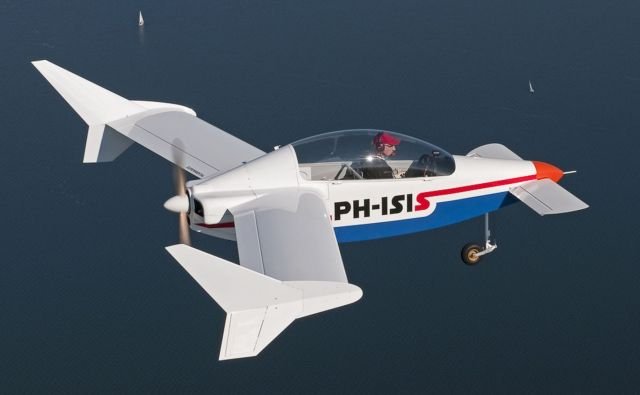
Roger Junqua's approach to aircraft design centered on achieving maximum efficiency through unconventional configuration. The French designer prioritized low fuel consumption and construction costs while maintaining respectable performance, creating an aircraft that could deliver superior cost-per-kilometer economics compared to traditional designs. The Ibis evolved from Junqua's earlier proof-of-concept aircraft, the Volucelle RJ-02, which first flew in 1985 piloted by his son Jean-Claude. The later Ibis retained the Volucelle's basic canard layout but incorporated more powerful engines and refined aerodynamics.
Technical Innovation
The Ibis's canard configuration represented a significant departure from conventional French homebuilt aircraft of the era. The unswept foreplane with constant chord carries slotted elevators for pitch control, positioned ahead of swept main wings fitted with full-span flaperons. This arrangement allowed Junqua to achieve performance characteristics superior to conventional designs of equivalent weight and power. The pusher engine configuration, mounted near the trailing edge of the fuselage, drives a two-blade propeller and eliminates the typical vibration and noise issues associated with tractor configurations.
The airframe construction utilizes traditional wooden techniques with modern materials. Four wooden longerons form the fuselage structure, covered with birch and Gaboon mahogany plywood in single-curvature sections. The main wings feature constant-chord plywood ribs built around a constant cross-section box spar filled with styrodur foam for structural integrity and weight savings. Pilot and passenger occupy tandem seats under a single-piece canopy, with the rear occupant positioned at the main wing's leading edge root.
Engine Options and Performance
Junqua designed the Ibis to accommodate various flat-four engines in the 45-60 kW range, including Volkswagen 1835cc and 1870cc air-cooled units, the Limbach L2000, and Jabiru 2200 engines. Design documentation indicates that 65 horsepower represents the optimal power setting, while 80 horsepower causes excessive fuel consumption without proportional performance gains.
With a 60-horsepower Volkswagen engine, the 470-kilogram aircraft achieves a maximum speed of 260 km/h and cruises at 200 km/h while consuming just 13 liters per hour. In economic cruise at 185 km/h, fuel consumption drops to 10.7 liters per hour, translating to remarkable efficiency of 5.8 liters per 100 kilometers. The aircraft's 60-liter fuel capacity provides a range exceeding 900 kilometers, making it suitable for cross-country touring despite its modest engine power.
Construction and Global Adoption
Unlike many homebuilt designs that rely on prefabricated kits, the Ibis was conceived as plans-built aircraft requiring traditional woodworking skills. This approach kept initial costs low but demanded significant construction time and craftsmanship from builders. The fixed tricycle undercarriage with spatted main wheels mounted on laminated plywood legs and steerable nosewheel with rubber shock absorption simplifies ground handling while maintaining the aircraft's clean aerodynamic lines.
By 2012, eleven Ibis aircraft had been completed and flown worldwide, with eight constructed in France and single examples in the Netherlands, Slovenia, and the United States. An additional 41 aircraft remained under construction globally, with six appearing on the French civil aircraft register. This modest production reflects both the specialized nature of wooden aircraft construction and the limited market for plans-built designs requiring extensive fabrication skills.
Operational Characteristics
The Ibis demonstrates impressive short-field performance despite its sleek configuration, requiring only 300 meters for takeoff and 310 meters for landing. The aircraft stalls at 95 km/h and climbs at 700 feet per minute, providing adequate safety margins for amateur-built aircraft operations. With an absolute ceiling of 16,000 feet, the Ibis can operate effectively in most general aviation environments while delivering airline-like fuel efficiency.
Legacy in Homebuilt Aviation
The Junqua Ibis represents a significant contribution to canard aircraft development, proving that unconventional configurations could deliver measurable advantages in the homebuilt market. While never achieving the widespread adoption of more conventional designs, the Ibis demonstrated how thoughtful aerodynamic design could overcome the performance limitations typically associated with low-powered aircraft. Roger Junqua's emphasis on efficiency over raw performance influenced subsequent generations of homebuilt designers seeking to maximize capability within modest power and budget constraints.
The aircraft continues to attract builders interested in wooden construction techniques and efficient cross-country performance, maintaining a small but dedicated following among European homebuilders more than three decades after its first flight.