
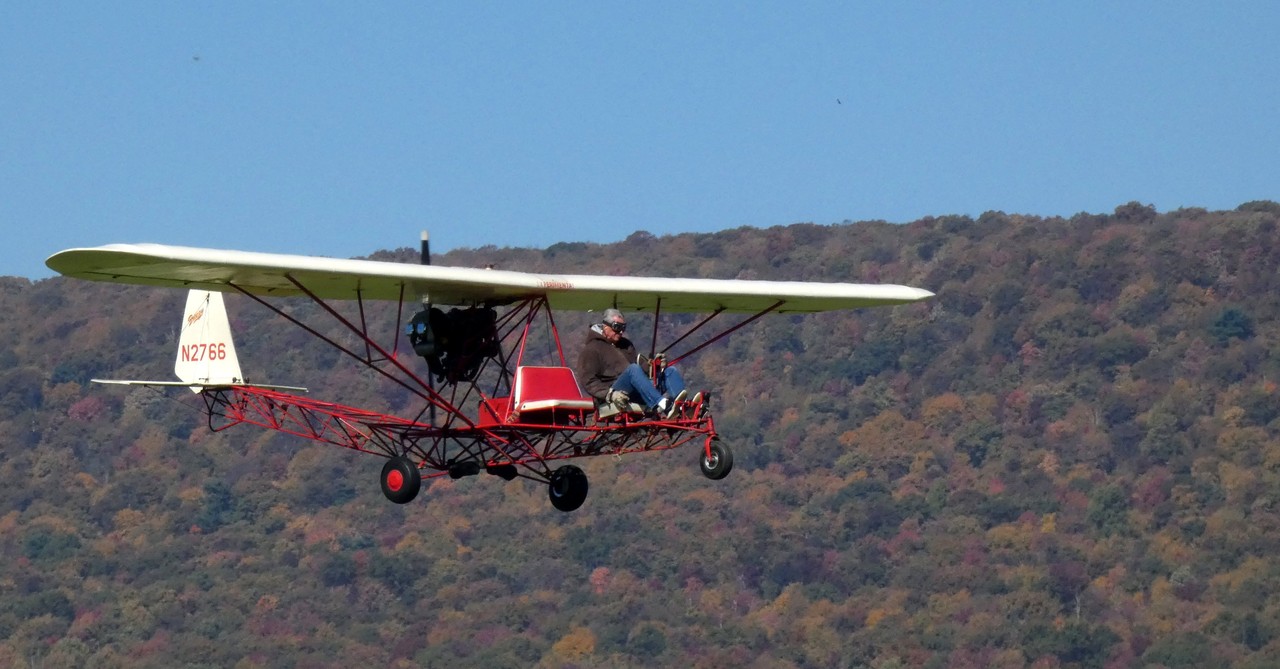
The Wind-in-Your-Face Revolution
The RLU-1 Breezy created an immediate sensation at the 1965 EAA Fly-In at Rockford, Illinois, where designer Carl Unger gave rides continuously from morning to night. This extraordinary public response demonstrated the aircraft's appeal as the ultimate expression of recreational flying—completely open to the elements with unobstructed visibility in all directions. The pusher propeller configuration eliminated any forward obstruction, while the pilot sat in the front seat with passengers on a rear bench, all exposed to the rushing air at 75 miles per hour.
Design Philosophy and Innovation
Charles Roloff, Robert Liposky, and Carl Unger approached the Breezy project with a clear objective: create a cheap, easy-to-build sporting aircraft that maximized the flying experience. Their professional pilot backgrounds influenced every design decision, from the modern hydraulic brakes to provisions for radio equipment. The trio's innovation lay not in revolutionary technology, but in clever simplification and component reuse. Rather than designing new wings, they specified existing Piper or Cessna wings from models including the PA-12, PA-14, PA-18, J-3, J-4, J-5, PA-22, or Cessna 172.
The open-framework fuselage consisted of welded steel tubing left completely uncovered, reducing both weight and construction complexity. This skeletal structure, combined with the fabric-covered braced tail, created an aircraft that could be built in a home workshop without sophisticated tooling. The parasol wing configuration, mounted above the fuselage on struts, provided exceptional downward visibility while the pusher propeller eliminated any forward visual obstruction.
Performance and Handling
Powered by Continental's reliable C-90 series engine producing 90 horsepower, the Breezy achieved a maximum speed of 105 miles per hour and cruised at 75 miles per hour. Its exceptional slow-speed characteristics included a remarkably low stall speed of just 25-28 miles per hour, making it forgiving for novice builders and pilots alike. The aircraft could operate from short strips with takeoff and landing runs of only 300-450 feet, while its service ceiling reached 15,000 feet with a climb rate of 500 feet per minute.
The Continental C-90's reliability proved exceptional in service. Carl Unger's prototype required only its second set of spark plugs after 800 hours of operation, demonstrating the engine's durability in this application. The engine featured a special pusher crankshaft configuration and had powered numerous Piper aircraft throughout its production run from the late 1940s through the 1960s.
Global Impact and Famous Flights
Carl Unger transformed his prototype into a flying ambassador for experimental aviation, providing free rides to thousands of passengers over 25 years. His passenger list included notable figures such as FAA Administrator and Senator Barry Goldwater, actor Cliff Robertson, and even a Concorde crew. These demonstration flights proved invaluable in promoting both the Breezy design and the broader homebuilt movement within the Experimental Aircraft Association.
The aircraft's international appeal resulted in construction projects across four continents. Builders in the United States, Canada, South Africa, and Australia have completed Breezy aircraft, with each example representing dozens or hundreds of hours of individual craftsmanship. The design's flexibility allowed for weight variations from 698 to 994 pounds empty, with gross weights ranging from 1,200 to 1,850 pounds depending on engine installation and equipment choices.
Manufacturing and Distribution
Unlike traditional aircraft manufacturers, RLU Aviation operated as an informal entity distributing construction plans rather than completed aircraft or formal kits. Carl Unger of Oaklawn, Illinois, handled plan sales and builder support in the design's later years. This grassroots approach aligned perfectly with the EAA philosophy of amateur construction and individual achievement in aviation.
The absence of factory production meant each Breezy reflected its builder's interpretation of the basic design. Some incorporated fuel capacities ranging from 10 to 18 gallons, while others featured different avionics installations or minor structural modifications. This variability became a feature rather than a limitation, allowing builders to customize their aircraft for specific missions or preferences.
Legacy and Preservation
Dozens of Breezy aircraft remain active today, evidenced by current FAA registrations and their regular appearance at fly-ins and airshows. The design achieved its 50th anniversary milestone with a special celebration at the 2014 EAA AirVenture in Oshkosh, Wisconsin, where multiple examples gathered to honor the original concept.
Carl Unger donated his prototype, registered as N59Y, to the EAA Aviation Museum in October 1990, where it remains on permanent display. This 698-pound example, powered by the original Continental C-90-8 engine, represents the pure vision that captivated experimental aviation enthusiasts for decades. The Breezy's cultural significance extends beyond its technical specifications—it embodies the essential joy of flight stripped to its most elemental form, inspiring continued construction by homebuilders worldwide who seek that same wind-in-the-face experience that made the 1965 Rockford demonstration so memorable.