
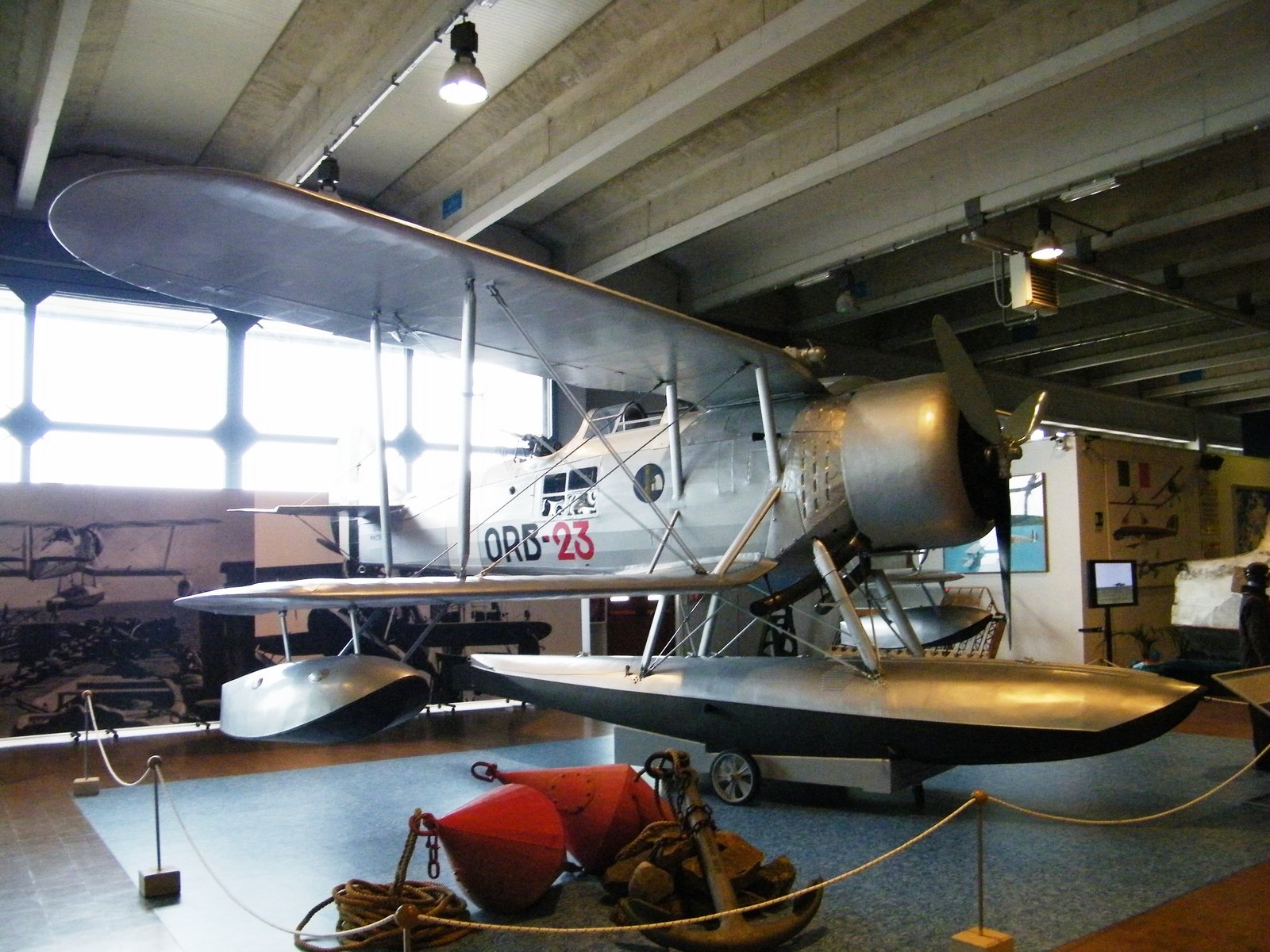
Design and Development
Designed by Giovanni Galasso for IMAM (Industrie Meccaniche e Aeronautiche Meridionali), the Ro.43 was developed to meet a 1933 Regia Marina requirement for a shipborne reconnaissance seaplane. The aircraft was intended to replace the CANT 25 and Piaggio P.6 on Italian warships. Galasso derived the design from the Ro.37 Lince land-based reconnaissance biplane, modifying it into a seaplane configuration featuring a single central float and small stabilizing wingtip floats. To accommodate the limited hangar space on cruisers and battleships, the aircraft was equipped with foldable wings, consisting of an upper gull wing and an inverted-gull lower wing. The airframe utilized mixed construction, employing wood and steel tubes covered in fabric and light alloy.
Technical Specifications
The Ro.43 was powered by a single Piaggio P.X R C.40 nine-cylinder air-cooled radial engine, which produced approximately 700 hp. This powerplant enabled a maximum speed of 300 km/h and a range exceeding 1,000 km, making it well-suited for long-endurance Mediterranean patrols. The aircraft had a wingspan of 11.00 meters and a length of 10.65 meters, with a maximum take-off weight ranging between 2,850 and 2,900 kg. For armament, the Ro.43 carried two forward-firing 7.7 mm Breda-SAFAT machine guns in the nose and one flexible 7.7 mm Breda-SAFAT gun for the observer/gunner in the rear.
Production and Operational History
Production took place in Naples, Italy, between approximately 1934 and 1941, with total production estimates ranging from 200 to 250 airframes. The prototype first flew on November 19, 1934, and series aircraft entered naval service by 1935. By June 1940, 105 aircraft were active in the Regia Marina. The Ro.43 played a critical role in several major naval engagements, including the Battle of Calabria (July 9, 1940), the Battle of Cape Spartivento (November 27, 1940), and the Battle of Cape Matapan (March 28, 1941). It also provided gunfire direction during the Second Battle of Sirte in March 1942. While valued for its range and agility, the aircraft suffered from structural fragility and poor seaworthiness, often making recovery difficult in rough seas.
Later Service and Legacy
Beyond the Regia Marina, the Regia Aeronautica operated the type from shore bases, and the Spanish Air Force utilized interned Ro.43s for search and rescue (SAR) operations from the Pollença naval base starting in August 1944. These Spanish aircraft were eventually written off due to corrosion in October 1949. By the Italian armistice in September 1943, 48 Ro.43s remained in service. No known examples of the aircraft survive today in museums or flying condition.